
Brief Summary
This module explores the integration of Artificial Intelligence (AI) within human movement science, highlighting its potential to improve data analysis, pattern recognition, and personalised assessments. It covers popular AI techniques such as machine learning, deep learning, and computer vision, and their applications in handling big data, enhancing research scalability, enabling real-time analysis, and facilitating continuous learning. The module emphasises the opportunity for collaboration between human movement science and data analytics, ultimately aiming to transform raw data into valuable knowledge for better understanding and prediction in the field.
- AI facilitates the analysis of large datasets in human movement science.
- Techniques like machine learning and computer vision enable real-time feedback and personalised assessments.
- Collaboration between data science and movement science can improve research scalability and automation.
Introduction to AI in Human Movement Science
The field of data science is rapidly growing due to technological advances, creating opportunities to share ideas and methods between movement science and data analytics for problem-solving. AI involves developing computer systems capable of tasks that typically require human intelligence, such as problem-solving and decision-making. AI techniques like machine learning, deep learning, computer vision, robotics, and human activity recognition are applicable in human movement science, with machine learning improving perception and actions based on data.
Machine Learning and Computer Vision
Machine learning, a subset of AI, enhances computer perception and actions using data from various fields like computer science, statistics, and neuroscience. For example, machine learning algorithms can identify normal and abnormal gait patterns for informed patient intervention. Computer vision enables computers to interpret visual information, such as estimating an athlete's pose from training videos to provide real-time feedback and improve coaching.
Deep Learning and Its Significance
Deep learning, a subfield of machine learning, uses neural networks to process complex data, such as pattern recognition for gait in stroke rehabilitation. It helps understand injury patterns and guide individualised rehabilitation programs. Human movement scientists collect large datasets using motion capture technology, force plates, and wearable sensors, which are then manually collated and simplified for statistical analysis.
Limitations of Traditional Statistics
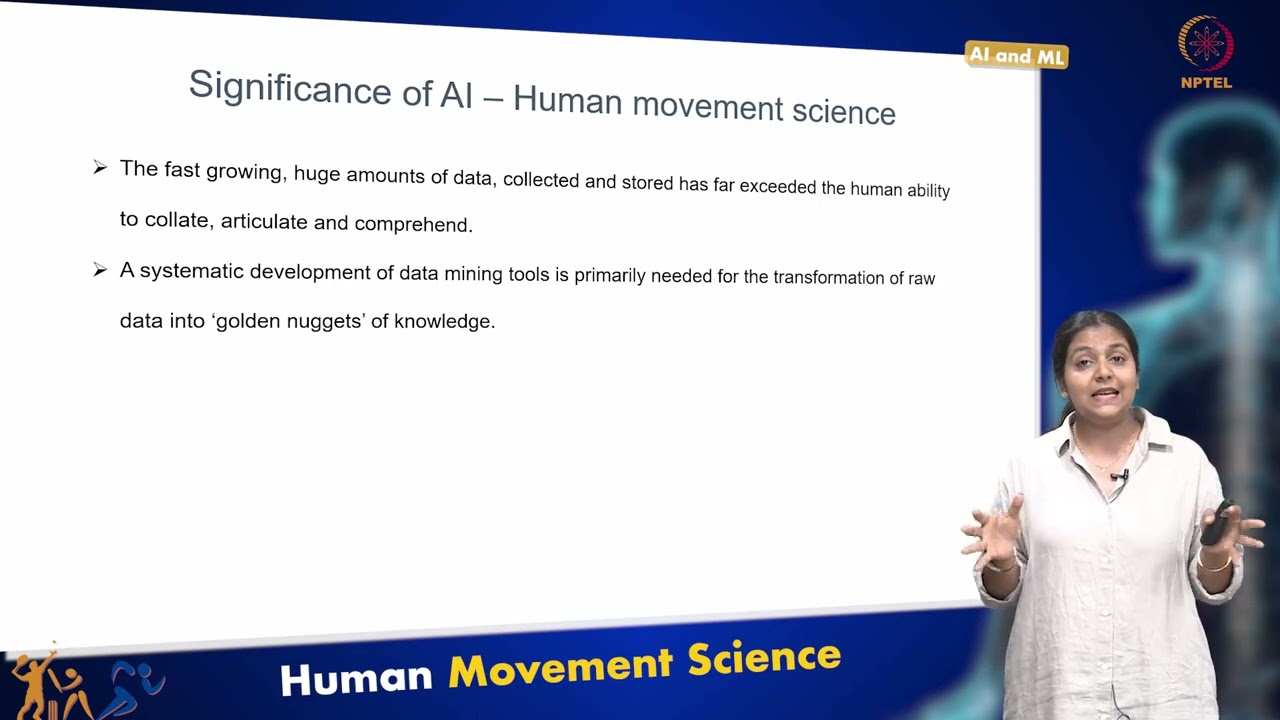
Traditional statistics limit the number of variables that can be studied due to the need for simplified datasets, resulting in data loss and restricted scalability of research to larger populations. Manual integration of results is time-consuming and prone to errors, reducing efficiency. The vast amounts of data collected now exceed human ability to collate and comprehend, necessitating the use of AI and machine learning algorithms.
Significance of AI in Data Mining
There is a need for data mining tools to transform raw data into valuable knowledge, with the aim of understanding the data and making necessary predictions. AI modelling, using machine learning, deep learning, and computer vision, adopts statistical and computational techniques for big data handling, increasing precision and accuracy of analysis. It aids in understanding complex patterns and scaling analysis to larger populations, enhancing automated solutions and personalised assessments.
Applications of AI Techniques
AI techniques facilitate handling big data and pattern recognition, such as identifying fine-tuning parameters for technique in sports using 3D motion capture data. They also enable the identification of injury patterns, like unique gait patterns in patients with neurological disorders, guiding early diagnosis and treatment. Automated solutions can be extrapolated to large populations, such as tracking population-level trends in physical activity using wearable variables to inform public health initiatives.
Personalised Assessments and Real-Time Analysis
Repeated personalised assessments of movement, tracked for continuous learning, aid in long-term intervention planning and evaluating technical skill changes over time. Clinical biomechanics can monitor individual patient characteristics to design custom orthotics and prosthetics. Real-time analysis provides insights for immediate feedback, such as athlete load monitoring in team sports using wearable sensors to inform decisions on substitutions and workload management.
Real-Time Analysis Examples and Summary
In rowing, inertial sensors provide insights into oar angle, stroke rate, and power output, guiding rowers to maintain optimal technique during training. Recent developments in technology and commonalities between human movement science and data analytics offer opportunities for collaboration. AI, including machine learning and deep learning, aids in handling big data, pattern recognition, research scalability, real-time analysis, continuous learning, personalised assessments, and automated solutions.

