
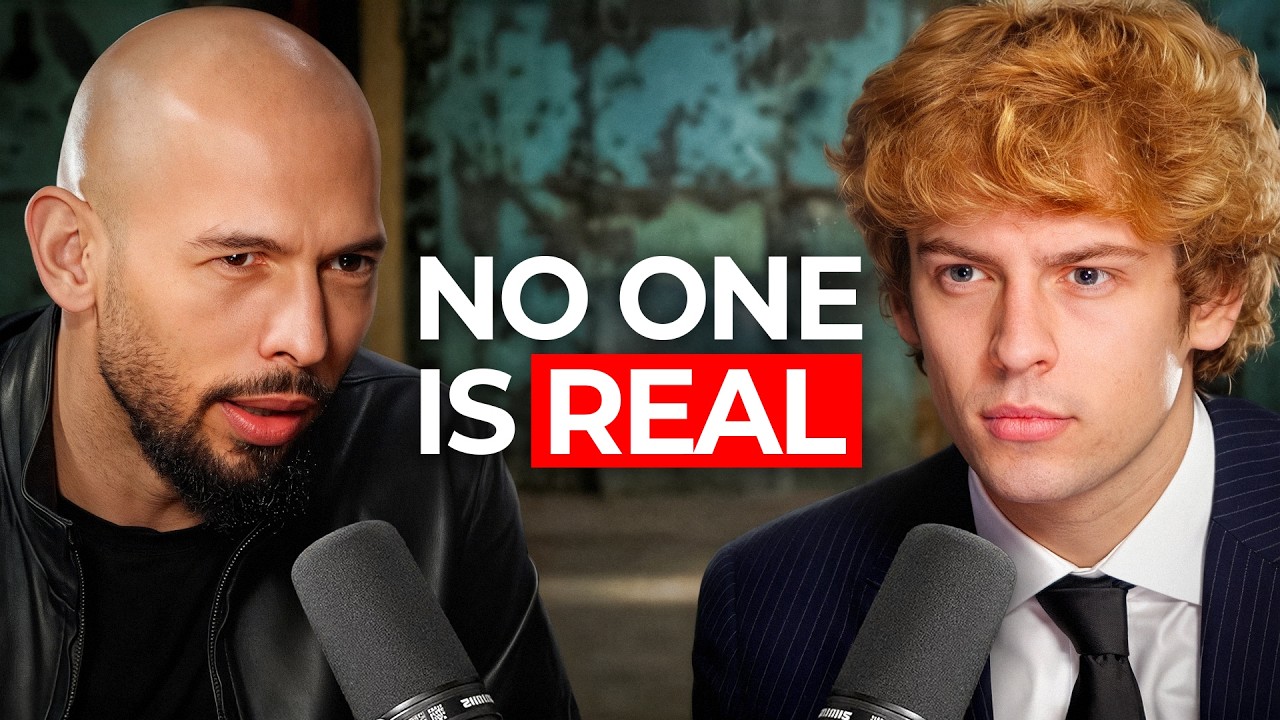
Brief Summary
Andrew Tate discusses a wide range of topics, from his personal experiences and legal battles to geopolitical analysis and social commentary. He touches on the "HH" Miami nightclub incident, Nick Fuentes's suffering for his views, and his own fame. He also talks about the selective silencing of viewpoints, accusations from women, and the targeting of Charlie Kirk.
- The importance of masculinity and brotherhood in resisting enslavement.
- The manipulation of information and the creation of false narratives by governments and other powerful entities.
- The need for individuals to think critically and question everything they are told.
Intro
Andrew Tate returns to the Jack Nail podcast, reflecting on his changed circumstances since the last recording in Romania, where he was imprisoned. He expresses amusement at finding himself in a Hollywood movie studio after his previous legal troubles.
Andrew Talks About the “HH” Miami Nightclub Incident
Andrew addresses the recent controversy surrounding his presence at a Miami nightclub where a Yay song was played. He jokes about constantly being at the centre of international incidents and discusses the anti-Semitic movement online. He clarifies his stance on Israel, criticising its government's actions while also condemning random attacks on Jewish individuals. Andrew argues that people are seeking to escape the matrix but are often trapped in new prisons of blame and hate. He states that he won't change his views to appease the internet and expresses interest in discussing the issue further with Nick Fuentes.
How Nick Fuentes Has Suffered for His Views
Andrew acknowledges that Nick Fuentes has suffered for his views, which is why he respects him. He contrasts Nick's approach with that of other streamers who feign outrage for attention. Andrew emphasises the importance of pointing people in the right direction and allowing them to work things out for themselves, rather than explicitly explaining everything. He notes the risks involved in being a prominent figure in the culture war, referencing the attempts on Charlie Kirk and Donald Trump's lives.
How Andrew Tate Might Be More Famous Than Any Other Celebrity
Andrew asserts that he is more famous and well-known than nearly every movie star, receiving more attention on the street than most celebrities. He attributes his lack of Hollywood roles and endorsements to his refusal to stay silent. Andrew acknowledges the temptation to "sell out" and questions why he is fighting for people who criticise him despite his efforts to awaken them.
Andrew Tate Explains Why People Think He Sold Sneako Out
Andrew addresses accusations that he "sold out" Sneako, clarifying that Sneako is not a close friend and has a history of seeking attention through controversy. He recounts the events leading up to Sneako's presence in Miami and defends his decision to state that Sneako played the song, as he was told that was the case. Andrew contrasts Sneako's lack of real-world influence with his own position, where his words and actions have significant consequences.
Did Andrew Speak to Ye About the Miami Incident?
Andrew implies that Ye (Kanye West) was not happy about the song being played in the club. He reflects on the challenges faced by A-list celebrities who speak out against powerful groups, noting that they often face pressure to conform or be silenced. Andrew argues that his and Kanye's actions, even if incomplete, help to expose the truth and further the conversation.
Andrew Shares How the UK Still Wants to Send Him to Prison
Andrew details his current legal situation, including the open case against him in Romania and the UK's warrant for his arrest based on a 2009 assault allegation. He explains that he remains on bail in Romania and could be imprisoned for hate speech if he says anything too extreme online. Andrew believes that the British government labelled him a national security threat in 2022 and is still trying to get him off the internet.
How Platforms Use Rules to Selectively Silence Points of View
Andrew argues that the concept of "inciting violence" is open-ended and can be used to selectively silence certain viewpoints. He explains that even seemingly innocuous actions, like standing by while a song is played, can be interpreted as hate speech and used against him in court. Andrew asserts that he has a lot of "guns aimed at my head" despite never being convicted of any crime.
Andrew Talks About Some of the Accusations He Has Received from Women
Andrew dismisses the accusations he has received from women, stating that they are largely fabricated. He explains that women he knew years ago are being pressured by federal agencies to make false statements against him. Andrew argues that it is unrealistic to expect these women to risk their own well-being to defend him, especially given his wealth and fame.
The Real Reason They Targeted Charlie Kirk & Why Candace Owens Is Allowed to Talk About Him
Andrew speculates on the reasons behind the targeting of Charlie Kirk, suggesting that it was not feasible to imprison him due to his squeaky-clean image and connections to Donald Trump. He contrasts this with his own situation, where his past actions made it easy for the authorities to build a case against him. Andrew believes that Candace Owens is allowed to speak freely about the situation because she is a black woman, and her views are often dismissed as "hysterical."
Ad Break
Advertisement break.
Why Liberals Actually Need People Like Charlie Kirk
Andrew argues that liberals need figures like Charlie Kirk to maintain their own sense of identity and moral superiority. He suggests that liberals thrive on conflict and need a common enemy to unite against. Andrew believes that the attack on Charlie Kirk was not perpetrated by liberals, but by someone else.
Are Radicalized People More Dangerous Than Organizations?
Andrew states that he is far more worried about government action than a radicalised individual. He believes that governments often use lone wolves as scapegoats to carry out their agendas. Andrew asserts that intelligence agencies worldwide are actively recruiting individuals to commit acts of violence and then blaming them for it.
Andrew Explains Why the Elites Hate Most People
Andrew explains why the ruling elites treat most people poorly, arguing that people are generally disappointing and that the elites become disillusioned as they climb the ladder and see more of this. He cites Donald Trump and Elon Musk as examples of individuals who have tried to help people but have been met with criticism and ingratitude. Andrew suggests that this leads the elites to believe that they should simply look after themselves and disregard the needs of the masses.
Why Most People Are Exactly Where They Belong
Andrew argues that most people are exactly where they belong in life, as there is a cosmic justice in the universe. He believes that people who are trapped in negative circumstances are there because of their own shortcomings, while those who escape do so because of their positive qualities. Andrew uses the analogy of physical fitness to illustrate this point, arguing that people have the bodies they want because they are willing to put in the necessary effort.
Why Do You Keep Wanting to Wake People Up?
Andrew questions why he still feels the need to "wake people up," admitting that he is starting to realise that many people are happier where they are and that trying to free them is futile. He notes the rise of anti-Semitism and other forms of extremism among those who believe they have escaped the matrix, arguing that they have simply trapped themselves in new prisons of hate and blame. Andrew expresses concern that his efforts to help people may be in vain, as they often choose to put themselves back in chains.
How Andrew Changed the Overton Window Politically and Socially
Andrew discusses how he has shifted the Overton window, making it possible to have conversations about topics that were previously taboo. He identifies anti-feminism as one of the most important areas where he has made a difference. Andrew notes that as the Overton window shifts, people become desensitised and seek out new extremes, leading to the rise of figures like Nick Fuentes.
Do You Get Skeptical When Something Goes Viral?
Andrew explains that his videos went viral because they spoke to the hearts of millions of young men who felt suppressed and unheard. However, he believes that truth is no longer the primary driver of virality, as people are now more interested in entertainment and extreme content. Andrew argues that the recent incident in Miami went viral because he was there, and the system could use it to attack him.
Ad Break
Advertisement break.
How Agents Manipulate Influential People
Andrew asserts that the media's job is not to report what happened, but to prepare people for what is about to happen. He uses the example of Diddy beating Cassie to illustrate this point, arguing that the video was released to set him up for future charges. Andrew believes that the internet is heavily manipulated by government agencies and that most of the accounts and interactions are fake.
Why the Internet Became the Most Dangerous Tool of Control
Andrew discusses how the internet, initially seen as a tool for liberation, has become the most dangerous tool of control. He argues that governments have learned to use algorithms and bots to shape narratives, manipulate public opinion, and suppress dissent. Andrew believes that the Arab Spring was an example of the US government using the internet to overthrow foreign leaders, but that the internet was later used against them when Donald Trump won the presidency in 2016.
How Influencers Have Accidentally Become Pawns
Andrew suggests that every famous influencer within the traditional matrix is being pushed for a reason. He uses the example of Mr. Beast, arguing that he was made famous to promote certain agendas. Andrew believes that the internet is now a "scop" designed to keep people subdued and prevent them from taking action.
Andrew Shares Some Horrific Details About His Life for the First Time Ever
Andrew reveals that he received well-written messages encouraging him to commit suicide after being released from jail. He believes that these messages were crafted by psychologists working for the state. Andrew also recounts how psychologists sent letters to the mothers of his children, trying to convince them to keep his kids away from him.
Why Andrew Decided to Talk to Bonnie Blue
Andrew explains his decision to speak with Bonnie Blue, stating that he agreed with everything she said to expose her agenda and demonstrate his ability to "win twice." He questions why Bonnie Blue is famous and suggests that he may have been able to destroy her mission while also amplifying it.
Do You Think the Lie Is Different at Every Level?
Andrew agrees that the lie is different at every level, explaining that the elites use divide-and-conquer tactics to control the masses, while unifying themselves through elitism. He notes that there is no genuine beef between the elites, as they are all competing for influence over the less important people. Andrew argues that the elites deliberately point out to those at the top that everyone below them is worthless.
Why the Western World Is So Confused About Sex
Andrew questions why the Western world has such a confused view on sex, noting the promotion of promiscuity alongside the threat of accusations against men. He argues that the suppression of sexuality, especially at the elite level, is a deliberate strategy to create compromat and control powerful individuals. Andrew suggests that the morals of Western society are being promoted by the system to retain control.
How Do You Decide What’s a Psy-Op?
Andrew explains that every idea is Trojan horsed and has poison inside of it. He argues that the matrix is feeding algorithms to individuals to convince them of certain things, depending on what the matrix wants them to do. Andrew believes that the real question is why you are reading what you are reading and what the system is trying to convince you to do.
Andrew Talks About Why Powerful People Get Paranoid
Andrew discusses how he prevents himself from becoming paranoid, noting that he has reached a point where he questions the motives behind everything and everyone. He acknowledges that he is under attack and that his hardest battle is staying sane. Andrew states that he does not want to reach a point where he believes that Epstein killed himself.
Do You Feel Understood?
Andrew admits that he does not feel understood by most of the people in his life, including his girlfriends and family. He states that the only people who truly understand him are those on the "other team," who are trying to recruit him. Andrew believes that he continues to do podcasts and speak out to retain some semblance of normality and understand the situation he is in.
Jack Gives Andrew a Gift
Jack gives Andrew a gift of cigars to thank him for taking a chance on his podcast.
What Happens After You Reach the Top?
Andrew states that he does not feel like his life is boring and that he is constantly experiencing action and anxiety. He explains that he quit drinking because he wanted less action in his life. Andrew's dream day is one where nothing goes wrong and he is simply left bored.
Is Someone Monitoring Your Spiritual State?
Andrew believes that his spiritual state is monitored and protected by the love of the women and children in his life. He states that a woman's love is a shield and that his relationships give him power. Andrew also mentions his promise with Tristan that if anything happens to one of them, the world will burn.
Is It Worth Getting to the Top, and How Do You Escape Unscathed?
Andrew argues that people do not have a choice as to where they end up in life, as it depends on their ability to handle pressure and decipher the truth. He states that he has stopped saying everything he knows, but that he is still telling more than he ever has before. Andrew believes that he is ahead of most people in terms of understanding the truth, but that there is still much that he does not know.
Andrew Shares His Last Message to the World
Andrew's final message is that masculinity is the answer to the troubles we face. He believes that bands of brothers of good men who stick together and are brave are the only thing that has ever resisted enslavement and built a society worth living in. Andrew urges men to get strong, resist, and not be afraid to speak their minds.

