
Brief Summary
This video provides an overview of biofilms and quorum sensing in microbiology. It explains what biofilms are, how they form, and their characteristics. It also discusses quorum sensing as a form of cell-to-cell communication in bacteria, enabling them to coordinate group behaviours. The video concludes with a quiz to test understanding of the key concepts.
- Biofilms are microbial communities encased in an extracellular polymeric substance (EPS) matrix.
- Quorum sensing is a communication method bacteria use to activate group behaviours when a population threshold is reached.
- Biofilms provide protection and promote genetic exchange and metabolic collaboration among microbes.
Introduction
The video introduces the topics of biofilms and quorum sensing. It encourages viewers to use the Level Up RN microbiology flashcards to follow along, paying attention to the bold red text for key information. A quiz will be given at the end of the video to test your understanding of the key facts.
Biofilms
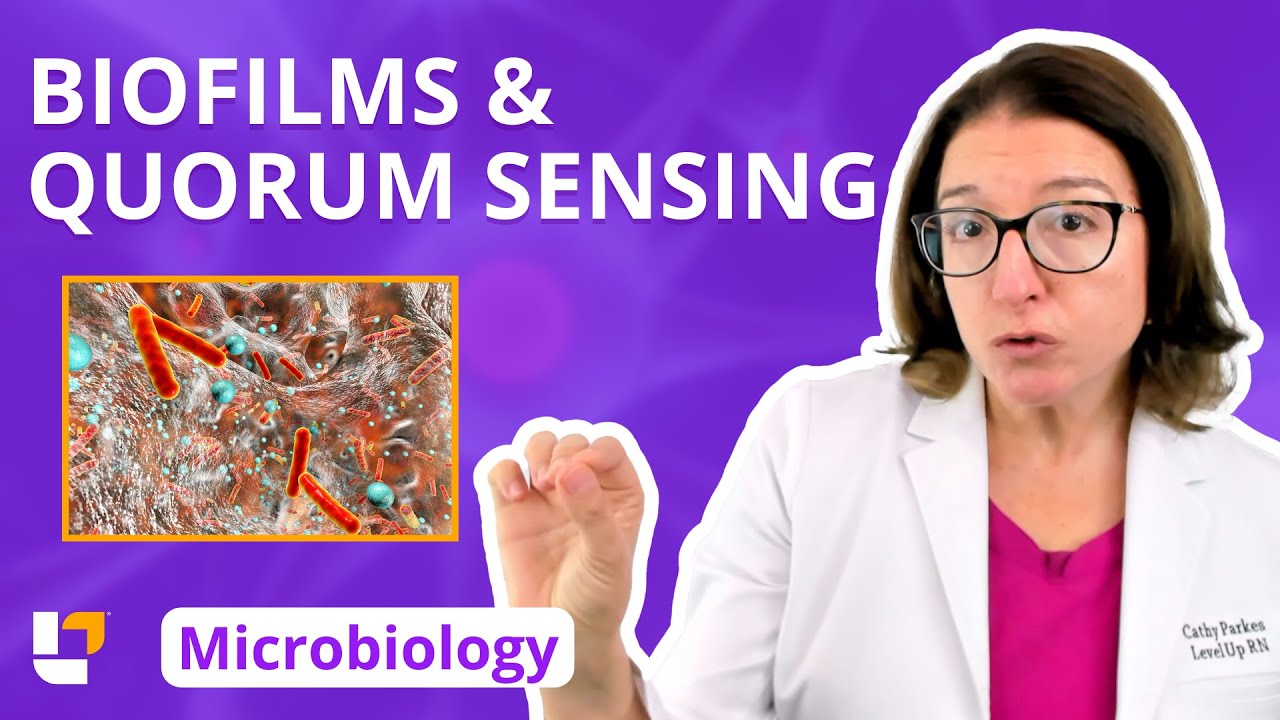
A biofilm is a community of microbes enclosed in an EPS (extracellular polymeric substance) matrix, forming a slimy layer on a surface. Examples include plaque on teeth and the slime in uncleaned showers. Biofilms play a significant role in infectious diseases and medical-device-related infections. Biofilms form when planktonic cells (free-floating microbes) attach to a surface and become sessile (unable to move freely). These microbes grow, divide, and produce EPS. As the biofilm matures, water channels develop, allowing nutrient transport and waste removal. Cells along the edge can then detach to colonise new sites, restarting the process. This close-knit community facilitates genetic material exchange, such as antibiotic resistance genes, and metabolic collaboration. Waste from one microbe can become nutrients for another. Biofilms also protect against environmental hazards like antibiotics, as microbes at the bottom are shielded. Finally, biofilms enable quorum sensing.
Quorum Sensing
Quorum sensing is a form of cell-to-cell communication that allows bacteria to activate group behaviours once the population reaches a threshold density. A small number of bacteria are unlikely to overwhelm a host, but a large group has a better chance of overcoming the host's immune defences. Bacteria in the biofilm produce small molecules called autoinducers. When the bacterial population reaches a quorum (threshold), these autoinducers bind to receptors in the bacterial cells. This binding triggers the transcription of genes that code for virulence factors, such as toxins or exoenzymes. Quorum sensing allows bacteria to synthesise virulence factors only when the population is large enough to overcome the host's immune defences.
Quiz Time!
A biofilm is a community of microbes enclosed in an extracellular polymeric substance. Biofilms form when planktonic cells become sessile. Quorum sensing is a form of cell-to-cell communication that allows bacteria to turn on group behaviours once the population reaches a threshold density.

