
Brief Summary
This module explores the application of human movement science principles in sports, focusing on needs analysis and movement characteristics. It highlights the importance of understanding movement patterns, force distribution, joint stability, and equipment optimisation to enhance performance and reduce injury risks. The module also categorises sports based on dominant skills and movement dominance to facilitate targeted training and skill development.
- Understanding needs analysis is crucial for optimising sports performance and reducing injury risks.
- Sports can be categorised based on dominant skills such as limb and hand-eye coordination, endurance, strength, balance, and team coordination.
- Movement dominance can be single-movement oriented, repetitive movement-oriented, or a combination of both.
Introduction to Needs Analysis
The module introduces the application of human movement science principles in sports, emphasising the importance of understanding movement characteristics through needs analysis. Biomechanical performance analysis involves applying mechanical and mathematical principles to optimise movement, using data collection, statistical analysis, and machine learning. This analysis helps interpret patterns related to performance and injury risks, requiring knowledge of appropriate tools, techniques, and biomechanical understanding.
What is Needs Analysis?
Needs analysis involves systematically assessing the mechanical aspects of human movement in sports to identify physical demands, movement patterns, force production, and joint stability. This analysis is crucial for coaches, trainers, and sports scientists to develop tailored training programs, optimise performance, and assess injury risks. It also aids in equipment modifications and injury prevention strategies, addressing specific mechanical requirements.
Kinematic Understanding
Understanding movement patterns, or kinematics, is vital for performance enhancement and risk identification. In basketball, analysing the kinematics of shooting, such as release point, angle, and trajectory, improves shooting accuracy. For wheelchair basketball, individualised kinematic patterns are essential due to variations in mobility and disability, requiring customised training programs and equipment adaptations to enhance shooting accuracy.
Force Distribution
Assessing the distribution and magnitude of force generated across different body segments during movements is crucial. In golf, analysing force distribution during the swing helps optimise technique for maximum power and accuracy. Understanding how forces are exerted on the club and transmitted through the body enables golfers to generate more club speed and achieve optimal ball trajectory, especially for long shots.
Joint Stability and Mobility
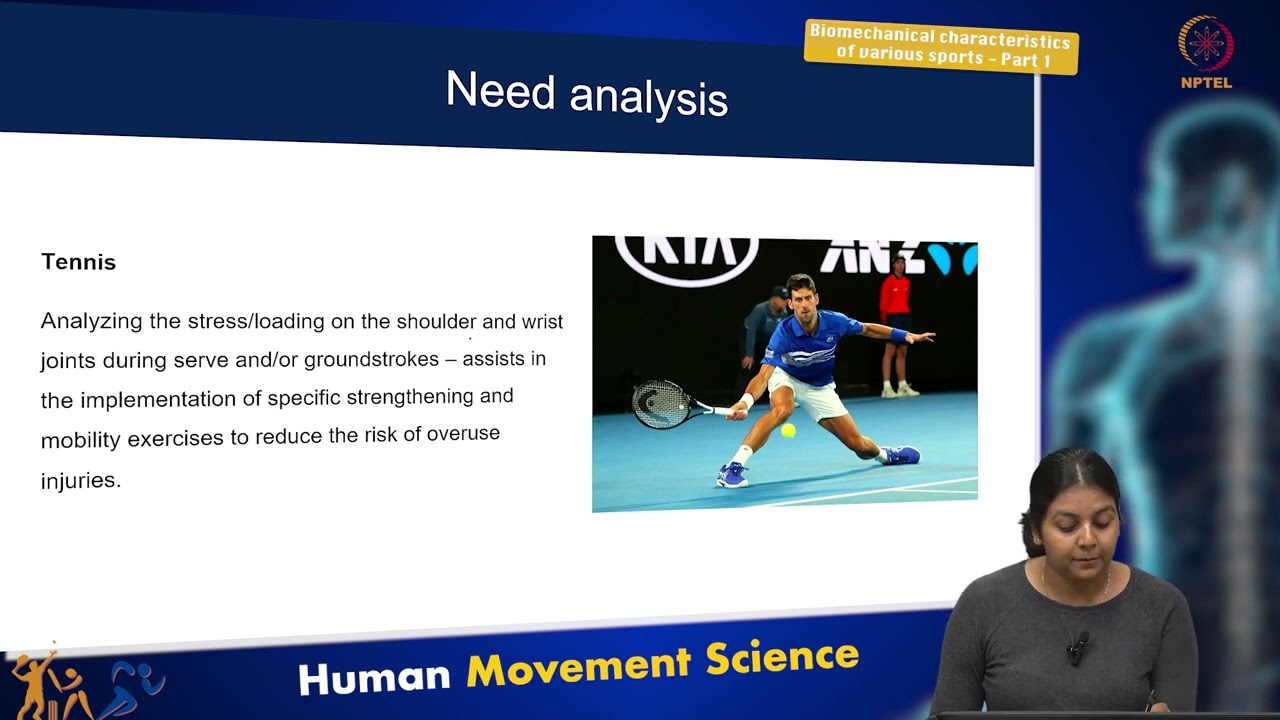
Evaluating joint stability and mobility during sporting movements helps identify potential areas of vulnerability and prevent injuries. Assessing joint loads is crucial for designing strength training programs that ensure adequate muscular strength, reducing injury risks. In tennis, analysing stress loading on joints like the shoulder, wrist, and lower back during serves and groundstrokes informs specific strength and conditioning protocols and mobility exercises.
Biomechanical Efficiency and Energy Conservation
Evaluating the efficiency of movement patterns minimises energy expenditure, optimising performance. In soccer, analysing running patterns, including stride length, helps optimise energy expenditure during matches, aiding in the development of endurance training protocols. Understanding the energy requirements based on player position and ball-carrying distance is essential for reducing fatigue and improving endurance.
Equipment and Gear Optimisation
Assessing the interaction between the body and equipment enhances performance and minimises musculoskeletal injuries. In tennis, understanding hand anthropometry helps optimise racket grip size and weight. In swimming, streamlined apparel reduces drag, improving performance. In cycling, aerodynamic bicycles and specialised gear, such as helmets and cycling shorts, reduce air resistance and improve overall speed during races.
Sports Characteristics and Dominant Skills
Sport is a complex physical activity with diverse skill sets that can be broken down and taught systematically to improve athletic performance. Categorising sports based on dominant skills, such as limb and hand-eye coordination, reactive ability and agility, endurance and stamina, strength and power, balance and coordination, or team coordination and communication, helps in understanding the specific demands of each sport. Movement dominance can be single-movement oriented, repetitive movement-oriented, or a combination of both.
Limb and Hand-Eye Coordination
Sports requiring limb and hand-eye coordination, such as tennis and badminton, also demand balance and agility. In tennis, athletes coordinate limb movements with visual perception to accurately hit the ball. In badminton, quick reflexes and spatial awareness are crucial for fast-paced rallies, requiring players to strategically place the shuttle while maintaining awareness of their position and the opponent's.

