
Brief Summary
This video outlines various career opportunities for human movement scientists, detailing the necessary qualifications and job descriptions for roles such as clinical movement scientist, sports performance analyst, biomechanical engineer, and more. It emphasises the importance of skills like biomechanical knowledge, data analysis, communication, and adaptability. The video also provides a disclaimer that the requirements for each role can vary based on the institution and position level.
- Diverse career opportunities in clinical, sports, engineering, and research settings.
- Essential skills include biomechanical knowledge, data analysis, communication, and adaptability.
- Educational requirements range from bachelor's to doctoral degrees depending on the role.
Introduction
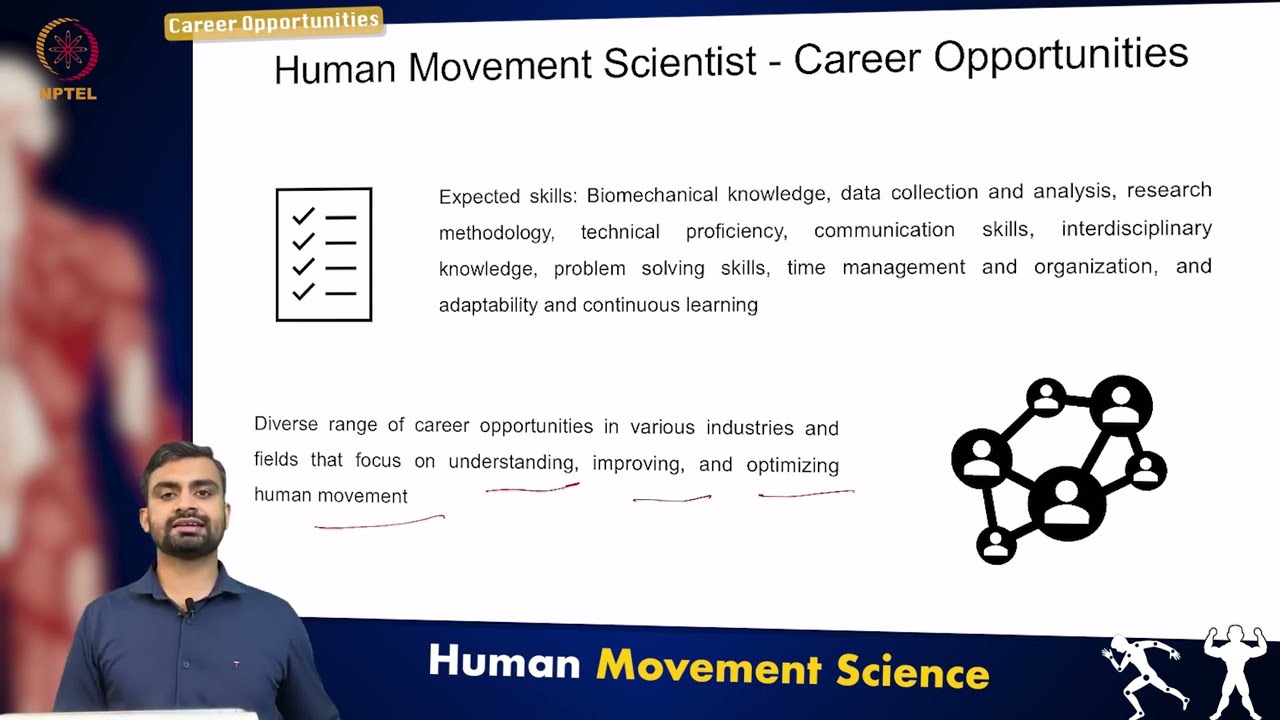
The video introduces the career opportunities available to human movement scientists. It will cover the diverse range of fields and industries that require expertise in understanding, improving, and optimising human movement. The discussion will also include the qualifications and job descriptions for various roles.
Essential Skills for Human Movement Scientists
To succeed as a human movement scientist, several key skills are needed. These include a solid understanding of biomechanics, proficiency in data collection and analysis, and an introductory knowledge of research methodology. Technical proficiency with relevant tools and methods is also crucial, along with strong communication skills and interdisciplinary knowledge encompassing anatomy, physiology, physics, and mathematics. Problem-solving abilities, time management, organisational skills, and a commitment to adaptability and continuous learning are also vital for success in this field.
Clinical Movement Scientist
A clinical movement scientist works in a clinical environment to assess and create treatment plans for individuals suffering from movement disorders or injuries. The role typically requires a bachelor's degree, but a master's or doctoral degree in human movement science or a related field may be necessary depending on the specific position.
Sports Performance Analyst
As a sports performance analyst, the focus is on analysing athletes' movement patterns to improve their performance and reduce the risk of injuries. This role involves working with sports teams, organisations, or individual athletes. A bachelor's, master's, or doctoral degree in human movement science, sports science, or a similar field is generally required.
Biomechanical Engineer
A biomechanical engineer applies mechanical principles to design and analyse equipment, prosthetics, and orthotics. This role, which requires a strong background in physics and mathematics, can involve research, product development, and consulting. A bachelor's, master's, or doctoral degree in biomechanical engineering, mechanical engineering, or civil engineering with structural mechanics knowledge is typically needed.
Rehabilitation Specialist
Rehabilitation specialists design and implement personalised rehabilitation programs for individuals recovering from injuries, surgeries, or other medical conditions affecting movement. A bachelor's, master's, or doctoral degree in rehabilitation science, physical therapy, or a related field is required for this position.
Clinical Researcher
Clinical researchers conduct studies and trials focused on understanding movement disorders, developing interventions, and improving rehabilitation techniques. This role requires a degree in human movement science, rehabilitation science, or a similar field.
Academic Educator
Academic educators teach courses on movement science, biomechanics, kinesiology, and related subjects at universities, colleges, or vocational schools. A master's degree is generally required, while a doctoral degree may be preferred for university positions or research-intensive roles.
Sports Coach or Trainer
Sports coaches and trainers focus on training athletes to improve their performance, technique, strength, and conditioning, while also addressing injury prevention. A degree in human movement science or a related field is beneficial, but certifications and coaching experience are essential.
Health and Fitness Consultant
Health and fitness consultants provide guidance on exercise, movement, and lifestyle modifications to individuals or groups aiming to improve their health and well-being. A bachelor's or master's degree in human movement science, exercise science, or a related field is typically required, along with fitness training certifications.
Research Scientist or Academic Researcher
Research scientists conduct original research in human movement science, contributing to the academic and scientific community's understanding of movement-related phenomena. This can include performance enhancement, rehabilitation techniques, and injury prevention, as well as research and development for sports equipment. A doctoral degree is generally required, with additional training or certifications in certain cases.
Healthcare Administrator or Manager
Healthcare administrators oversee operations in healthcare settings such as rehabilitation centres, sports clinics, and research facilities focused on movement science. A master's degree in healthcare administration or a related field is generally required.
Ergonomics or Occupational Health Consultant
Consultants in ergonomics analyse workplace environments to optimise ergonomics, reduce occupational hazards, and improve worker productivity. A bachelor's, master's, or doctoral degree in human movement science, ergonomics, or a related field is required.
Disclaimer on Requirements
The video provides a disclaimer that the requirements discussed represent the bare minimum and can vary from institution to institution, and even within the same institution. The employer has the discretion to set the minimum requirements for these positions, which can also depend on the position level (intern, entry-level, mid-level, or senior-level).

