
Brief Summary
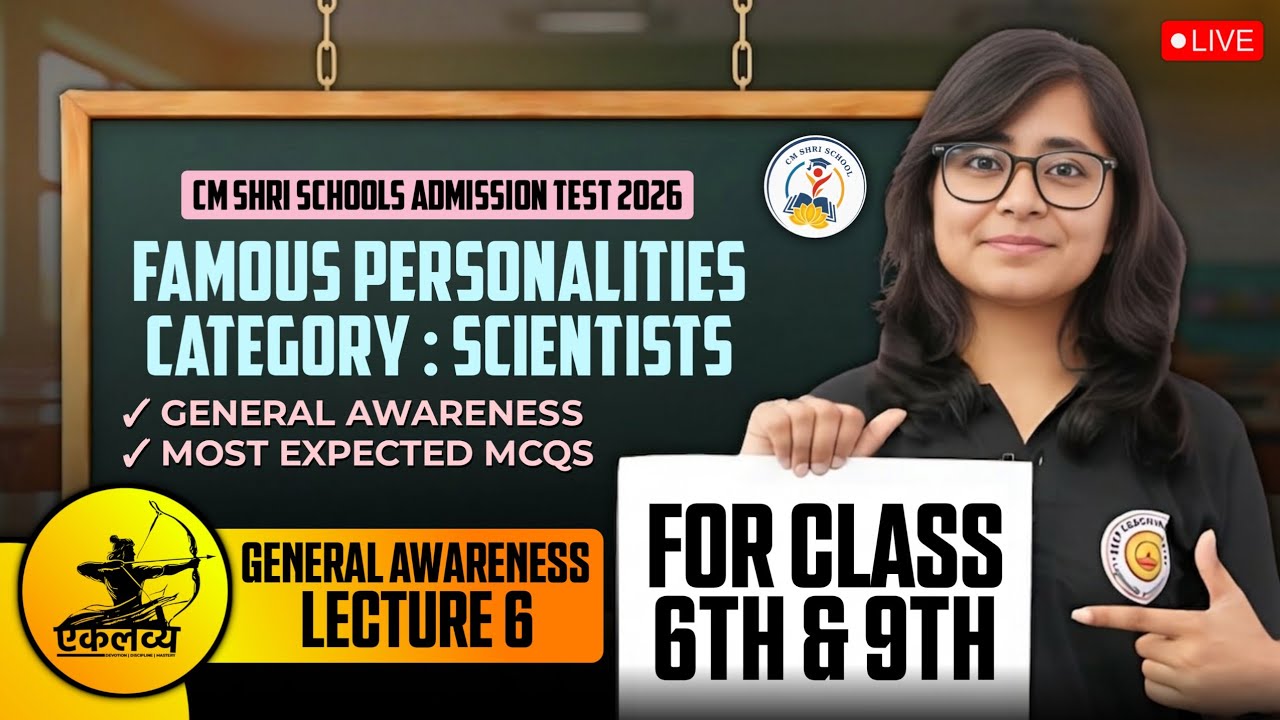
This lecture focuses on famous scientists and their contributions, categorising them into Indian scientists, foreign scientists, and space scientists/astronauts. It encourages students to actively participate by taking notes and memorising facts. The lecture concludes with a quiz to test the students' knowledge and highlights resources for further learning and doubt clarification.
- Focuses on famous scientists and their contributions.
- Categorises scientists into Indian, foreign, and space-related.
- Includes a quiz to test knowledge.
- Highlights resources for further learning.
Introduction
The lecture is an important topic in general awareness, focusing on famous personalities, specifically scientists. This is the second lecture on the topic, and students are encouraged to memorise facts and take notes. The lecture is dedicated to students in sixth and ninth grade.
Categories of Scientists
The lecture categorises scientists into three groups: Indian scientists, foreign scientists, and space-related scientists (astronauts). Knowing about scientists is crucial for understanding technological advancements. The lecture aims to help students crack the RCM's exam by making it easier to remember facts.
Indian Scientists
The lecture covers several Indian scientists and their contributions. C.V. Raman, a physicist and Nobel Prize winner in 1930; Satyendranath Bose, known for his work in physics and association with Einstein's theory; Srinivasa Ramanujan, a mathematician known for number theory; Subramanyam Chandrasekhar, an astrophysicist who proposed the Chandrasekhar Limit; and Meghanad Saha, also in astrophysics. Other scientists mentioned include Vikram Sarabhai, associated with space science and ISRO; A. P. J. Abdul Kalam, an engineer and missile developer who served as President; Homi Jehangir Bhabha, crucial in nuclear testing; Satish Dhawan, chairman of ISRO; K. Sivan, associated with the Chandrayaan mission; Madhavan Nair, known for PSLV; Jagadish Chandra Bose, who contributed to biology and physics; M. S. Swaminathan, famous for the Green Revolution; Verghese Kurien, known as the father of the white revolution in dairy science; Salim Ali, an ornithologist; Har Gobind Khorana, famous for his work on the genetic code; Venkatraman Ramakrishnan, known for structural biology and the ribosome; Birbal Sahni, a botanist known for his work on fossil plants; and A. S. Rao, in the field of electronics development.
Foreign Scientists
The lecture discusses several foreign scientists and their contributions. Albert Einstein, a physicist known for the theory of relativity and a Nobel Prize winner; Isaac Newton, known for the concept of gravity; Stephen Hawking, who studied theoretical physics and cosmology and is famous for his book "A Brief History of Time"; Max Planck, who developed quantum theory; Werner Heisenberg, who gave the uncertainty principle; Thomas Edison, an inventor known as the Wizard of Menlo Park and famous for the light bulb; Alexander Graham Bell, the inventor of the telephone; the Wright brothers, who successfully flew the first flight; James Watt, known for his work on the steam engine; Johannes Gutenberg, who made printing famous in Europe with the printing press; Charles Darwin, a naturalist and biologist known for the theory of evolution; Louis Pasteur, who contributed to microbiology and chemistry and is known for pasteurisation; Gregor Mendel, who studied genetics and botany and is known as the father of genetics; Edward Jenner, who invented the smallpox vaccine; Alexander Fleming, who discovered penicillin; Sigmund Freud, who worked in psychology; Marie Curie, who worked in physics and chemistry and is famous for radioactivity; Dmitri Mendeleev, who is known for the periodic table; Niels Bohr, who is famous for the atomic model; Ernest Rutherford, who discovered the atomic nucleus. Antoine Lavoisier, considered the father of modern chemistry.
Space Scientists and Astronauts
The lecture highlights space scientists and astronauts, beginning with Vikram Sarabhai, the founder of ISRO and the father of the Indian space program. Satish Dhawan, another chairman of ISRO, and K. Sivan, who led the Chandrayaan mission, are also mentioned. Madhavan Nair is recognised for his work with PSLV. Rakesh Sharma, the first Indian in space, and Kalpana Chawla, the first Indian woman in space, are celebrated for their achievements. Sunita Williams, known for the longest space mission and spacewalk by a female, and Neil Armstrong, the first man on the moon in 1969, are also highlighted. Buzz Aldrin, who assisted the moon mission in 1969, Yuri Gagarin, the first man in space in 1961, Valentina Tereshkova, the first woman in space in 1963, John Glenn, the first American to orbit Earth, Sally Ride, the first American woman in space, and Chris Hadfield, known for social media activity from space, are also recognised. Mae Jemison, the first African-American woman in space, is also mentioned.
Quiz and Wrap-Up
The lecture concludes with a quiz to test the students' knowledge of the famous personalities discussed. The questions cover key facts about the scientists and astronauts, such as their contributions and firsts in their respective fields. The lecture also provides information on where to find updates, lectures, and resources for further learning, including the Telegram channel for PPTs and a WhatsApp community for doubt clarification.

