
Brief Summary
This module introduces coaching science, emphasising the integration of sports science disciplines to enhance athlete performance. It covers the importance of movement science, skill categorisation (skill, technique, and style), skill characteristics (open vs. closed, discrete, continuous and serial), skill segmentation into phases (preparation, execution, and follow-through) and the importance of feedback and communication in coaching. Effective communication of biomechanical findings is crucial for athlete development and performance enhancement.
- Coaching science integrates biomechanics, physiology, psychology, and nutrition to improve athlete performance.
- Understanding skill, technique, and style is crucial for targeted coaching interventions.
- Skills are categorised as open or closed, and as discrete, continuous, or serial, each requiring different coaching approaches.
- Breaking skills into phases (preparation, execution, follow-through) aids detailed analysis and targeted feedback.
- Effective feedback, including knowledge of results and performance, is essential for athlete improvement.
Introduction to Coaching Science
Coaching science is an interdisciplinary field that integrates various sports science disciplines such as biomechanics, physiology, psychology, and nutrition to enhance athlete performance. The module aims to introduce the principles of coaching science, focusing on the coach-athlete relationship and the importance of movement science. It will explore the concepts of skill, technique, and style, and how these concepts can be used to improve athlete performance. The module will also cover the characteristics of different types of skills and how to teach them based on these characteristics.
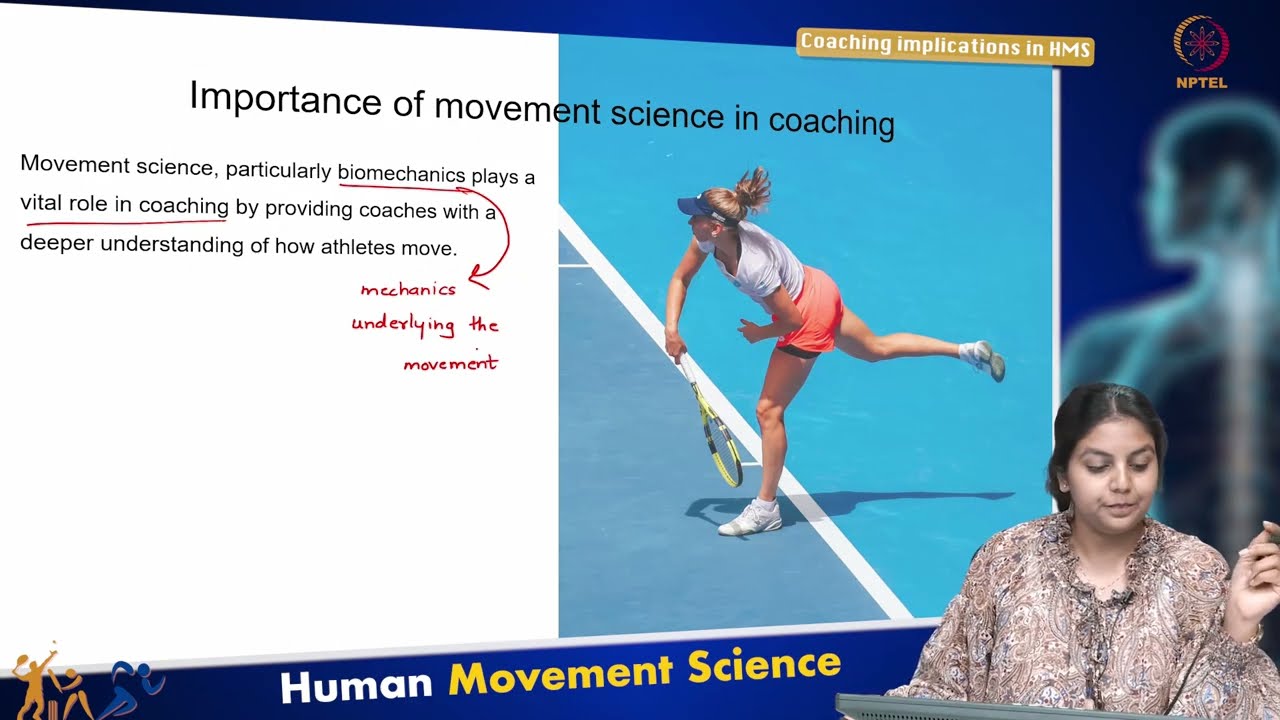
Importance of Movement Science in Coaching
Movement science, particularly biomechanics, plays a vital role in coaching by providing a deeper understanding of how athletes move. Coaches can use biomechanical data to identify patterns for technique improvement, performance enhancement, and injury risk reduction. For example, a tennis coach can use biomechanical knowledge to assess factors like racket speed and body positioning to enhance a player's serve. Maintaining proper body position after the execution phase is crucial for reducing injury risk and ensuring good serve direction.
Skill, Technique and Style
Skills are the fundamental building blocks in sport, representing an athlete's ability to perform a specific action successfully. Technique refers to the defined execution of a sporting action, while style is the individual's unique expression of that technique. Understanding the differences between skill, technique, and style is crucial for coaches to effectively plan coaching sessions and address performance issues. It is important to categorise whether an athlete's performance difference stems from technique or style variations.
Characteristics of Skills
Skills have key characteristics that are important for movement analysis. They are goal-oriented with a specific purpose within the context of a sport and require practice and precision to master. Skills can be categorised as closed or open, providing further understanding of their underlying movement patterns and how to teach them effectively. Closed skills are executed in stable, predictable environments, such as archery or weightlifting, where the conditions are controlled. Open skills, on the other hand, are performed in unpredictable, dynamic environments with changing conditions, such as soccer, where players must constantly adjust their movements.
Types of Motor Skills
Motor skills can be differentiated into discrete, continuous, and serial skills based on their underlying characteristics. Discrete skills have distinct start and stop points, with clear and specific actions and defined endpoints, such as a basketball free throw or a golf swing. Feedback is typically given after the skill is complete, and precision and accuracy are critical. Continuous skills do not have a distinct start and stop point and generally involve rhythmic and continuous movement, such as swimming or cycling. Precision and timing are crucial, and feedback during the skill is important for adjusting movements. Serial skills are a sequence of discrete movements strung together in a specific order, such as a gymnastics routine, where the timing and order of the sequence are crucial, and feedback can occur between or after the discrete actions.
Skill Segmentation for Movement Analysis
Segmenting skills into phases is a foundational concept in coaching, as it simplifies complex movements for efficient skill development. Breaking down skills into phases allows for detailed analysis, identification of critical movements, and specific feedback. This approach also aids in designing targeted coaching interventions, identifying errors, promoting easier understanding of complex skills, and allowing for targeted learning. For example, breaking down the freestyle stroke in swimming into entry, pull, and recovery phases allows coaches to focus on specific aspects to enhance technique.
Skill Segmentation into Phases
Every skill or movement is comprised of multiple phases, each with a specific purpose and function. Dividing a skill into phases provides a structured way to approach skill analysis. The primary skill phases are preparation, execution, and follow-through. The preparation phase involves preparing for the main action, setting a good foundation for the skill. The execution phase is where the core action of the skill is executed, requiring precision and timing for a good outcome. The follow-through phase concludes the skill, maintaining control and balance post-execution to prevent injury and ensure effective skill completion.
Sub-Phases and Event of Interest
Phases can be further broken down into sub-phases to aid deeper understanding of the skill. An event of interest refers to a key moment within a phase or sub-phase, providing valuable insights regarding technique and potential risks of injury. For example, a javelin thrower's release point is a key event of interest, as the position at release influences the trajectory, distance, and speed of the javelin.
Feedback and Communication
Effective communication is crucial for successful coaching, requiring coaches to convey complex biomechanical data to athletes in a structured way. The nature and approach of providing movement feedback depend on the type of skill, athlete, and sport. There are two major types of feedback: knowledge of results (KR) and knowledge of performance (KP). Knowledge of results provides information about achieving the goal or the outcome of the performance, while knowledge of performance provides information about the movement characteristics that lead to the performance outcome, highlighting flaws and providing positive reinforcement.

