
Brief Summary
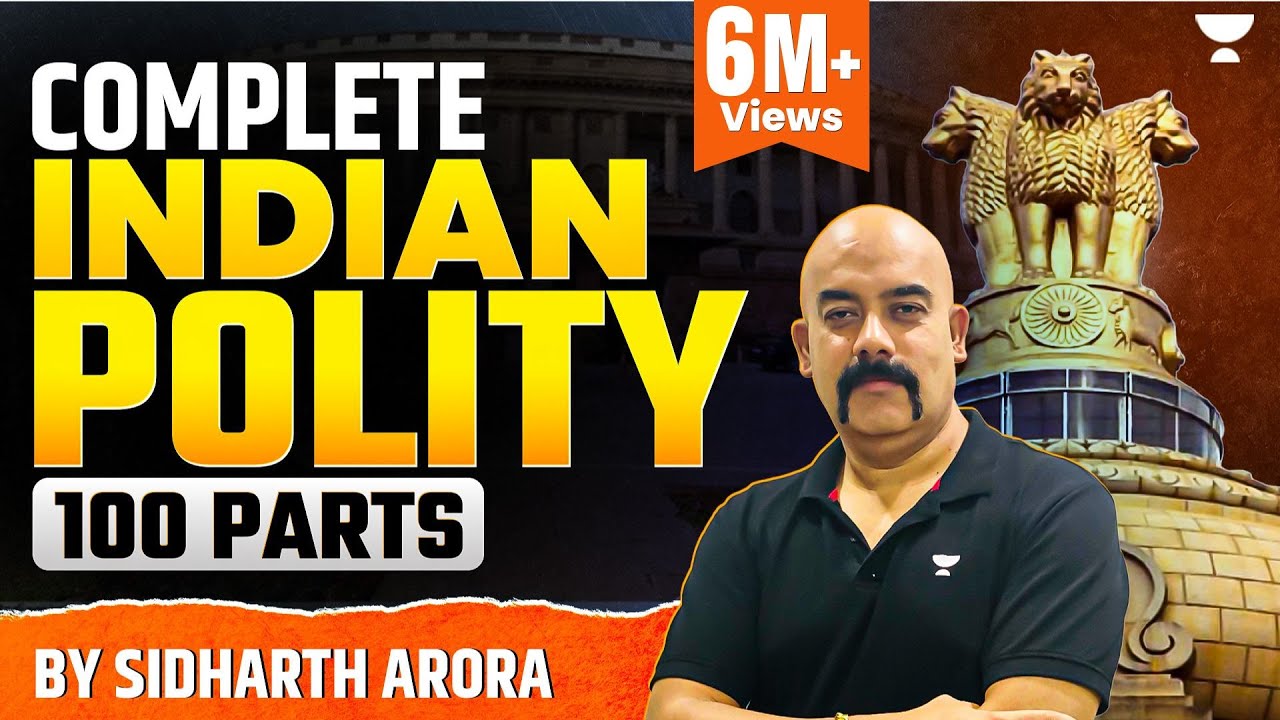
This YouTube video provides a comprehensive summary of Indian Polity, covering topics from the historical background of the Constitution to contemporary issues. It simplifies complex concepts, making it easier for UPSC CSE aspirants to understand and retain key information.
- Historical context of the Indian Constitution
- Key features and articles of the Constitution
- Functions and roles of various governmental bodies
- Important commissions and their recommendations
- Analysis of critical legal concepts and their implications
Road to Independence - MG
The East India Company came to India as traders in 1600 with an exclusive royal charter, granting them a monopoly. By 1765, they acquired Diwani rights over Bengal, Orissa, and Bihar, allowing them to collect civil revenue and taxes. Mismanagement led the company to seek financial aid from the British government, resulting in the implementation of regulating acts to control the company's affairs. The Regulating Act of 1773 marked the first step towards centralised governance, making the Governor of Bengal the Governor-General. A Supreme Court was established in Calcutta, leading to conflicts addressed by the Settlement Act of 1781. Pitt's India Act of 1784 asserted British government control over the company's territories. The Charter Act of 1833 centralised powers further, making the Governor-General of Bengal the Governor-General of India. Coveted civil services were opened to Indians in 1853. The First War of Independence in 1857 led to the Government of India Act 1858, transferring control to the British Crown. The Indian Councils Act of 1909, also known as the Morley-Minto Reforms, introduced separate electorates for Muslims, furthering divide and rule tactics. Mahatma Gandhi's arrival marked a turning point, providing a roadmap for independence.
Salient features of the Constitution
India's Constitution is the lengthiest written constitution due to geographical diversity, joint governance for Union and States, and lawyers' detailed drafting. It combines rigidity and flexibility, allowing amendments through simple and special majorities. The federal system has a unitary bias, with a strong centre and single citizenship. The parliamentary form of government features a nominal head (President) and a real head (Prime Minister).
Preamble
The Preamble, adopted from the US, is the Constitution's identity card, summarising its essence. It declares India a sovereign, socialist, secular, democratic republic, aiming for justice, liberty, equality, and fraternity. The Preamble outlines the source of power, nature of the state, objectives, and date of adoption.
Article 1-4
Article 1 defines India as a Union of States, including territories specified in the First Schedule. Article 2 allows Parliament to admit new states, while Article 3 permits the formation of new states and alteration of existing ones. These articles grant Parliament significant power to redraw India's map.
Beru Bari case
The Berubari Union case clarified that Parliament cannot cede territory to another country without a constitutional amendment. This case led to the passage of the Ninth Constitutional Amendment Act in 1960.
Citizenship
Citizenship is defined in Part 2 of the Constitution (Articles 5-11), primarily concerning those at the commencement of the Constitution. Article 11 grants Parliament power to regulate citizenship. Citizenship can be acquired by birth, descent, registration, or naturalisation. The modes of losing citizenship are renunciation, termination, and deprivation. India does not recognise dual citizenship.
Fundamental Rights and right to equality
Fundamental Rights, inspired by the US Bill of Rights, are guaranteed and enforceable by the courts. Article 14 ensures equality before the law and equal protection of the laws. Article 15 prohibits discrimination on grounds of religion, race, caste, sex, or place of birth. Article 16 guarantees equal opportunity in public employment. Article 17 abolishes untouchability, and Article 18 abolishes titles.
Right to freedom
Article 19 guarantees six freedoms: speech and expression, assembly, association, movement, residence, and profession. These freedoms are subject to reasonable restrictions. The summary also touches on the Government of India Act 1935, highlighting its role as a major source of the modern Indian Constitution.
DPSP
Directive Principles of State Policy (DPSP), inspired by the Irish Constitution, guide future governments to establish a welfare state. They include socialistic, Gandhian, and liberal-intellectual principles. DPSPs are non-justiciable but fundamental to governance.
Basic structure
The basic structure doctrine limits Parliament's power to amend the Constitution. It was established in the Kesavananda Bharati case (1973).
Constitutional amendment
Article 368 outlines the procedure for constitutional amendments, requiring either a simple majority, a special majority, or ratification by state legislatures.
Fundamental Duties
Fundamental Duties, added by the 42nd Amendment in 1976, remind citizens of their obligations to the nation.
Parliamentary System
The parliamentary system features a nominal head (President) and a real head (Prime Minister). The executive is responsible to the legislature.
Federal System
The federal system divides powers between the Union and the States.
Emergency
Emergency provisions (Articles 352, 356, 360) allow the Union to centralise power during crises.
President
The President is the head of state, elected indirectly.
Vice President
The Vice President is the ex-officio chairman of the Rajya Sabha.
Prime Minister
The Prime Minister is the real head of the government, appointed by the President.
Council of Ministers
The Council of Ministers aids and advises the President.
Cabinet
The Cabinet is the nucleus of power in the parliamentary system.
Parliamentary form of Gov - Rajya Sabha
The Rajya Sabha represents the states in Parliament.
Parliamentary form of Gov - Lok Sabha
The Lok Sabha is the directly elected house of Parliament.
Sessions of Parliament
Parliament typically has three sessions: Budget, Monsoon, and Winter.
Article 64 - Chairman of RS
Article 64 designates the Vice President as the Chairman of the Rajya Sabha.
Article 93 - Speaker of LS
Article 93 provides for the election of the Speaker of the Lok Sabha.
Joint Session
A joint session is called to resolve disagreements between the two houses.
Bills in the Parliament (Ordinary bills, Money Bills, Financial Bills I & II)
Bills in Parliament are classified as ordinary bills, money bills, or financial bills (Type I & II).
Stages of Passing Ordinary Bill
Ordinary bills go through several stages, including introduction, committee review, and voting.
Constitution Amendment Bills (A368)
Constitutional amendment bills require a special majority in Parliament.
Budget
The budget is an annual financial statement presented to Parliament.
How the Budget is Passed (actually starting at 12:00:00)
The budget process involves presentation, general discussion, committee review, voting on demands for grants, and passage of the appropriation bill and finance bill.
Centre-State
Centre-State relations are governed by constitutional provisions.
Inter-State (Administrative relationship A256-A263)
Inter-state relations are managed through administrative cooperation.
Emergency Relations
Emergency provisions alter the balance of power between the Centre and the States.
Judicial system
India has an independent and integrated judicial system.
PIL
Public Interest Litigation (PIL) allows concerned citizens to seek justice for public causes.
State executive
The State Executive consists of the Governor and the Council of Ministers, headed by the Chief Minister.
Legislative process in state legislature
The legislative process in state legislatures mirrors that of Parliament.
A163 State council of ministers
Article 163 deals with the State Council of Ministers.
Delhi
Delhi has a special status as a National Capital Territory.
High Courts
High Courts are the highest courts at the state level.
Parliamentary privileges
Parliamentary privileges are special rights enjoyed by MPs.
Subordinate courts
Subordinate courts function under the High Courts.
Alternate Dispute Resolution
Alternate Dispute Resolution (ADR) mechanisms offer alternatives to traditional litigation.
Family Courts Gram Nyayalay
Family Courts and Gram Nyayalayas provide specialised justice at the local level.
Special Status of J&K
The special status of Jammu and Kashmir, formerly governed by Article 370, has been modified.
Office of Profit
Office of Profit disqualifies individuals from holding legislative positions.
Anti Defection Law
The Anti-Defection Law (Tenth Schedule) prevents political defections.
Panchayati Raj
Panchayati Raj Institutions (PRIs) promote local self-governance in rural areas.
UTs
Union Territories (UTs) are administered by the Union government.
Scheduled Areas
Scheduled Areas are regions with a significant tribal population, requiring special administrative provisions.
CBI & Lokpal
The Central Bureau of Investigation (CBI) and Lokpal are anti-corruption agencies.
NHRC
The National Human Rights Commission (NHRC) protects human rights.
CVC
The Central Vigilance Commission (CVC) promotes integrity in public service.
CAG
The Comptroller and Auditor General (CAG) audits government accounts.
CIC & RTI
The Central Information Commission (CIC) and Right to Information (RTI) promote transparency.
Municipalities
Municipalities are urban local self-governing bodies.
UPSC
The Union Public Service Commission (UPSC) conducts civil service examinations.
Attorney General
The Attorney General is the highest law officer of the Union.
Preventive Detention Laws
Preventive Detention Laws allow detention without trial to prevent potential crimes.
Article 371
Article 371 provides special provisions for certain states.
Coop Societies
Cooperative Societies are promoted under Article 43B and regulated by Part 9B of the Constitution.
Official Language
The official language of the Union is Hindi in Devanagari script.
42 CAA 1976
The 42nd Constitutional Amendment Act of 1976, known as the Mini Constitution, made significant changes to the Constitution.
Model code of conduct for election
The Model Code of Conduct guides political parties and candidates to ensure free and fair elections.
NITI Aayog
NITI Aayog is a policy think tank of the Indian government.
political parties
Political parties play a crucial role in the democratic process.
linguistic minorities
Linguistic minorities are protected by constitutional safeguards.
Schedules of constitution
The Schedules of the Constitution provide additional details and classifications.
formation of India
The formation of India involved integrating princely states and reorganising provinces.
Comparison
The Indian Constitution is compared with other constitutions, such as those of the US, UK, France, and Germany.
Parts of the constitution
The Constitution is divided into Parts, each covering a specific area of governance.
Representation of People's Act
The Representation of the People Act (RPA) governs elections.
Tenth Schedule
The Tenth Schedule deals with the Anti-Defection Law.
Sarkaria Commission
The Sarkaria Commission recommended reforms in Centre-State relations.
Role of A32
Article 32 grants the right to constitutional remedies.
Sources of Indian Constitution
The Indian Constitution draws from various sources, including the Government of India Act 1935, the US Constitution, and the Irish Constitution.
GOI Act, 1935
The Government of India Act 1935 was a major source of the Indian Constitution.
Public Services(A308 to A323)
Public Services are governed by Articles 308 to 323.
Delimitation
Delimitation involves fixing the boundaries of electoral constituencies.
Property, Contracts, Rights etc
Property, contracts, and rights are governed by Part 12 of the Constitution.
Role of Indira Gandhi
Indira Gandhi played a significant role in shaping Indian Polity.
National Investigation Agency
The National Investigation Agency (NIA) is a central counter-terrorism law enforcement agency.

