
Brief Summary
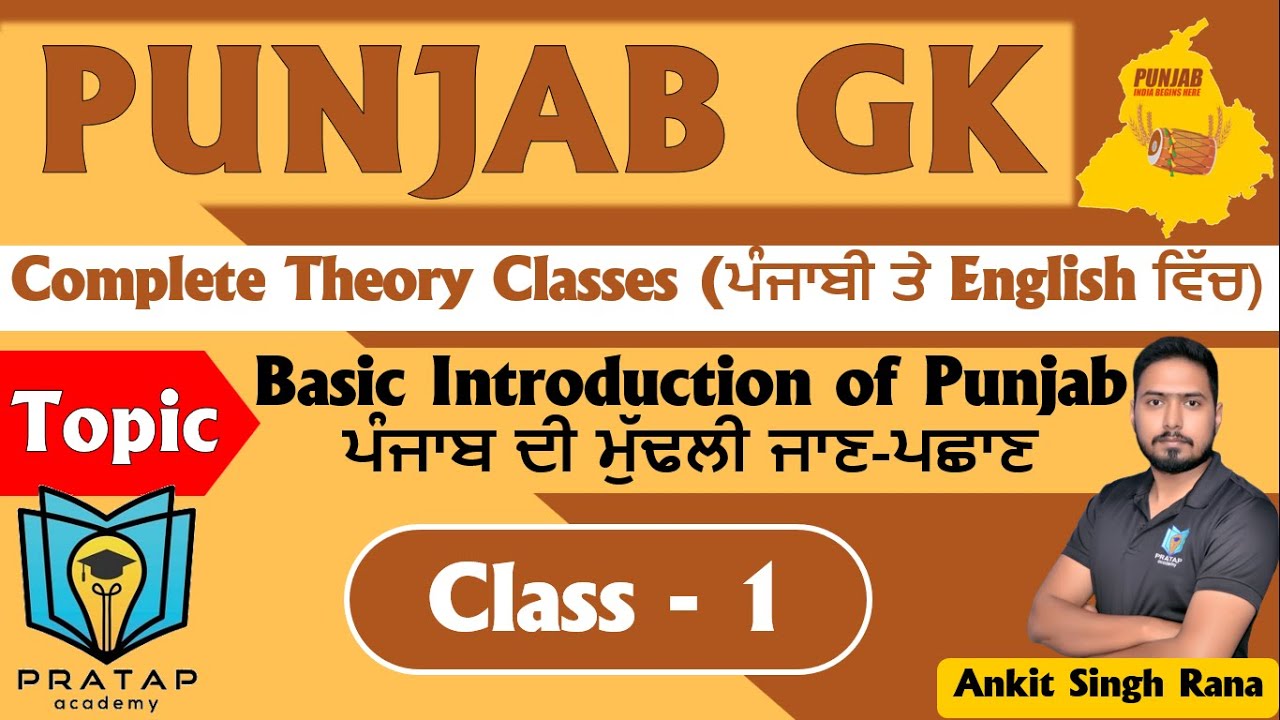
This video serves as an introduction to a comprehensive Punjab General Knowledge (GK) course offered by Pratap Academy. The course aims to cover all aspects of Punjab GK relevant to various competitive exams, including geography, history, polity, art and culture, and economics. The instructor outlines the topics to be covered and encourages viewers to engage with the content through likes, shares, and subscriptions, as well as connect on social media platforms for updates and further interaction.
- Comprehensive Punjab GK course for competitive exams.
- Covers geography, history, polity, art and culture, and economics.
- Encourages viewer engagement and social media connection.
Introduction to Punjab GK Course
The instructor, Ankush Singh Rana, welcomes viewers to the Pratap Academy YouTube channel, announcing a new series of Punjab GK classes. These classes will be theory-based and cover all important aspects of Punjab GK relevant to various competitive exams. The importance of Punjab GK in exams is emphasised, noting that questions related to Punjab are frequently asked in various tests.
Course Structure and Topics
The course will begin with an introduction to Punjab, covering its basic information and facts. The instructor mentions that the course will be useful for any exam that includes Punjab GK. The course will cover geography, including demographics, literacy rates (based on census data), divisions (both administrative and by colour), and districts. Following geography, the course will move on to history, covering ancient, medieval, and modern periods, including the freedom struggle. The polity section will cover the formation of the state, key events from 1947 to 2003, political parties, and important political figures like governors. The course will also cover art and culture, including music and literature, with a focus on literature as a frequently tested topic. Finally, the course will address agriculture, irrigation, tourism, transport, energy, health, sports, government schemes, and miscellaneous topics.
Historical Context and Geographical Identity
The historical context of Punjab is discussed, referencing its ancient name, "Sapta Sindhu," due to the presence of seven rivers. The region's identity evolved over time, with mentions in religious texts like the Ramayana and Mahabharata. The name "Punjab" signifies the land of five rivers. References to Punjab are also found in Greek texts.
State Symbols and Basic Statistics
The video highlights Punjab's state symbols, including the state animal (blackbuck, with its scientific name Antilope cervicapra), state bird (baaz), and state flower (gladiolus). The state aquatic animal is the Indus River dolphin, found in the Beas River at Harike Pattan, where the Beas and Sutlej rivers meet. Punjab's total area is 50,362 square kilometres, which is 1.54% of India's total area, ranking it 19th among Indian states. According to the 2011 census, Punjab's population is 2.77 crore, ranking it 16th in India. The population density is 551 people per square kilometre.
Dimensions, Divisions and Districts
The video provides information on Punjab's dimensions, noting its length from north to south is 335 km and from east to west is 300 km. Punjab is divided into five divisions. The creation of Malerkotla as the 23rd district on 14 May 2021, carved out of Sangrur, is mentioned. The instructor references the official Punjab Government website for accurate information. The number of tehsils is noted as 93.
Metropolitan and Smart Cities
A metropolitan city is defined as one with a population exceeding 1 million. Punjab has two such cities: Amritsar and Ludhiana. Additionally, Punjab has three smart cities: Jalandhar, Amritsar, and Ludhiana. These cities were selected under the National Smart City Mission launched by the Government of India in 2015, which aimed to develop 100 smart cities across India.
Governance and Demographics
Punjab has a unicameral legislature, meaning it has only one house, the Legislative Assembly (Vidhan Sabha). Article 332 of the Constitution specifies the reservation of seats in the Legislative Assembly for Scheduled Castes (SC). The state previously had a Legislative Council (Vidhan Parishad), which was abolished in 1970.
Municipal Corporations and Sex Ratio
The video lists the municipal corporations in Punjab: Jalandhar, Hoshiarpur, and Fatehgarh Sahib. The structure of local government is explained, starting from the Gram Sabha at the village level, progressing to Nagar Panchayats, Municipal Councils, and finally, Municipal Corporations for larger cities. According to the 2011 census, Punjab's sex ratio is 895 females per 1000 males, and the child sex ratio (0-6 years) is 846. The literacy rate is 76.7%, with 81.5% for males and 70.7% for females.
Borders and Neighbouring States
Punjab shares an international border with Pakistan. The six districts that border Pakistan are Pathankot, Gurdaspur, Amritsar, Tarn Taran, Firozpur, and Fazilka. Punjab also shares borders with two Union Territories: Jammu and Kashmir (only Pathankot district) and Chandigarh (only Mohali district). The state is bordered by Himachal Pradesh to the north-east, Haryana to the south, and Rajasthan to the south-west. The districts bordering Himachal Pradesh are Pathankot, Gurdaspur, Hoshiarpur, and Rupnagar.
Rivers and Judiciary
The video mentions the rivers Ravi, Beas and Sutlej. The districts located between the Beas and Ravi rivers are Hoshiarpur, Kapurthala, Jalandhar and Nawan Shehar. The joint High Court for Punjab and Haryana is located in Chandigarh. The first Chief Justice of the High Court was Justice Ramlal Singh.
Firsts in Punjab and Course Conclusion
The first Governor of Punjab was Chandulal Madhavlal Trivedi, and the first Chief Minister was Gopi Chand Bhargava from the Congress Party. The first Lokpal of Punjab was Justice S.S. Sodhi. The instructor notes the importance of knowing the Governors during key periods such as India's independence, the formation of PEPSU, and the reorganisation of Punjab. The video concludes by outlining the course structure, which will cover geography, history, polity, art and culture, and economics. The instructor plans to conduct live tests and encourages viewers to like, share, and subscribe to the channel. Viewers are also invited to connect with the instructor on Instagram and Telegram for updates and further interaction.

