
Brief Summary
This video provides a comprehensive glossary of essential financial and investment terms. It covers everything from basic concepts like assets and liabilities to more complex strategies such as hedging and shorting. It also explains different types of investment analysis, including fundamental and technical analysis, and various order types used in trading.
- Key Concepts: Assets, Liabilities, Capital, Equity, Dividends
- Trading Strategies: Hedging, Shorting, Swing Trading, Day Trading, Value Investing, Growth Investing
- Market Analysis: Fundamental Analysis, Technical Analysis
- Order Types: Market Order, Limit Order, Stop-Loss Order
Asset
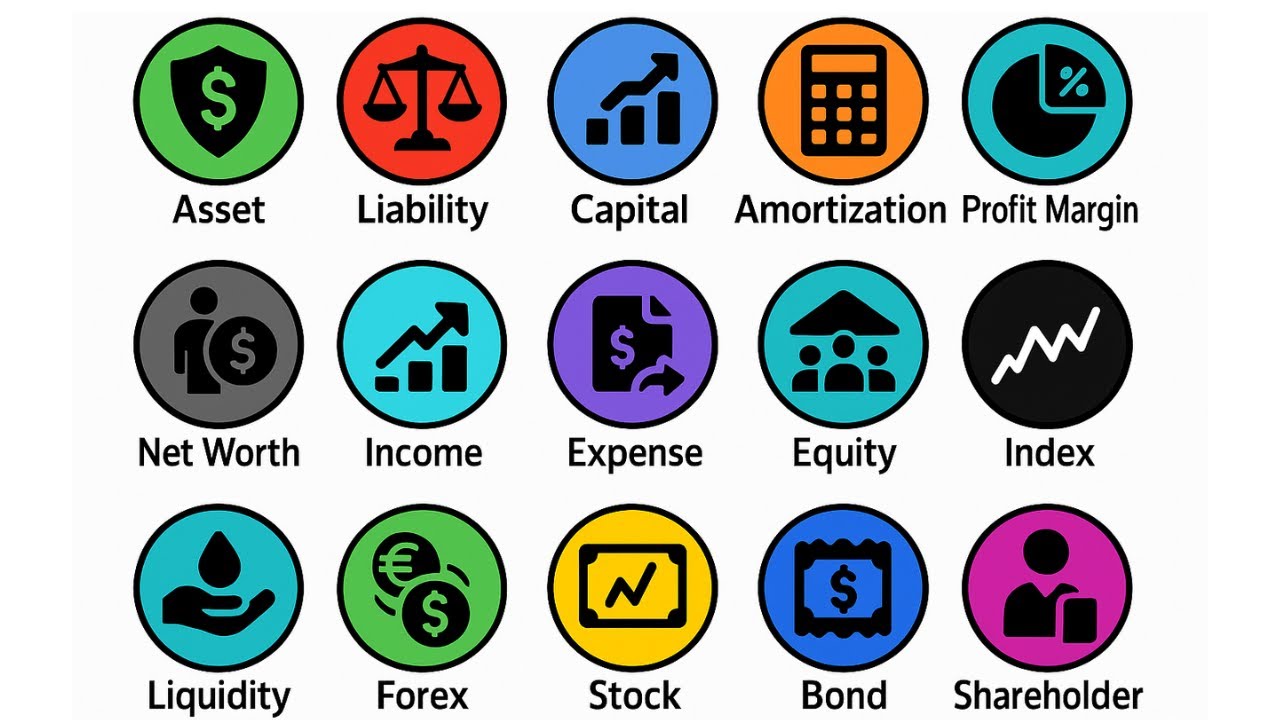
An asset is anything of value that you own, such as stocks, land, cash, or gold, that can be used to build wealth. A liability, on the other hand, is anything you owe, including loans, salaries, rent, or any other financial obligation. Capital is what you use to purchase items, construct things, or engage in trade, essentially another term for money.
Amortization
Amortization involves spreading out payments over time, such as when repaying a loan monthly with both interest and principal components. Profit margin indicates the amount of money a company retains after covering all expenses; for instance, a company selling an item for $100 and keeping $20 after costs has a 20% profit margin. Net worth is the difference between total assets and total liabilities.
Income
Income refers to money earned from work or investments, while expenses are the funds spent on goods or services. Equity represents the ownership interest in an asset or company. An index is a tracked group of stocks, such as the S&P 500, providing an overview of the market's overall performance.
Liquidity
Liquidity refers to how quickly an asset can be converted into cash without losing value; stocks are generally liquid due to their ease of sale. Forex involves trading currencies, such as dollars, euros, and yen, based on the expectation that one currency will increase in value relative to another.
Stock
Purchasing a stock means buying a small portion of a company. A bond is essentially a loan to a company or government, with a promise of repayment plus interest. A shareholder is someone who owns stock in a company. Volume indicates the number of shares being traded; high volume suggests significant buying or selling activity, while low volume indicates less activity.
Underwriting
Underwriting is the process where banks manage a company's initial public offering (IPO) or new stock offering by setting the price, purchasing shares, and reselling them to investors. FOMO (fear of missing out) buying occurs when individuals purchase a stock simply because others are doing so. A stock exchange is where the buying and selling of stocks takes place.
Public Company
For a company to be listed on the stock exchange, it must become a public company, allowing the general public to purchase its shares. An index fund is a low-cost investment option that tracks a market index like the S&P 500, providing exposure to a wide range of companies without the need to select individual stocks. Dividends are a portion of a company's profits distributed to shareholders as a reward for holding their stock.
Ticker Symbol
A ticker symbol is a short code used to identify a company on the stock market, such as AAPL for Apple or TSLA for Tesla, facilitating quick identification during trading or chart analysis. "To the moon" is a phrase used when people anticipate a stock's price will increase dramatically. A broker is an individual, platform, or app that facilitates the buying and selling of stocks.
Bull Market/Bear Market
A bull market signifies rising prices, while a bear market indicates declining prices. Hedging involves protecting investments from risk, such as investing in oil stocks to offset potential losses from airline stocks if oil prices rise. Foreign exchange reserves are foreign currencies, like US dollars or euros, held by countries as a backup to stabilise their economy, control inflation, or support their own currency.
Trade Deficit
A trade deficit occurs when a country imports more goods than it exports. A bubble is when prices increase rapidly without relation to real value, driven by speculative buying. The bid is the price buyers are willing to pay for a stock, while the ask is the price sellers are seeking. The bid-ask spread is the difference between these two prices.
Tanking
Tanking refers to a significant drop in a stock or the overall market. Panic selling is when investors sell their holdings simultaneously due to fear, causing further price declines. Volatility measures how much stock prices fluctuate; high volatility indicates greater risk but also greater potential for profit or loss. A portfolio is the collection of all an investor's investments, including stocks, bonds, and real estate.
Blue Chip Stocks
Blue chip stocks are those of well-established companies like Coca-Cola or Microsoft, generally considered safer and more stable investments. A mutual fund pools money from multiple investors to invest in stocks, bonds, or other assets. Earnings per share (EPS) indicates a company's profit per share of stock, with higher EPS typically indicating better profitability.
Return on Investment
Return on investment (ROI) measures the profit earned relative to the initial investment; for example, a $2,000 profit on a $10,000 investment yields a 20% ROI. Interest is the additional money earned when lending money, such as through savings accounts or bonds. Compound interest is when interest earned also earns interest, leading to exponential growth.
Dollar Cost Averaging
Dollar-cost averaging involves investing a fixed amount regularly to mitigate the risk of timing the market, as it involves buying at both high and low price points. A day order expires at the end of the trading day, suitable for trades intended for that day only. A good-till-cancelled order remains active until it is fulfilled or manually cancelled.
Market Order
A market order executes a trade immediately at the current market price. A limit order allows setting a specific price at which to buy or sell, executing only if the market reaches that price. A stop-loss order is a safety measure that automatically sells a stock if it falls to a specified price.
Averaging Down
Averaging down involves buying more shares of a stock at a lower price to reduce the average cost per share. Control stock provides the holder with significant influence over a company's decisions, often held by founders or major investors. A holding company owns other companies but does not produce goods or services itself, such as Berkshire Hathaway.
Holdings
Holdings are the specific investments within a portfolio, such as stocks of Apple, Amazon, and Google. An ETF (exchange-traded fund) is a basket of various investments bundled into one, offering diversification. An IRA (individual retirement account) is a retirement account with tax benefits.
Security
A security is a general term for tradable investments like stocks, bonds, or mutual funds. A commodity is a basic good like oil, gold, or wheat that can be traded. Inflation is the increase in prices over time, reducing purchasing power. Penny stocks are low-priced stocks, often associated with hype trading and weaker fundamentals.
Market Capitalization
Market capitalization is a company's total value in the stock market, calculated by multiplying the stock price by the number of shares. Book value is a company's assets minus its liabilities. The price-to-book ratio compares a company's market price to its book value, potentially indicating undervaluation or problems.
IPO
An IPO (initial public offering) is when a private company first offers shares to the public. Shorting involves betting that a stock's price will decline by borrowing shares and selling them, hoping to buy them back at a lower price. A short squeeze occurs when a stock's price rises unexpectedly, forcing short sellers to buy back shares to cover their positions, driving the price even higher.
Long Squeeze
A long squeeze is the opposite of a short squeeze, occurring when investors betting on a stock's rise are forced to sell due to falling prices, pushing the price further down. Leverage involves using borrowed money to invest, increasing potential gains but also potential losses. Hedge funds are private funds for wealthy investors that use riskier strategies to seek high returns.
Swing Trading
Swing trading involves holding investments for a few days or weeks to profit from short-term price movements. Day trading involves buying and selling within the same day. A pump and dump scheme involves hyping up a cheap stock to increase its price, then selling off the shares for a profit, leaving other investors with losses.
Rugpull
A rug pull, common in crypto, involves a project's creators disappearing with investors' money. Unicorns are startups valued at over $1 billion. Whales are large investors who can influence market prices with their substantial trades. A dead cat bounce is a brief price increase after a stock crash before it continues to fall.
Jigged Out
"Jigged out" describes a market that is moving randomly or acting strangely. Yield is the return on an investment, expressed as a percentage. Value investing focuses on finding undervalued stocks with the expectation of selling them at a higher price later. Growth investing involves investing in companies expected to grow rapidly.
Fundamental Analysis
Fundamental analysis involves studying a company's earnings, leadership, and financial health. Technical analysis involves looking at stock charts and patterns to make trading decisions. Intrinsic value is the perceived value of a company based on its fundamentals. A balance sheet shows a company's assets, liabilities, and equity.
Black Swan
A black swan is a rare, unexpected event that can crash the market. Fading is a strategy of betting against the current market trend. Options give the holder the right, but not the obligation, to buy or sell a stock at a certain price within a certain time. The P/E ratio (price-to-earnings ratio) can indicate if a stock is over- or undervalued.
Efficient Market Hypothesis
The efficient market hypothesis (EMH) suggests that stock prices reflect all available information, making it impossible to consistently beat the market. Insider trading involves using non-public information to trade stocks, which is illegal. Supply and demand dictates that if more people want to buy a stock, the price increases, and if more people want to sell, the price decreases.

