
Brief Summary
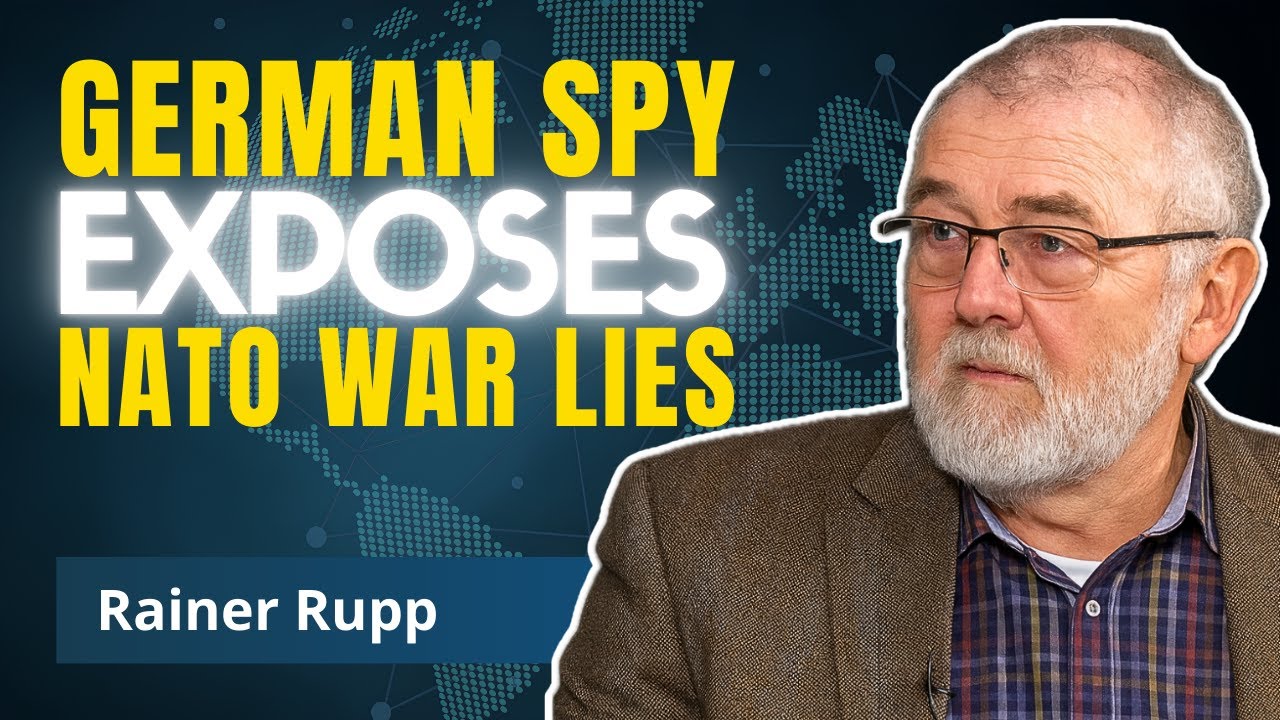
Rhino Rup, a former East German spy who infiltrated NATO, discusses his motivations, experiences, and perspectives on current geopolitical issues. He highlights the propaganda, nuclear risks, and the operational realities versus the myths surrounding potential Russian invasions. Rup also touches on the loyalty of Western elites, the future of NATO, and the possibility of European sovereignty.
- Rup's motivation stemmed from disillusionment with the Vietnam War and admiration for socialist ideals.
- He believes his spying helped prevent misunderstandings that could have led to war.
- Rup criticises NATO's aggressive behaviour towards Russia and the theatrics of modern propaganda.
- He suggests Western elites prioritise loyalty to a global order over national interests.
- Rup predicts NATO's eventual collapse due to internal divisions and economic pressures.
Introduction
The host introduces Rhino Rup, a former East German spy who worked for NATO and forwarded internal documents to the East. Rup was caught in 1993 after the end of the Cold War and served a prison sentence until 2000. The host expresses his interest in Rup's motivations and experiences during his time working in the shadows.
Motivation: The Vietnam War & Recruitment by East Germany
Rup explains that his motivation to work for East Germany stemmed from his disillusionment with the Vietnam War and exposure to Marxist teachings. He grew up in an environment that admired the Americans, but he questioned their involvement in Vietnam. He even wrote to the US embassy to volunteer for the American army but was turned down. Later, he realised the extent of American crimes in Vietnam, which appalled him. Simultaneously, he became involved with a leftist group and studied the works of Marx and Engels, finding their ideas aligned with his own. Rup was approached by a talent scout from the HVA (East German intelligence service) and, after discussions and a visit to East Germany, agreed to help defend what the GDR was building by gathering information on neo-fascist groups in West Germany.
Infiltrating NATO: From Brussels to the Situation Center
Rup received a grant to study at the Free University of Brussels, which his handlers supported as a move towards infiltrating the EU. After completing his studies and working in various roles, including as a director for industrial research at a British merchant bank and later in an EU lobbying group, he applied for a job at NATO. Despite the usual practice of filling NATO positions with national ministry personnel, Rup's unique background and networking skills from his lobbying experience helped him secure a role. He quickly gained a reputation for efficiency and was given access to important documents and projects. Eventually, he became a China specialist and gained access to the situation centre, a highly secure communications hub within NATO where intelligence and assessments were analysed. Rup was part of the current intelligence group, which analysed overnight developments and sent out daily reports. He also participated in Vitex exercises, simulating nuclear war scenarios.
Did Spying Prevent World War III? (Game Theory & Strategy)
Rup forwarded NATO defence plans and other critical information to the East, sometimes even before NATO ministers had seen the final results. He believes this exchange of information helped maintain stability by ensuring the Soviet Union knew NATO's plans. Rup uses game theory to illustrate that knowing the opponent's cards gives a significant advantage. He clarifies that his intention was not to help the East win a war but to prevent misunderstandings that could lead to conflict. He cites a top-secret NATO document stating that the Soviet Union did not want a war with NATO and aimed to carry any conflict onto the aggressor's territory. Rup's actions were considered during his trial, leading to a reduced sentence because his motivation was to prevent war, not financial gain.
NATO’s Aggression and the Long-Term Plan for Russia
Rup argues that NATO's attitude and behaviour have not changed since the Cold War, continuing to provoke Russia. He criticises the moral exaggeration used to justify NATO's expansion and military presence near Russia's borders. He notes that the general trust in the West has diminished compared to the Cold War era. Rup believes that while the end of the Cold War was detrimental to the East, it did not change the institutions in the West, with NATO maintaining the same mentality. He recalls writing articles for NATO review after the fall of the wall, pointing out the destructive impact of IMF policies on the Soviet Union. Rup recounts a conversation with Lord Riddale, who expressed a desire to exploit Russia's resources, a sentiment that Rup found appalling.
Current Propaganda, Nuclear Risk, and the "Screaming Eagles"
Rup observes that current propaganda has intensified, with theatrical displays and a simplistic portrayal of Russia as the boogeyman. He contrasts this with the Cold War, where there was more coherence between signalling and actions. While the ruling class had problems backing down from the Cold War stance, they were aided by Russian flexibility. Rup agrees with Gargarov that Western elites are trying to diminish the fear of nuclear war, which he sees as dangerous. He uses probability theory to explain the increasing risk of a nuclear conflict due to various factors. Rup highlights a specific incident in 2022 when the US deployed the "Screaming Eagles" in Eastern Europe, and their commander expressed readiness to enter Ukraine, which he believes could have triggered a catastrophic escalation.
Operational Reality vs. The Myth of a Russian Invasion
Rup notes that public rhetoric and actual operational planning are different. He points to the sophisticated military capabilities demonstrated by Russia in Ukraine, contrasting it with the West's limited understanding. He dismisses the idea of a Russian invasion of Europe as ludicrous, questioning why Russia would want to inherit Europe's problems or even need to control Western Ukraine, given the challenges of dealing with Ukrainian resistance. Rup suggests that the operational planning in NATO likely recognises the inferiority of NATO compared to the Russian military.
Western Elites: Loyalty to Empire Over Nation
Rup discusses why Western elites stick together and make decisions detrimental to their own people, attributing it to loyalty to a new world order created under George H.W. Bush. He argues that these elites have transcended national loyalty, prioritising their network and the centre in Washington. He cites examples of German presidents who were ousted for expressing dissenting views or refusing to sign bailout packages for banks. Rup suggests that the operational arm of NATO, while still present in the European Union, seems to be more rational in trying to contain the war inside Ukraine.
The Future of NATO and European Sovereignty
Rup notes that more people are finding it difficult to believe the official narrative. He suggests that Europe is going through a similar situation to the Soviet Union, where public messaging no longer coheres with economic realities. While a European Gorbachev is unlikely, a leader in a major European country stepping out of the "madness" could cause the rest to crumble. Rup predicts that NATO will not survive another 70 years, as the American elites have turned to exploiting their vassals. He suggests creating a matrix of NATO countries and their positions on different issues to reveal the growing divisions. Rup believes that the current situation is unsustainable and will either lead to an authoritarian state or a return to common sense and bourgeois democracy.
Conclusion
The host concludes by asking Rup where he publishes his work. Rup mentions that his articles can be found on the website rheruna. The host thanks Rup for his time and insights.

