
Brief Summary
Cam Harvey, a finance professor, answers common investing questions from the internet, offering guidance on various topics. Key points include:
- Index funds are a good starting point for most investors due to their diversification and low effort.
- A small portion of a portfolio can be allocated to individual stocks for learning and fun.
- Gold can be a safe haven but is as volatile as the S&P 500.
- International diversification is crucial, as US stocks currently represent a disproportionate share of global market value.
- The AI "bubble" is different from the dot-com bubble due to AI's broad impact and companies' willingness to self-disrupt.
- P/E ratio is an important valuation metric.
- Beginners often make the mistake of buying high and selling low.
- Brokerage choice depends on investor needs, with low-cost options for younger investors and more comprehensive services for older investors.
- Meme coins are extremely volatile and high-risk investments.
- Day trading is difficult due to competition from institutional traders.
- Hedge funds use strategies like shorting stocks to hedge against market movements.
Investing Support
Cam Harvey, a professor of finance at Duke University, introduces an "Investing Support" segment where he answers investing questions from the internet.
Stick with an Index Fund?
Investing in a low-cost exchange-traded fund or index fund is good advice for most individual investors. Picking individual stocks requires significant effort, time, and access to data that most individual investors don't have. Index funds offer diversification, removing the need to worry about individual stock selection.
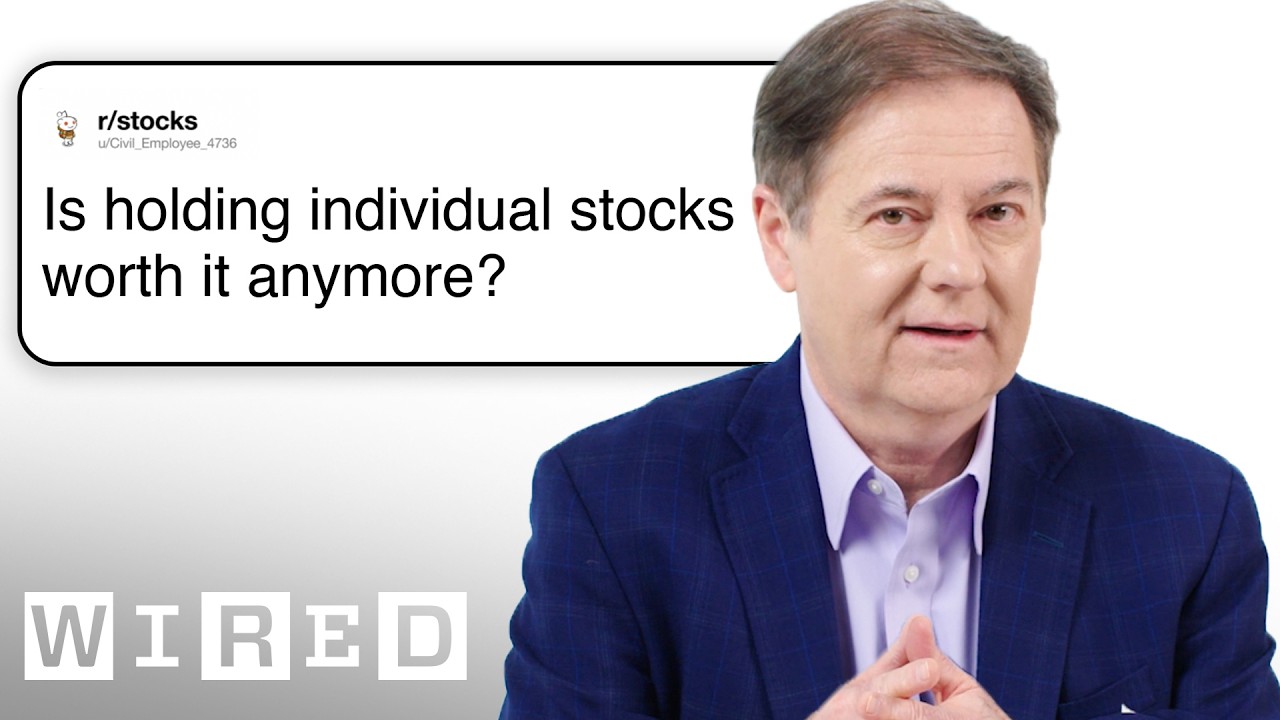
Is holding individual stocks worth it?
While holding individual stocks can be stressful, particularly with only a few stocks, allocating a small portion of your portfolio (around 10%) to individual stocks is beneficial. This allows for learning and tracking investments, and can also be enjoyable.
Gold
Gold is a safe haven asset that tends to hold its value during market or economic turmoil. Despite its safe haven status, gold is volatile, with volatility comparable to the S&P 500.
How would you invest 20,000 today?
If investing $20,000 today, most of it should go into a diversified equity portfolio that includes both US and international stocks. A smaller portion should be allocated to a money market fund to maximise yield. Holding out 5-10% to invest in researched stocks is also recommended for the learning experience.
International allocation
Most investors don't have enough international allocation in their portfolios, which are often dominated by US investments. US stocks account for 50% of the world's stock market value, while the US represents only 15% of world GDP. Diversification by buying stocks outside the US, through exchange-traded funds that include developed and emerging markets, is a good idea. A 50% international, 50% US allocation is suggested.
Will the “AI Bubble” pop?
The value of AI-related stocks has surged, driving most of the stock market's value creation recently. While there might be a correction, the AI "bubble" is different from the 1999 tech bubble. AI's technological disruption is more profound than the internet's introduction, as AI can be creative and solve problems, vastly improving productivity. AI impacts every company, unlike the internet's differential effect. Companies are also more willing to self-disrupt. AI firms are also massively profitable, unlike the firms in the 1990s.
Why does the P/E ratio matter?
The P/E ratio (price-to-earnings ratio) is a popular metric for stock valuation, calculated by dividing the stock price by earnings per share. A high P/E ratio compared to a stock's history suggests the stock is expensive and may revert to its previous P/E. While low P/E stocks are often called cheap, they may simply be in distress. The P/E ratio for the S&P 500 is currently very high, and historically, a high market P/E has indicated lower returns in subsequent years.
AI tools for investing
Many people are using AI tools for investing, particularly large institutional asset managers with trained AI and machine learning teams. These managers understand how the programs work, their implications, and fine-tune the applications to vast amounts of data. Understanding how any tool works is key to using it effectively.
Can the stock market really keep returning 7% a year?
The stock market's long-term average return is 7% per year, but this varies. To achieve this return, investors need to stay in the market and ride out periods of decline. The 7% return comprises a real return and inflation compensation. With inflation at the Fed's target of 2%, the real return after inflation is about 5%.
What percentage of your portfolio should be crypto?
Crypto is a broad category, including cryptocurrencies like Bitcoin that are not backed by anything, and others like stablecoins that are backed by assets like US dollars. It's a mistake to invest heavily in crypto; a small exposure of 2-4% of your portfolio is more appropriate, and caution is advised.
Beginner’s investing mistakes
The biggest mistake beginner investors make is buying high and selling low. The best strategy is to buy when the price is low and sell when the price is high. Investors often buy stocks after the price has already increased, leading to disappointment when the valuation corrects.
Brokerage choice
Brokerage choice depends on the investor's needs. Younger investors should use low-cost brokers like Robinhood or Schwab for access to stocks and exchange-traded funds at low fees. Older investors may prefer more expensive brokers that offer additional services like legal and estate planning advice.
Stock research
When researching a new stock, it's important to follow news about the company, including mainstream media, annual reports, quarterly releases, and 10-K filings with the SEC. Analyst coverage and quarterly earnings calls are also valuable sources of information. It's important to look at the fundamentals of the company and exercise restraint if the price has already risen dramatically.
Private equity for the average Joe
It is difficult for the average investor to participate in private equity companies due to qualification requirements. In the US, you need to make a certain amount of money to be a qualified investor. The system should change to allow knowledgeable individuals to qualify through research and testing, making these investments available to a broader set of investors.
Meme coins
Meme coins are cryptocurrencies with no fundamental value, traded more for fun. They are extremely volatile, 20 to 100 times more so than the stock market. There's no evidence that a portfolio of meme coins makes money. If you invest in a meme coin, be prepared to lose 100% of your funds.
Stock options as compensation
Stock options give an employee the right to buy company stock in the future at a particular price. For example, options to buy stock at $400 in five years when the current price is $90. If the stock price increases to $1,000, the employee can buy at $400 and sell for $1,000, making a $600 profit. Companies use stock options to compensate and retain employees, aligning incentives to increase the stock's value.
Is “Mad Money” just insider trading?
Insider trading involves using non-public information for trading, which is illegal, unethical, and unfair. Information on TV, video, or the internet is public. Pundits talking up a stock is fine, but trading on information from a company insider will get you into trouble.
The perils of day trading
Day trading is difficult to make money from for the average investor. Day traders compete against institutional-grade hedge funds and high-frequency traders with massive computing resources and fast data feeds. It is not recommended.
ELI5: Hedge Funds
Hedge funds come in different styles, but a common type is an equity hedge fund that buys stocks it expects to increase in value and shorts stocks it expects to decrease. This strategy hedges against market-wide movements. For example, if the market drops by 20%, a hedge fund might lose 20% on its long positions but gain 30% on its short positions, resulting in an overall gain of 10%.

