
Brief Summary
This module explores the applications of human movement science, focusing on fundamental movement skills, exercises, and gait. It emphasises the importance of understanding fundamental movements as building blocks for sports skills and analysing them using movement science principles. The module categorises fundamental movements into locomotor, stability, and manipulative skills, detailing their implications for holistic development, including physical, cognitive, social, and motor skill aspects. It also compares and contrasts the squat jump and countermovement jump, analysing their biomechanical characteristics, muscle actions, and phases to understand their roles in assessing lower body strength and explosive power.
- Fundamental movements are foundational skills crucial for sports and physical activities.
- These movements are categorised into locomotor, stability, and manipulative skills.
- Acquiring these skills is vital for holistic development, including physical, cognitive, social, and motor aspects.
- The vertical jump, including squat and countermovement jumps, is analysed to understand biomechanical differences and performance outcomes.
Introduction to Applications of Human Movement Science
The module introduces the applications of human movement principles to fundamental movement skills, exercises, and gait. The learning outcomes include understanding fundamental movements, their importance as building blocks for sports skills, their implications, and how to analyse them using movement science principles. The module integrates functional anatomy, biomechanics, tools and techniques for studying kinematics and kinetics, and motor control to understand different skills, from fundamental movements to sports.
What are Fundamental Movements?
Fundamental movements are foundational skills that serve as building blocks for more complex tasks, physical activities, and sports. These movements are categorised into locomotor skills, which involve changing body position or moving through space (e.g., walking, running, jumping), stability skills, which involve maintaining a stationary position and controlling balance, and manipulative skills, which combine locomotor and non-locomotor movements and require handling objects (e.g., throwing, catching, kicking).
Implications of Acquiring Fundamental Movements
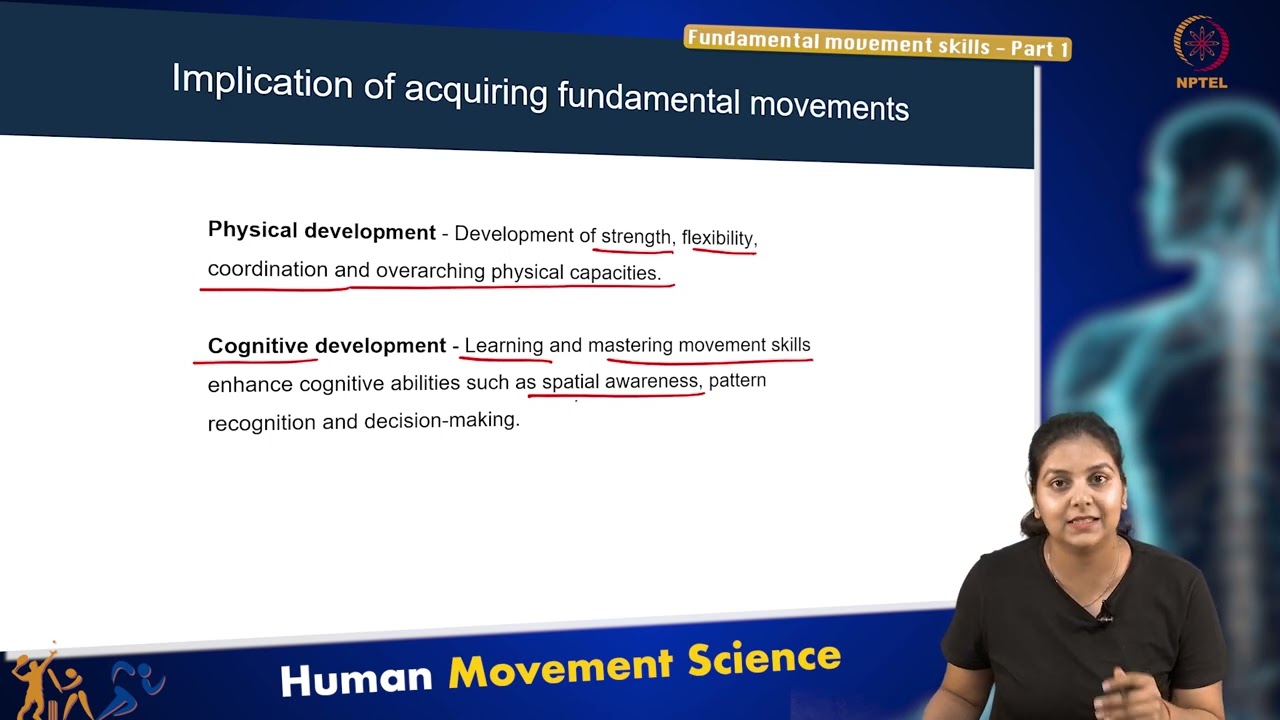
Acquiring fundamental movements is crucial for holistic development, encompassing physical, cognitive, social, and motor skill aspects. These movements contribute to physical development by enhancing strength, flexibility, and coordination. They aid cognitive development by improving spatial awareness, pattern recognition, and decision-making. Socially, they promote teamwork, communication, and interaction. For motor skill development, they serve as essential building blocks for advanced sports-specific movements, preparing individuals for complex activities and versatility in sports. Applying these skills requires a multi-dimensional approach, informing how the body adapts to the environment and aiding in talent identification by tracking progress and development rates.
Vertical Jump Analysis: Squat Jump vs. Counter Movement Jump
The vertical jump is analysed as a fundamental movement used for performance testing, with variations like the squat jump and countermovement jump (CMJ) differing in biomechanical characteristics. The squat jump involves a less complex movement pattern with hands on the hips for stability, primarily using concentric muscle contraction to test lower body strength. In contrast, the CMJ uses a dynamic arm swing for counterbalance, combining concentric and eccentric muscle contractions to assess explosive power. Movement analysis involves sagittal plane motion and lateral view, using video cameras and force plates. Key muscle actions include knee extension (quadriceps), hip extension (hamstrings), and ankle plantar flexion (gastrocnemius and soleus). The squat jump starts from a static squat position, while the CMJ starts from a standing position with a quick downward movement utilising the stretch-shortening cycle.

