
Brief Summary
This video explores the biomechanical considerations for analysing fundamental skills like vertical and horizontal jumps, and running. It details the phases of each movement, the muscles involved, and key performance variables to consider. The importance of understanding these foundational movements for improving athletic performance and preventing injuries is emphasised.
- Biomechanical analysis of vertical and horizontal jumps.
- Functional anatomy and muscle involvement in running.
- Key performance variables for assessing movement efficiency.
Biomechanical Considerations for Vertical Jump
The analysis of a vertical jump involves several biomechanical considerations. During the flight phase, maintaining proper body positioning and coordination is crucial as it directly impacts the subsequent landing. Efficient landing mechanics are essential for absorbing ground reaction forces through flexion in the hips, knees, and ankles, which helps prevent injuries. Ground reaction forces are generated by pushing off the ground and act against gravity, propelling the body upwards. Force production relies on lower body muscles like the quadriceps, hamstrings, and gluteus maximus, which contract to generate upward propulsion. Maintaining a controlled centre of mass and balanced posture is also vital for efficient force transmission during the jump.
Horizontal Jump Analysis: Aim and Categories
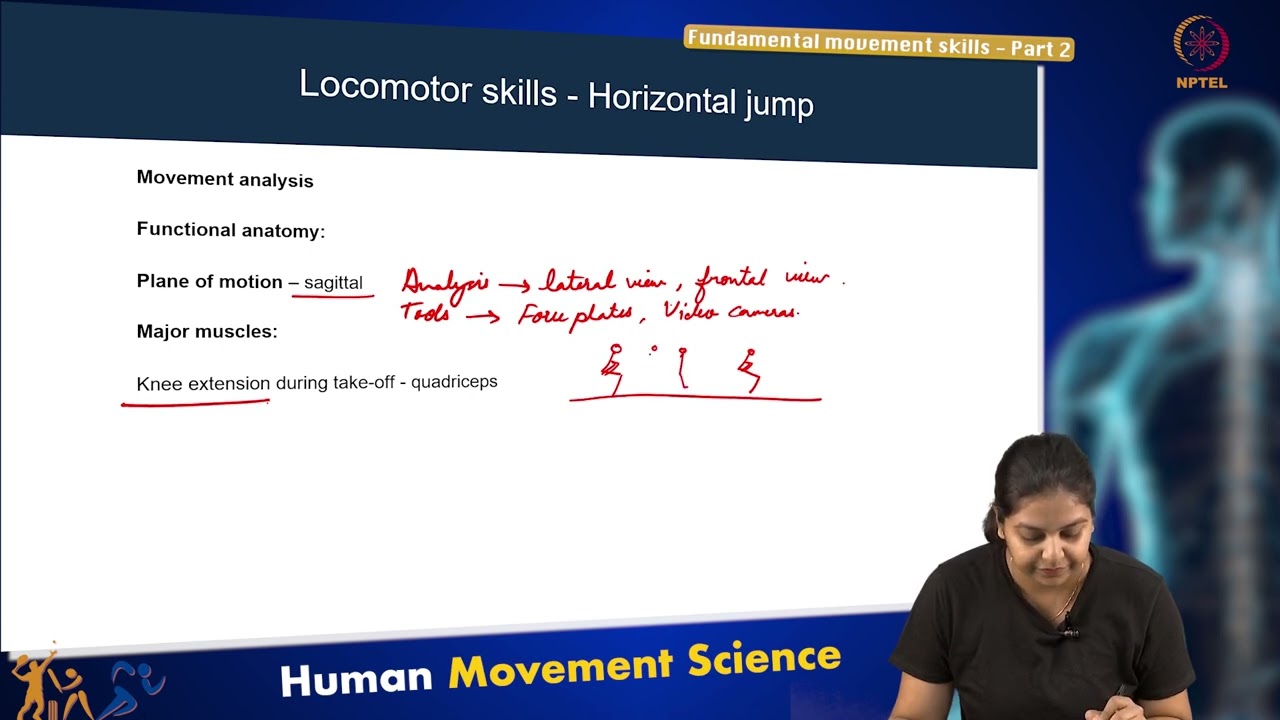
The horizontal jump aims to achieve maximum horizontal distance, testing lower body strength and explosive power. It is categorised into standing broad jump with hands and without hands. The jump with hands utilises arm swing to create additional forward momentum, making it an explosive movement. The jump without hands primarily tests lower body strength. Analysing the horizontal jump involves examining movement in the sagittal plane, best viewed from a lateral perspective, using tools such as force plates and video cameras.
Functional Anatomy and Muscle Engagement in Horizontal Jump
The horizontal jump involves significant muscle engagement in the lower body. Knee extension during take-off utilises the quadriceps, while hip extension employs the hamstrings and gluteus maximus. Ankle plantar flexion during take-off relies on the gastrocnemius and soleus. Core muscles stabilise the spine during take-off and landing. In the broad jump with hands, the deltoids and pectoralis major facilitate the arm swing.
Phases of the Horizontal Jump
The horizontal jump is divided into three phases: take-off, mid-air, and landing. The take-off phase involves rapid hip and knee extension through coordinated muscle activation. During the mid-air phase, the jump without hands involves minimal muscle activation, focusing on balance and coordination. The jump with hands utilises arm swing for additional forward momentum. The landing phase requires hip and knee flexion to absorb impact, with eccentric control from lower body muscles and core stabilisation.
Blueprint for Skill Analysis
Analysing skills involves breaking them down into phases and identifying important events. This includes assessing functional anatomy (plane of motion, axis, major muscles) and movement characteristics (biomechanics). This approach helps coaches and sports scientists understand the nuances of complex movements and develop targeted training programs.
Biomechanical Considerations for Horizontal Jump
Key biomechanical considerations for the horizontal jump include maintaining proper body positioning and coordination during the flight phase to impact landing position. Landing mechanics involve hip, knee, and ankle flexion to absorb impact forces. Ground reaction forces propel the body forward, generated by lower body muscles contracting for forward propulsion. The centre of mass travels horizontally, requiring balance and posture for efficient force transfer.
Key Performance Variables for Jump Analysis
Key performance variables for analysing jumps include jump height and distance, ground reaction forces, velocity profiles (vertical and horizontal components), and acceleration. Joint kinematics, particularly hip, knee, and ankle angles during take-off, landing, and mid-air, are crucial. Analysing the duration of each phase (take-off, mid-air, landing) and the depth achieved during the countermovement provides insights into movement efficiency. Video cameras are used for qualitative analysis, while force plates and 3D motion analysis provide quantitative data on kinematics and kinetics.
Functional Anatomy for Running
Running involves complex biomechanical characteristics that vary depending on the type of running (sprinting, marathon, recreational). Major muscles include the quadriceps (eccentric contraction during initial contact, concentric contraction during loading), hamstrings (eccentric contraction during loading for controlled knee flexion), gastrocnemius and soleus (concentric contraction for plantar flexion during take-off), gluteus maximus (concentric contraction during mid-stance for hip extension), and hip flexors (concentric contraction during pre-swing and initial swing for hip flexion). The tibialis anterior (eccentric contraction during initial contact for foot dorsiflexion) and upper body muscles (shoulder muscles, rotator cuffs, anterior chest muscles) contribute to arm swing, while abdominal muscles provide core stability and maintain body posture.
Phases and Mechanics of Running
Running is divided into three major phases: stance, swing, and transition. The stance phase is the weight-bearing phase, involving load absorption, propulsion, and balance maintenance. The swing phase is non-weight-bearing, involving limb advancement. The transition phase occurs between the stance and swing phases, involving transfer of body weight and controlled movements in preparation for the next phase. These phases can be further subdivided for detailed analysis.

