
Brief Summary
This video discusses the key performance variables for analysing fundamental movements, which are categorised into locomotor, stability and manipulative skills. It highlights the importance of understanding functional anatomy, biomechanics and motor control to build a strong technical foundation for sports.
- Stride length and frequency are key to running efficiency.
- Proprioception and kinesthetic awareness are crucial for balance.
- Foot placement and weight shift are important in turning.
- Stance, grip and trajectory are important in throwing.
- Hand-eye coordination, body position and hand configuration are important in catching.
Key Performance Variables in Running
When analysing running, key performance variables include stride length, which is the distance covered with each step, and stride frequency, or cadence, which is the number of steps taken per minute. Foot strike patterns, such as heel strike, mid-foot strike, and forefoot strike, each have different performance and injury considerations. Acceleration, which is the rate of change of velocity, and joint kinematics, which involves joint angles at the hip, knee, ankle, and shoulder, are also important. Ground contact time, the amount of time the foot is in contact with the ground, is a key variable for sprinters.
Biomechanical Considerations for Balance
Key biomechanical considerations for balance include proprioception, which is the ability to sense the position, location, and movement of body parts, and kinesthetic awareness, which is the awareness of position and movement without relying on vision. Dynamic balance is the ability to maintain stability during movement, and postural sway is the extent of movement of the body's centre in different directions. The base of support, which is the area between the feet, is also an important factor in maintaining balance.
Biomechanical Considerations for Turning
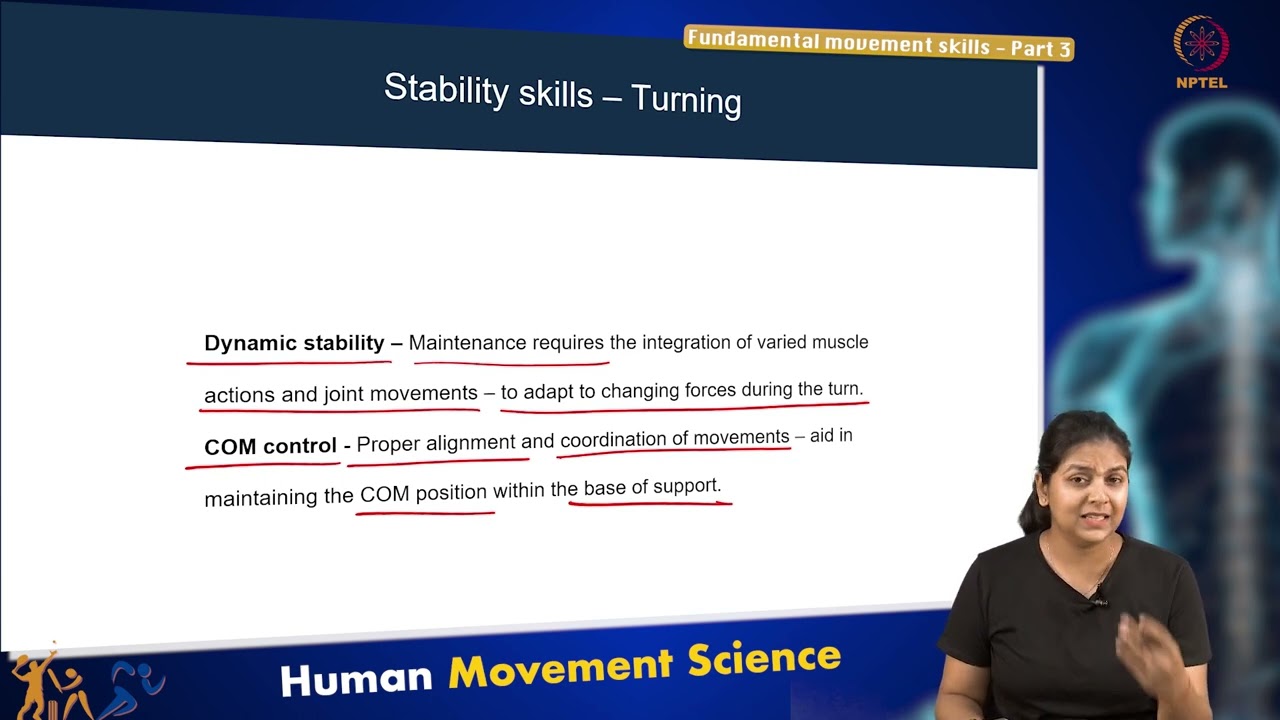
Turning is a key skill in sports like skiing, surfing, and ice skating. Important biomechanical considerations include foot placement, which initiates and controls the turn, and weight shift, where shifting weight towards the direction of rotation aids in maintaining balance and facilitates smooth rotation. The rotation of the hips and shoulders, with coordination between them, is also crucial, with the initiation of the turn coming from the hip and moving to the shoulder. Dynamic stability, range of motion control, and arm position and movement are also important for efficient and controlled turning.
Manipulative Skills: Throwing
Throwing involves a combination of locomotor and non-locomotor movements. Key factors include stance and foot position, where the back foot is planted for stability and the front foot facilitates hip rotation. Grip and hand position, including release angle and height, are important for controlling the release and adding spin. Optimal trajectory, influenced by release angle, release height, and velocities, is crucial for accuracy and distance. The wind-up and cocking phase involves a sequence of movements studied using kinetics, focusing on energy flow and force transmission from proximal to distal segments. The kinetic chain involves sequential activation from the lower body to the upper body, and shoulder rotation and elbow extension contribute to speed and force. Trunk rotation enhances power generation and energy transfer, and weight shift from the back foot to the front foot generates momentum.
Manipulative Skills: Kicking
Kicking involves a rapid and controlled leg swing to generate speed and force. Leg swing kinematics, including angles and forces, are important variables. The contact point and foot position at impact significantly influence the direction and speed of the kick. Torso rotation enhances the range of motion and overall power. Balance and weight distribution between the supporting leg and the kicking leg are crucial for control and injury prevention. Stance and foot position provide the foundation, with the non-kicking foot planted for stability. Hip flexion and leg lift generate momentum for the striking phase.
Manipulative Skills: Catching
Catching requires hand-eye coordination to visually track and intercept an object. Body position and balance create a stable platform for catching. The catching hand configuration, including shape and orientation, is important for maximizing the catching surface and securing the object. Elbow and arm positioning allows for absorption of the impact, facilitating a controlled catch.
Summary of Fundamental Movements
Fundamental movements are the foundation for more complex tasks and are categorised into locomotor, stability, and manipulative skills. Functional anatomy, biomechanics, and motor control are important for gaining a good technical foundation for sports. Analysing these skills involves breaking them down for coaching, testing, and queuing.

