
Brief Summary
This module provides an overview of gait analysis, including its definition, importance, and terminology. It explains the gait cycle, spatial and temporal parameters, and various applications in fields like orthopaedics, sports science, and forensic science. Key points include:
- Gait analysis is a systematic study of human locomotion, focusing on walking and running.
- The gait cycle is divided into stance and swing phases, further subdivided into eight sub-phases.
- Spatial parameters (stride length, step length, stride width, foot progression angle) and temporal parameters (stride time, stance time, swing time, cadence, speed) are crucial for analysis.
- Gait analysis has diverse applications in assessing mobility, diagnosing movement disorders, enhancing athletic performance, and forensic investigations.
Introduction to Gait Analysis
Gait analysis is a systematic study of human locomotion, particularly walking and running. It examines how the body moves from one point to another, involving visual, somatosensory, and vestibular systems. While "gait" and "walking" are often used interchangeably, gait refers to the manner or style of walking, focusing on the pattern of movement rather than the process itself.
Understanding the Gait Cycle
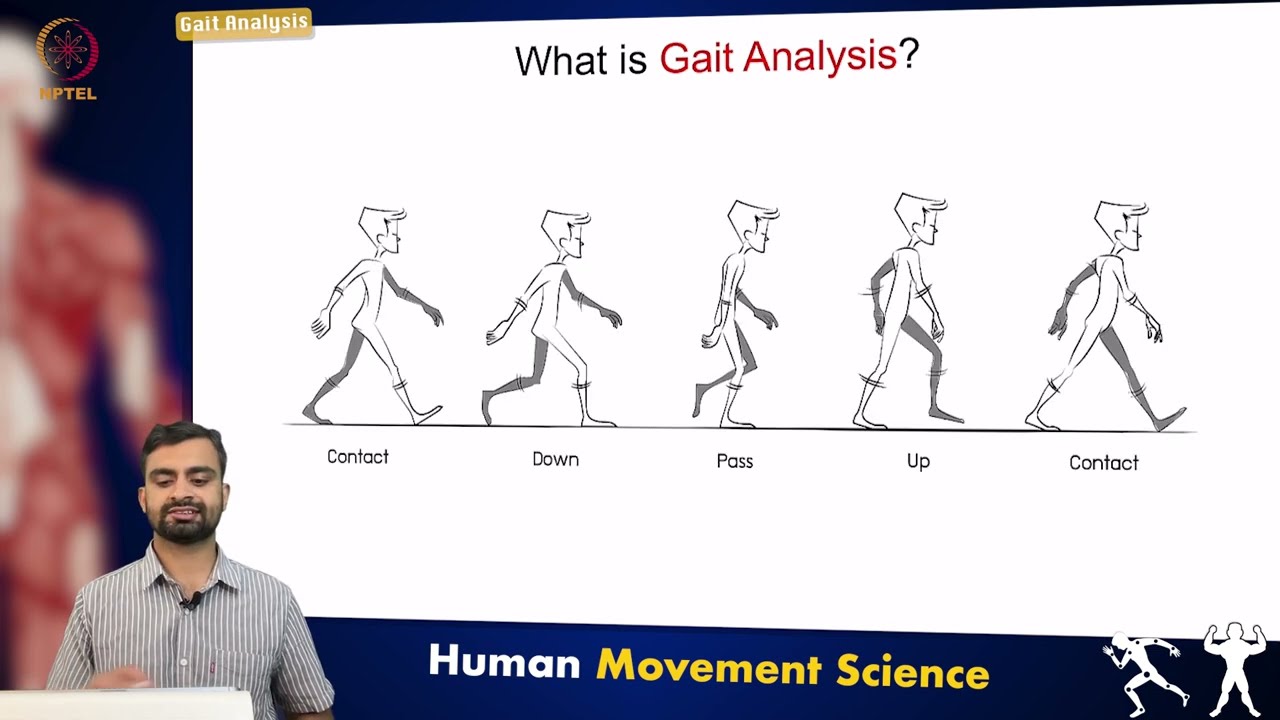
The walking gait cycle is a repetitive sequence of limb motions involving interactions between the thigh, shank, and foot segments. A single sequence of events by one limb is known as a gait cycle, typically starting with heel strike (or initial contact). The gait cycle involves reciprocal floor contact patterns, where one limb supports while the other advances. Stride, also known as the gait cycle, is based on the actions of one limb, measured from initial floor contact to the next by the same limb. Step refers to the timing between two limbs, from left to right.
Stance and Swing Periods
The gait cycle is divided into the stance period (foot in contact with the ground) and the swing period (foot in the air). The stance period includes initial double stance, single limb support, and terminal double stance. The swing phase occurs when the foot is in the air preparing for the next initial contact. The gait cycle can be further divided into tasks such as weight acceptance during stance and limb advancement during swing.
Phases of the Gait Cycle
The gait cycle is divided into eight sub-phases: initial contact, loading response, mid-stance, terminal stance, pre-swing, initial swing, mid-swing, and terminal swing. Initial contact starts the stance period, followed by the loading response where weight is transferred. Mid-stance involves progression over the stationary foot, while terminal stance completes single limb support. Pre-swing involves weight release and transfer. The swing phase includes initial swing, mid-swing, and terminal swing, focusing on foot clearance and limb advancement.
Spatial Parameters in Gait Analysis
Spatial parameters relate to space and are measured in meters. Stride length is the distance travelled during one complete gait cycle (heel strike to the next heel strike of the same foot). Step length is the distance between the contact of one foot and the subsequent contact of the opposite foot. Stride width (or base of support) is the medial-lateral distance between the feet. The foot progression angle is the angle between the long axis of the foot and the line of forward progression.
Temporal Parameters in Gait Analysis
Temporal parameters relate to time. Stride time is the time elapsed between ground contacts of the same foot. Stance time is the time the foot is in contact with the ground, while swing time is the time the foot is in the air. The swing-stance ratio shows the distribution of stance and swing phases. Double support time is the time when both feet are in contact with the ground, and single support time is when only one foot is in contact. Cadence is the number of steps per minute, and speed of walking is a function of both cadence and step length.
Applications of Gait Analysis
Gait analysis has various applications, including assessing and improving mobility, diagnosing and treating movement disorders, and enhancing athletic performance. Specific applications include orthopaedics and rehabilitation (pre- and post-surgical assessments, prosthetics design), paediatrics (developmental disorders, cerebral palsy management), neurology (Parkinson's, multiple sclerosis), sports science (performance enhancement, injury prevention), geriatrics (fall risk assessment), forensic science (criminal investigations), rehabilitation engineering (assistive devices), and biomechanics research (understanding musculoskeletal function).

