
Brief Summary
This video features Professor Tarek Masoud from Harvard University answering internet questions about Iran, covering topics from its nuclear capabilities and the Iran Nuclear Deal to its regional conflicts and relationship with the US and Saudi Arabia. Key points include:
- Iran likely doesn't have nuclear weapons yet, but is close to having enough enriched uranium to build one.
- The Iran Nuclear Deal (JCPOA) was a mixed bag, providing a pause to Iran's nuclear program but also concerns about its sunset clauses and funding of Iranian proxies.
- Iran's threat to the US is debated, with some seeing it as a major threat due to its anti-US stance and nuclear ambitions, while others view it as a manageable regional power.
- The Strait of Hormuz is critical due to the large percentage of the world's oil supply that passes through it, giving Iran significant leverage.
- A realistic "win" for the US in a conflict with Iran is hard to define, with goals ranging from ending the nuclear program to regime change.
- Iran's animosity towards the US and Israel stems from historical grievances and ideological differences.
Iran War Support
The victor in a war is determined by the side that achieves its strategic objectives, not necessarily the one with the most kills. Professor Tarek Masoud from Harvard University will be answering questions from the internet about Iran.
What are the chances that Iran already has nuclear weapons?
The chances of Iran already possessing nuclear weapons are fairly low, as no government or Iran itself has claimed it has one. While Iran may be close to having enough enriched uranium to build a bomb, it is not close to having a deliverable weapon. Uranium enrichment involves increasing the concentration of uranium-235, necessary for nuclear weapons. Iran is currently enriching uranium to 60%, and reaching the 90% needed for a bomb would take a couple of weeks. However, weaponisation involves further steps that are detectable and interruptible.
Was the Iran Nuclear Deal a good thing?
The Iran Nuclear Deal, or Joint Comprehensive Plan of Action (JCPOA), involved Iran limiting its nuclear program in exchange for sanctions relief. Opinions on the deal's effectiveness vary. Supporters argue it paused Iran's nuclear program without war, while critics point to sunset clauses, weak inspections, and the potential for sanctions relief to fund proxies like Hezbollah. President Trump withdrew from the deal, opting for a "maximum pressure campaign," leading Iran to increase uranium enrichment and halt inspections. While President Biden attempted to revive the JCPOA, Iran sought guarantees against future withdrawal, which couldn't be provided. The deal was good, but not good enough because disagreements between Iran and the US were destined to collapse it.
Is Iran really that much of a threat to the United States of America?
There are two views on whether Iran poses a significant threat to the United States. One view, held by the US President, considers Iran a threat due to its long-standing animosity, support for proxies like Hezbollah, and nuclear and missile development. The other view considers Iran a regional power that primarily threatens Israel and other Persian Gulf countries, a threat that is manageable. Proponents of this view also highlight internal conflicts within Iran and suggest that reducing external pressure might allow for internal change. However, given the current state of open conflict, Iran is considered an absolute threat.
Why are people talking about the Strait of Hormuz and why does it matter so much?
The Strait of Hormuz is a narrow waterway of critical importance because it is the route for about 20% of the world's oil supply. Iran, which holds about 12% of the world's proven oil reserves, controls part of this strait. Alternative routes exist, but they are insufficient to bypass the Strait of Hormuz entirely. Disruptions in this area can lead to higher energy prices. Other key locations include Kharg Island, an Iranian oil facility, and the Bab al-Mandab Strait, controlled by Iranian-backed Houthis, which impacts trade flowing through the Suez Canal.
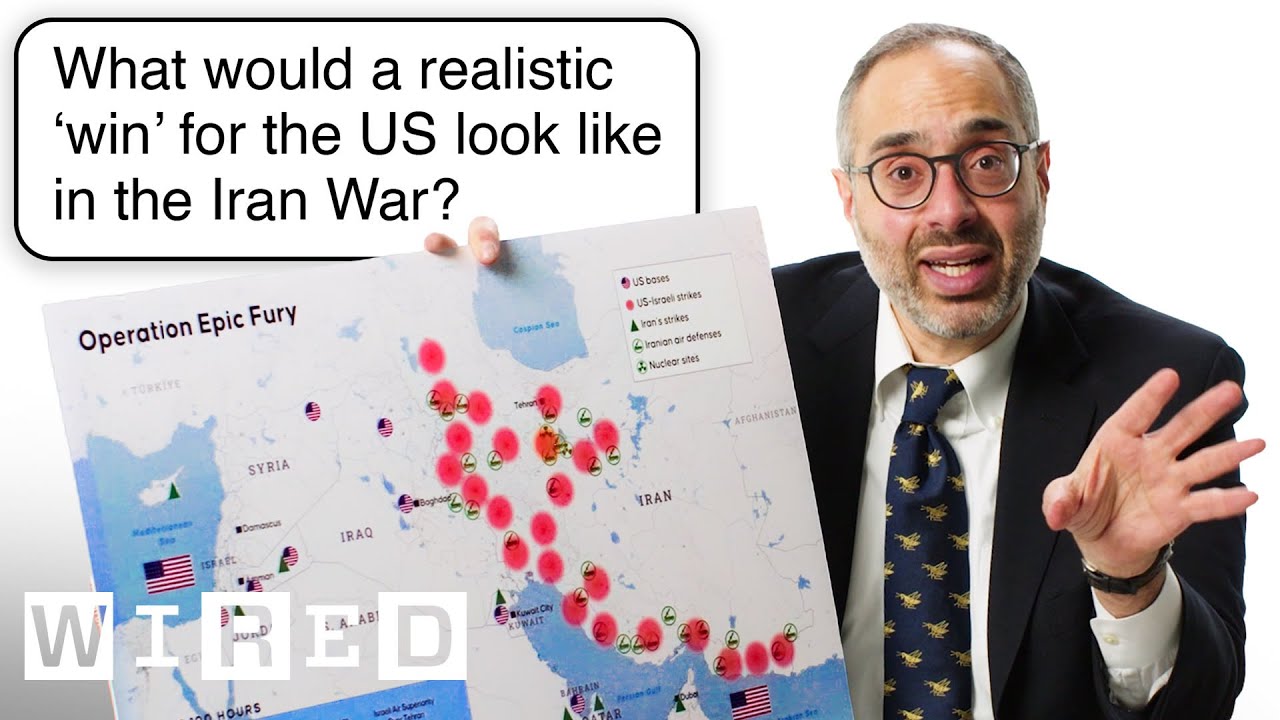
What would a realistic ‘win’ for the US even look like in the Iran war?
Defining a realistic "win" for the US in a conflict with Iran is challenging. Some define it as ending Iran's nuclear program, which would require locating the enriched uranium. Others define it as replacing the current regime with a more US-friendly one, which would require a sustained military engagement. For Iran, survival is a low bar for victory.
Why is Iran bombing seemingly completely unrelated countries?
Iran has been launching missiles and drones at various countries, including Israel, Kuwait, Bahrain, Qatar, the UAE, Oman, and Saudi Arabia. Iran claims it is targeting American facilities in those countries to raise the cost of the war and pressure the US into negotiating a deal. The UAE has taken more fire than Israel due to its importance as an economic hub. Despite these attacks, many of these countries have called for restraint and have not openly joined the US and Israeli war effort.
If President Trump ordered a ground invasion of Iran, would it be a long war or an easy victory?
A limited US ground invasion of Iran to seize enriched uranium or take Kharg Island would be difficult but not necessarily lead to a prolonged conflict. However, a ground invasion aimed at regime change would likely result in a long war, similar to those in Afghanistan and Iraq. The Islamic Revolutionary Guard Corps is a capable fighting force, and the reaction of the Iranian people to a US invasion is uncertain.
Do Saudi Arabia and Iran hate each other?
Prior to the current conflict, Saudi Arabia and Iran had a reasonably decent relationship, restoring diplomatic ties in 2023 with Chinese mediation. However, underlying tensions exist due to competition for regional hegemony, economic rivalry as major oil producers, and ideological differences. Saudi Arabia follows a Sunni Islam that views Iranian Shia Islam as heresy, and Iran's revolutionary ideology clashes with Saudi Arabia's conservative monarchy. The Saudis have historically been pro-American, while Iran leads an axis of resistance against the US. Now that Iran has hit targets in Saudi Arabia, the Saudis are reportedly urging the US to eliminate Iran.
Explain like I’m five: who is Hezbollah?
Hezbollah is a militia and political party in Lebanon, established in 1982 with Iranian support to protect Lebanese Shiites and push out Israel. It has become a capable military force, involved in conflicts against Israel and supporting the Assad regime in Syria. There are reports that they trained Hamas. They have launched rockets into Northern Israel, causing evacuations. Hezbollah is a key organisation in Iran's network of proxies. However, recent events have significantly weakened Hezbollah, with Israeli actions leading to the deaths of key leaders and an invasion of Lebanon aimed at eliminating the group.
Why does Iran hate the USA and Israel?
Iran's animosity towards the US stems from the US's support for the Shah and its involvement in a 1953 coup. They also hate the US because of its support for Israel, which Iran views as occupying Muslim land and oppressing Palestinians. This issue is significant to the Iranian regime, as demonstrated by the naming of the IRGC's special forces as the Quds Force (Jerusalem Force) and the annual Quds Day rally. Iran's concern for Israel is driven by a pan-Islamic ideology and a desire to appeal to the Arab street in its campaign for regional influence.

