
Brief Summary
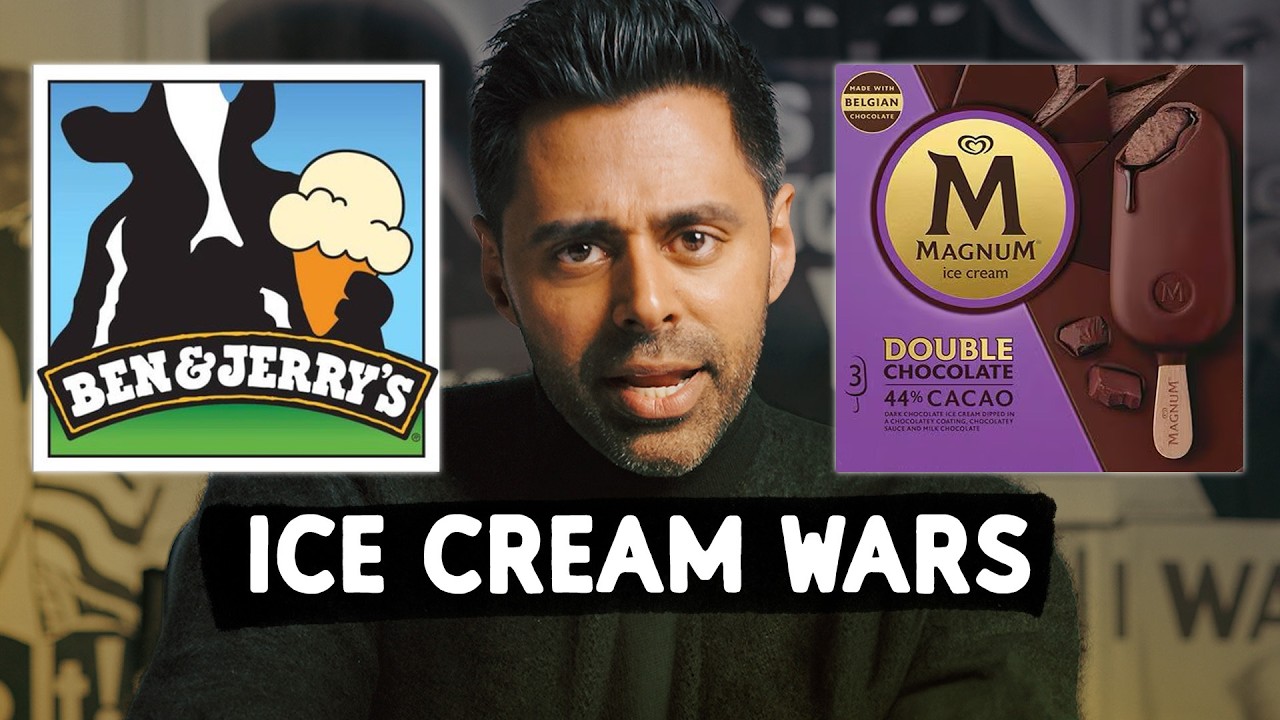
This episode features Hasan Minhaj interviewing Ben Cohen, co-founder of Ben & Jerry's, about the brand's activism, its clashes with corporate parent Magnum (formerly Unilever), and Cohen's personal activism against the military-industrial complex. They discuss corporate values, the challenges of maintaining a social mission under corporate ownership, and the political polarisation affecting business. Cohen shares his views on military spending, US foreign policy, and the importance of grassroots activism.
- Ben & Jerry's struggles to maintain its social mission under corporate ownership.
- Cohen's activism against military spending and US foreign policy.
- The importance of public awareness and grassroots movements for social change.
Opening Monologue
Hasan Minhaj introduces Ben Cohen, co-founder of Ben & Jerry's, highlighting the brand's history of supporting progressive causes, from marriage equality and trans rights to indigenous and Palestinian rights. Minhaj explains that Ben & Jerry's was sold to Unilever in 2000, with an agreement to maintain a firewall between Unilever and the Ben & Jerry's board, allowing them to take political positions freely. However, this changed in 2021 when Ben & Jerry's announced it would end sales in the occupied West Bank, leading to clashes with Unilever, who eventually spun off its ice cream business into Magnum ice cream company. Jerry Greenfield resigned in protest, and Ben Cohen has launched the "Free Ben & Jerry's" campaign to advocate for the brand's independence.
Corporate values
Ben Cohen discusses the importance of incorporating values like caring for the oppressed, welcoming strangers, and feeding the hungry into business practices. He argues that businesses can thrive while upholding these values, contrary to the notion that capitalism and virtue are incompatible. Cohen emphasises that integrating social concerns into business operations makes the experience more meaningful and motivating for employees and customers, fostering a strong bond based on shared values.
The swing right
Cohen reflects on the corporate response to George Floyd's murder in 2020, noting the initial wave of statements and commitments to DEI initiatives. However, he expresses cynicism towards the subsequent rollback of these programs, particularly with the rise of political polarisation. Cohen believes the country is more divided than ever, with political leaders exacerbating the divide. He suggests that Magnum Corporation is aligning with certain political trends, making it harder for Ben & Jerry's to maintain its social stance.
Subverting the org chart
Minhaj discusses the legal framework created during Unilever's acquisition of Ben & Jerry's in 2000, which guaranteed the independent board of directors the authority to take political stances. Cohen explains that this framework was designed to protect the social mission of Ben & Jerry's, giving the board legal authority over the social mission, product specifications, ice cream quality, trademark use, and marketing. This was in response to concerns that the acquisition would compromise the company's values.
The P word
The conversation shifts to the challenges Ben & Jerry's faced when addressing the Israeli-Palestinian conflict. Cohen explains that the board felt selling ice cream in the occupied Palestinian territories went against the company's values, as it supported the mistreatment of people living there and the illegal occupation. Despite initial agreement from Unilever to pull products from the West Bank, the head of Unilever allegedly reversed the decision after pressure from Israeli officials, leading to a lawsuit by the Ben & Jerry's board and subsequent muzzling of the brand on various social issues.
Ben Cohen’s arrest for protesting the genocide in Gaza
Minhaj shows footage of Ben Cohen's arrest at a Senate hearing while protesting Israel's Gaza blockade. Cohen explains that he felt compelled to act after reading about the US providing weapons to Israel and the lead poisoning outbreak in US cities. Frustrated by the allocation of resources towards military spending instead of addressing domestic issues, he decided to protest, highlighting the need to prioritise human welfare over war.
freebenandjerrys.com
Cohen discusses Jerry Greenfield's resignation following the sale to Magnum, emphasising their continued friendship and shared belief that Ben & Jerry's social mission could not survive under Magnum's ownership. He explains the purpose of freebenandjerrys.com, which calls for socially conscious investors to acquire Ben & Jerry's and allow it to operate independently. Cohen stresses that public involvement is crucial to pressure Magnum into selling the brand, arguing that Magnum is destroying the values-led business model that made Ben & Jerry's successful.
Dunking on the Pentagon budget
Minhaj and Cohen discuss their shared passion for critiquing the military-industrial complex. Cohen shares a video illustrating the federal discretionary budget, using Oreos to represent the vast amount spent on the Pentagon compared to smaller allocations for education, renewable energy, and social programs. He criticises the callousness of prioritising military spending over addressing issues like starvation, preventable diseases, and lack of access to child care and healthcare.
Know Your Empire!
Minhaj engages Cohen in a game of "Know Your Empire," quizzing him on the extent of US military presence around the world. They discuss the number of US military bases in other countries (approximately 800), the number of countries with US troops stationed (approximately 175), and the number of countries the US is in active armed conflict with (four to six). Cohen argues that these bases are used to dominate and control the world through military force, criticising US foreign policy and the pursuit of a unipolar world.
What is the purpose of NATO?
Cohen discusses the purpose of NATO, originally formed to protect Western Europe from the Warsaw Pact. He argues that NATO should have been disbanded after the dissolution of the Soviet Union, but it still exists and acts as a nuclear war tripwire. Cohen defends Ben & Jerry's tweet calling for de-escalation and peace in the context of the Russia-Ukraine conflict, despite accusations of being an appeaser. He advocates for a negotiated peace agreement to avoid further loss of life and destruction.
50,000 BBs and The Golden Dome
Cohen presents a visual demonstration of the US nuclear arsenal, using 50,000 BBs to represent the capacity to kill everyone on Earth. He criticises the amount spent on nuclear weapons per minute ($100,000) and questions the logic of prioritising offensive capabilities over defensive measures. They discuss the "Golden Dome" initiative, a proposed space-based missile defence system, with Cohen dismissing it as a physically impossible fantasy akin to Ronald Reagan's "Star Wars" program.
Bernie Sanders & Vermont
The conversation shifts to Bernie Sanders and the political climate in Vermont. Cohen reflects on his and Jerry's early support for Sanders, attributing Vermont's progressive values to its small size, rural mentality, and connection to nature. He believes Sanders could have won the 2016 election if the DNC had supported him more, noting the similarities between Sanders' and Trump's messages about corporate and economic inequality. Cohen expresses disillusionment with the Democratic Party, viewing it as calcified and prioritising the interests of corporations and the wealthy over everyday people.
A man with a teaspoon
Minhaj asks Cohen if he feels hopeful or hopeless about the future. Cohen shares a story about Pete Seeger witnessing people using teaspoons to fill a bucket on a seesaw, despite the bucket having holes. The moral of the story is that even small efforts contribute to a larger cause, and persistence can eventually lead to significant change. Cohen affirms his commitment to fighting for justice, viewing himself as "a guy with a teaspoon" contributing to a collective effort.
Future generations saved, brought to you by Oreos #FuckRaytheon
Cohen uses Oreos to visually represent the disparity between military spending and social programs. He demonstrates how a small fraction of the military budget could fund Medicaid for everyone in the country, end homelessness, provide universal pre-kindergarten, and eliminate lead poisoning. Cohen contrasts this with the much smaller amounts spent by countries like China, Russia, and Iran on their militaries, advocating for a shift in priorities towards helping people and improving society.

