
Brief Summary
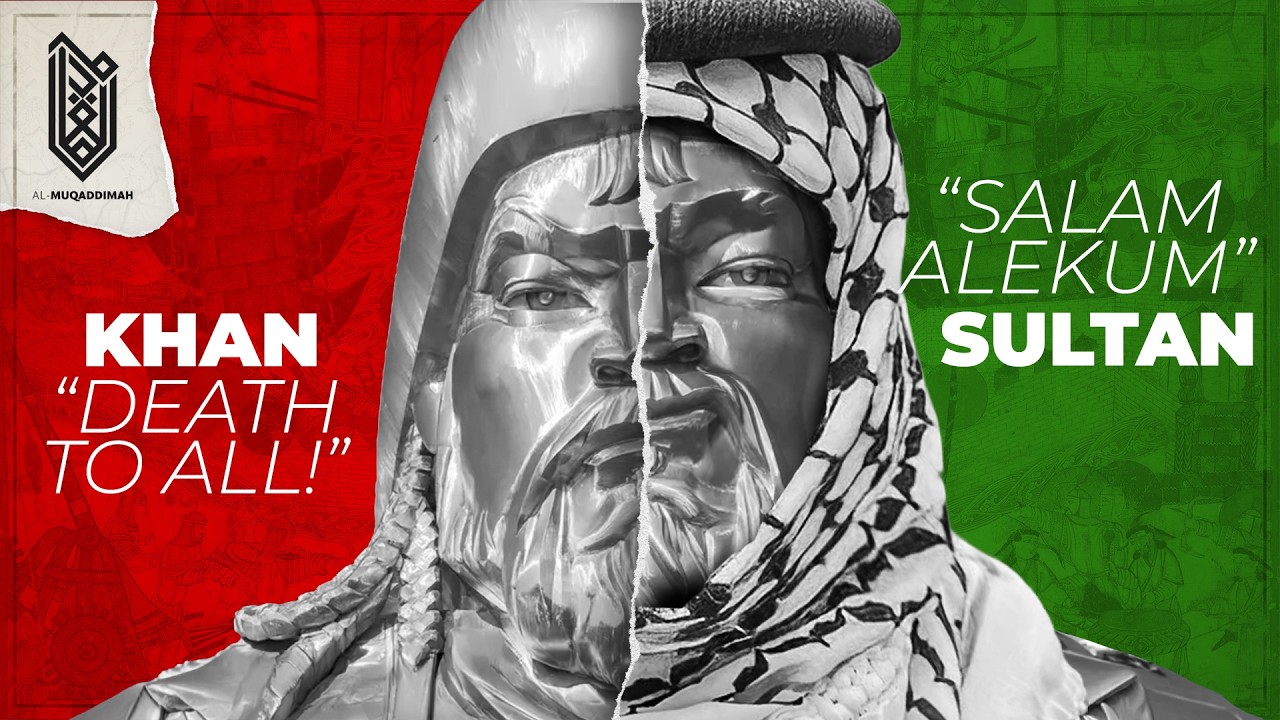
This video explores the fascinating transformation of Mongol conquerors into Muslim rulers and a central part of Islamic history. It details how, despite initially being seen as a "punishment of God" for Muslim sins, the Mongols and their successor states embraced Islam within a century.
- The Mongols' policy of religious tolerance and the influence of Sufism played key roles in this conversion.
- The Ilkhanate, the Golden Horde, and the Chagatai Khanate each had unique paths to Islamisation, with varying degrees of success and challenges.
- This conversion marked a significant shift in Islamic history, moving from Arab dominance to a more diverse Turo-Mongol-Persian influence.
Intro
The video introduces the story of how the Mongol conquerors, once seen as a divine punishment by Muslims, eventually converted to Islam. It highlights a speech by Ghengis Khan after conquering Bukhara, where he declared himself as God's punishment for the sins of the people. The video will explore how the successors of Ghengis Khan, despite his own beliefs, became Muslim rulers and integrated into Muslim society. The narrator also addresses the pronunciation of names, opting for Persian pronunciations due to Persian's dominance in many Mongol courts, while acknowledging a slight Urdu influence.
A House United
Even before the widespread conversion, Muslims held significant positions within the Mongol Empire, with some among Ghengis Khan's closest companions. Many Turkish peoples in the Central Asian steppes were already Muslim and joined the Mongol ranks. Early Mongol rulers employed Muslim vassals, administrators, and viziers, and resettled Muslim artisans across their empire, supporting a Muslim diaspora with mosques built as far as China and Tibet. While the Mongols were generally tolerant of all religions, Islam was not the only one with influence. Kublai Khan, for example, banned halal slaughter in China. As more Mongols converted, inter-religious conflicts arose, intersecting with debates over Mongol traditional law (Yassa) and Islamic law (Sharia). The Islamisation process began with rank-and-file soldiers and lower nobility, facilitated by Turkic and Iranian Muslims in the Mongol army and the policy of religious tolerance. Sufism significantly influenced the spread of Islam among the Mongols, with Sufi sheikhs playing a key role in the conversion of Mongol Khans.
The Ilkhanate
The Ilkhanate experienced several false starts in its conversion to Islam. Ahmed Tagdar was the first Ilkhan to convert to Islam, but he was overthrown by his Buddhist brother, Arun Khan. Geikhatu Khan attempted to introduce Chinese-style paper money, which included the Shahada in Arabic, but this was unsuccessful. Ghazan Khan, after converting to Islam, became the first Muslim Ilkhan to establish Islam as the official state religion. He initially imposed restrictions on other religions, but later softened his approach. Ghazan also mixed Islamic and Mongol practices, leading to criticism from scholars like Ibn Taymiyyah, who viewed him as a false Muslim due to his adherence to the Yassa alongside Islamic practices. Ghazan's successor, Jaitu, was known for his frequent conversions to different religions, eventually becoming a Shia Muslim. Abu Sa'id, Jaitu's son, was the first Mongol ruler raised as a Muslim, and his reign saw the Ilkhanate become an overtly Islamic monarchy. However, Abu Sa'id died without heirs in 1335, leading to the collapse of the Ilkhanate.
The Golden Horde
Berke Khan was the first Mongol Khan of the Golden Horde to convert to Islam, accepting Islam in 1251 or 1252. He declared his fidelity to Islam to the Mamluk Sultan Babers. Despite Berke's conversion, he was succeeded by non-Muslim Khans. In 1312, Ozbeg Khan seized power and, with the help of Toka's former vizier, embraced Islam, eliminating several non-Muslim Mongol families. Ozbeg Khan is remembered as a strong leader who constructed a new capital at New Sarai and asserted the place of Islam in step society. He maintained elements of the Mongol Yassa, mixing them with Islamic Sharia. After Ozbeg Khan's death in 1341, all succeeding Khans of the Golden Horde were Muslim.
The Chagatai Khanate
The first Muslim Chagatai Khan was Moubarak Shah, who came to rule in 1252. However, he was overthrown and it wasn't until the 14th century that another Muslim ruler, Tarmashirin, came to power, establishing Islam as the religion of the dynasty and state in 1331. Tarmashirin likely became Muslim in Ghazna and was known for building mosques and madrasas. He was overthrown by anti-Muslim Mongols, leading to a religiously inflamed civil war. The eastern branch of the Chagatai Khanate, known as Moghulistan, continued to be ruled by Buddhist Khans until 1347 when Tughlugh Timur converted to Islam after promising a Sufi sheikh. Tughlugh Timur, along with Maana Arshiduin, publicly converted 160,000 Mongols to Islam.
Mongol Subjects
In Islamic lands, the now-Muslim Mongols integrated with Turkic and Iranian elites, becoming integral parts of Muslim society and state. Timur, also known as Tamerlane, claimed succession from Ghengis Khan and conquered an empire out of the successor states of the Ilkhanate. The Golden Horde persisted into the early modern period, breaking apart into smaller Tatar Muslim khanates. India came under the rule of Muslim Mongols, who were then called the Mughals. The Mongol invasions marked a watershed, shifting Islam from Arab dominance to Turo-Mongol-Persian dominance. The last direct descendant of Ghengis Khan to rule a part of the Islamic world was Sayyid Mir Muhammad Alim Khan, who ruled the Emirate of Bukhara and was overthrown by the Red Army in 1920.

