
Brief Summary
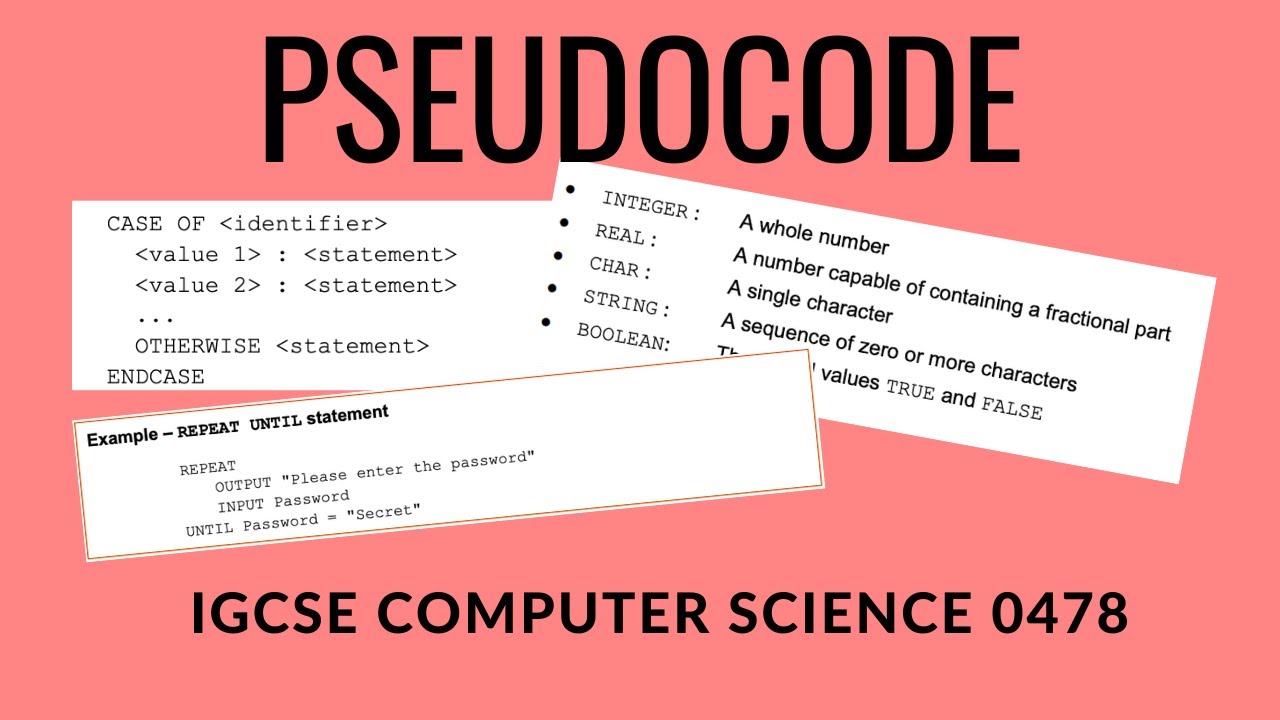
This video provides a comprehensive guide to understanding and writing pseudocode for the IGCSE computer science paper 2 exam. It covers the fundamental components of pseudocode, including syntax, data types, variables, constants, arrays, and control structures like if statements and loops. The video emphasises the importance of logic and efficiency in pseudocode, as well as adherence to specific rules regarding indentation, case, and keywords.
- Importance of pseudocode in IGCSE paper 2.
- Key components: font style, indentation, case, lines, comments.
- Data types: integer, real, char, string, Boolean.
- Identifiers: variables, constants, procedures, functions.
- Control structures: if statements, case statements, for loops, repeat until loops, while loops.
Introduction to Pseudocode
The video introduces pseudocode as a crucial element of the IGCSE computer science paper 2, noting that it constitutes a significant portion of the exam. Pseudocode is described as an english-like representation of code, simplifying complex lists into more manageable segments. The presenter highlights that IGCSE focuses on pseudocode rather than specific programming languages like Python or Java because pseudocode teaches the fundamental language applicable to various coding environments, which is more adaptable to the ever-changing landscape of programming.
Components of Pseudocode
This section details the essential components of pseudocode, as outlined in the IGCSE pseudocode guide. It begins with font style and size, emphasising that pseudocode appears in a mono-spaced font in exams, requiring fixed-width characters. Indentation is highlighted as crucial for defining code segments, with IGCSE recommending four spaces for indentation within statements and two spaces for continuation lines. The guide also covers case and italics, noting that keywords are in uppercase, while identifiers use mixed case (camel case). Line numbering is important for error location, and comments, indicated by a double slash (//), are used for code explanation, though not mandatory in IGCSE.
Variables, Constants and Data Types
The video explains atomic data types, which are fundamental categories for data in pseudocode. These include integer (whole numbers), real (decimal numbers), char (single characters), string (groups of letters), and Boolean (true or false values). The presenter explains the importance of specifying data types in programming to ensure the computer understands the type of value it will receive. Identifiers, which can be variables, constants, procedures, or functions, are also discussed. Variables are assigned values using an arrow (<-), and rules for naming variables are outlined, including the use of underscores for multiple words and adherence to camel case. Constants, unlike variables, remain unchanged throughout the program.
Arrays
Arrays are introduced as structured elements accessible by index, used for lists of data like names or scores. The video mentions one-dimensional (1D) and two-dimensional (2D) arrays. While array declaration isn't required in the IGCSE syllabus, understanding how to create and use arrays is important. Accessing an element within an array involves specifying the array name and its index (e.g., studentNames[1]).
Operations and Keywords
This section covers operations, starting with input and output, which involve entering and displaying values, respectively. Keywords, which must be in uppercase, are introduced, with the video directing viewers to a list of essential keywords and symbols in the IGCSE pseudocode guide. Arithmetic operations (addition, subtraction, multiplication, division) and logic operators (AND, OR, NOT) are also explained.
Selection and Statements
The video discusses selection statements, focusing on IF statements. The general structure of an IF statement is explained: IF condition THEN statement ENDIF. Nested IF statements, where an IF statement is placed within another, are also covered. CASE statements are presented as a way to execute different statements based on the value of a variable. The structure of a CASE statement involves specifying the variable and different values, each with a corresponding statement.
Loops
The video details different types of loops used in pseudocode. The FOR loop, a count-controlled loop, repeats a set number of times. The REPEAT UNTIL loop, a post-condition loop, continues executing until a specified condition is true. The WHILE loop, a pre-condition loop, executes as long as a condition remains true. The presenter emphasises the importance of understanding the structure and usage of each loop type.
Conclusion
In conclusion, the video reiterates the key elements of pseudocode, including keywords, identifiers, and loop structures. It directs viewers to the IGCSE pseudocode guide for further study and emphasises that while IGCSE prioritises logic over syntax, good syntax is important for clear communication. The video concludes with a promise of a follow-up video featuring practice questions to improve pseudocode skills.

