
Brief Summary
This video explores injury patterns in human movement, focusing on identifying types of injuries, their mechanisms, and movements leading to them, particularly in sports. It categorises injuries as acute traumatic or overuse injuries, detailing the causes, symptoms, and examples of each. The video also discusses various injury mechanisms, including biomechanical, training, environmental, and individual factors, highlighting the importance of proper form, adequate rest, and suitable training environments to prevent injuries.
- Acute injuries occur suddenly due to trauma, while overuse injuries develop from repetitive actions.
- Injury mechanisms include biomechanical factors like poor posture, training factors such as sudden increases in intensity, environmental factors like uneven surfaces, and individual factors like age and fitness level.
- Prevention strategies involve maintaining proper form, ensuring adequate rest, and training in suitable environments.
Introduction
The module will cover injury patterns, using previous knowledge of human movements and anatomy to understand how tissues can be injured. It will also explore basic strategies for injury prevention and rehabilitation. The video aims to identify different types of injuries and their causes, focusing on movement-related injuries in sports.
Acute Traumatic Injuries
Acute or traumatic injuries occur suddenly to previously normal tissue due to sudden trauma, with symptoms appearing almost immediately. These injuries happen when the force applied exceeds the strength of the tissue, such as muscles, ligaments, tendons, or bone, causing it to break down. Acute injuries can be direct (contact) or indirect (non-contact). Direct injuries involve a head-on collision or impact, while non-contact injuries occur when the site of force application is different from the site of injury, often due to poor biomechanics. A common example of a non-contact injury is an ACL tear, which can result from poor movement patterns that overstress the ligament. Other examples of acute injuries include ankle sprains and shoulder dislocations, the latter being common due to the shoulder's instability.
Overuse Injuries
Overuse injuries are caused by repetitive actions, where the tissue is repeatedly stressed. At a microscopic level, the tissue adapts to this stress and recovers in a stronger condition, such as bone density increasing with repeated impact or muscle tissue repairing and thickening. However, insufficient recovery time between workouts can lead to overuse injuries, as the tissue hasn't recovered from previous stresses. These injuries develop over time and may not be immediately evident. Poor posture during movement can also cause overuse injuries by using muscles not designed for those loads, leading to compensatory actions. Proper form and adequate rest are crucial to allow tissue recovery and adaptation. Examples of overuse injuries include stress fractures, tendinopathy, ligament micro-tears, fasciitis, bursitis, and neuropathy.
Injury Mechanisms
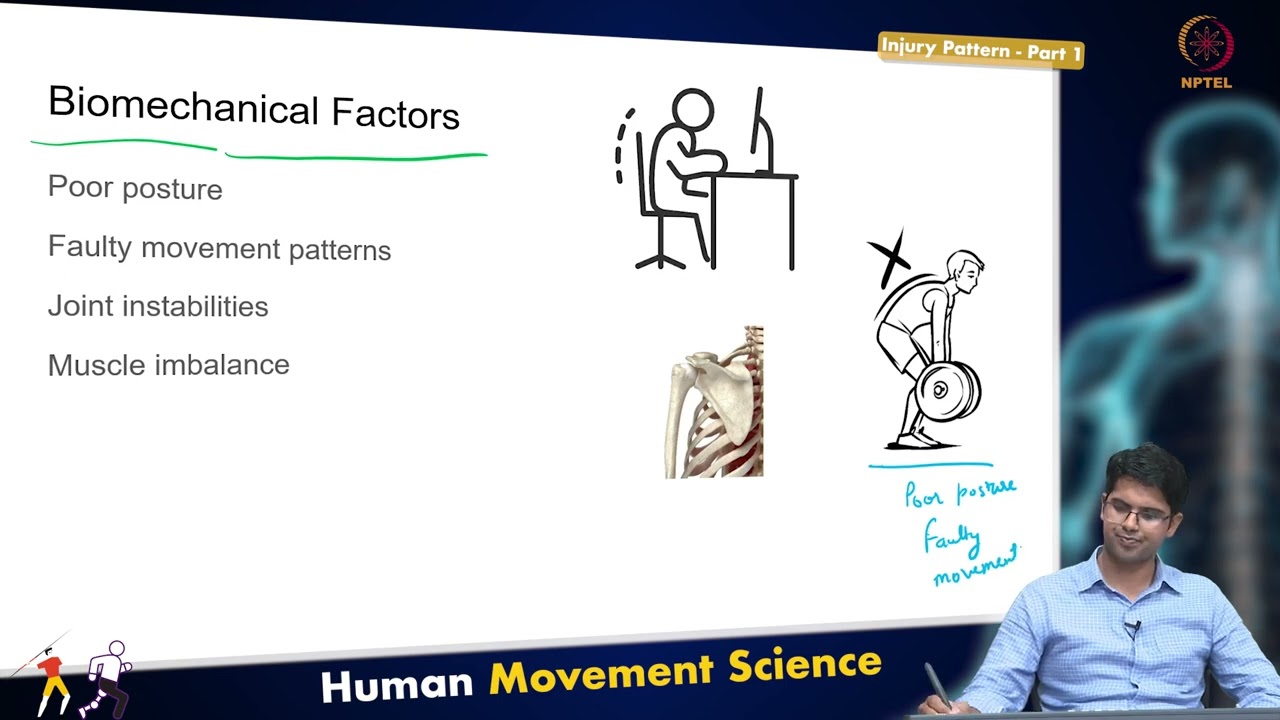
Injury mechanisms include biomechanical factors, such as poor posture and faulty movement patterns, which can cause muscle overstrain and permanent tissue changes. Poor posture can lead to muscle imbalances, where some muscles become contracted while others expand, increasing the risk of injury during activities like deadlifts. Joint instabilities, particularly in the shoulder, can also contribute to injuries due to imbalances in muscular tissue, tendons, and ligaments. Training factors, such as sudden increases in training intensity or volume and inadequate rest, can lead to overuse injuries. Environmental factors, like uneven surfaces or rigid pavements, and damaged equipment can also cause injuries.
Individual Factors
Individual factors that contribute to injuries include age, with younger athletes generally having better recovery rates, and gender, where female athletes have a higher propensity for ACL injuries due to different muscle recruitment patterns. Fitness level also plays a role, as attempting high-intensity activities without proper conditioning can lead to both stress and acute injuries. A previous injury history can increase the risk of repeated injuries in the same area, and genetic predispositions can also influence the types of injuries that occur.

