
Brief Summary
This video provides an overview of key ecological concepts, including definitions of terms like ecosystem, biosphere, biota, carrying capacity, biotic potential, keystone species, ecotone, and ecological niche. It also discusses the factors influencing ecosystem stability, energy flow, and the impact of climatic factors such as sunlight, temperature, and rainfall on plant communities.
- Ecosystems are self-maintained conditions.
- Climatic factors like rainfall significantly determine plant communities.
- Key ecological terms are defined, including carrying capacity and biotic potential.
Introduction to Ecology
The video begins with a general welcome, setting the stage for a discussion on ecology. It quickly transitions into defining core ecological terms and concepts, which form the foundation of understanding ecosystems and their functions.
Defining Key Ecological Terms
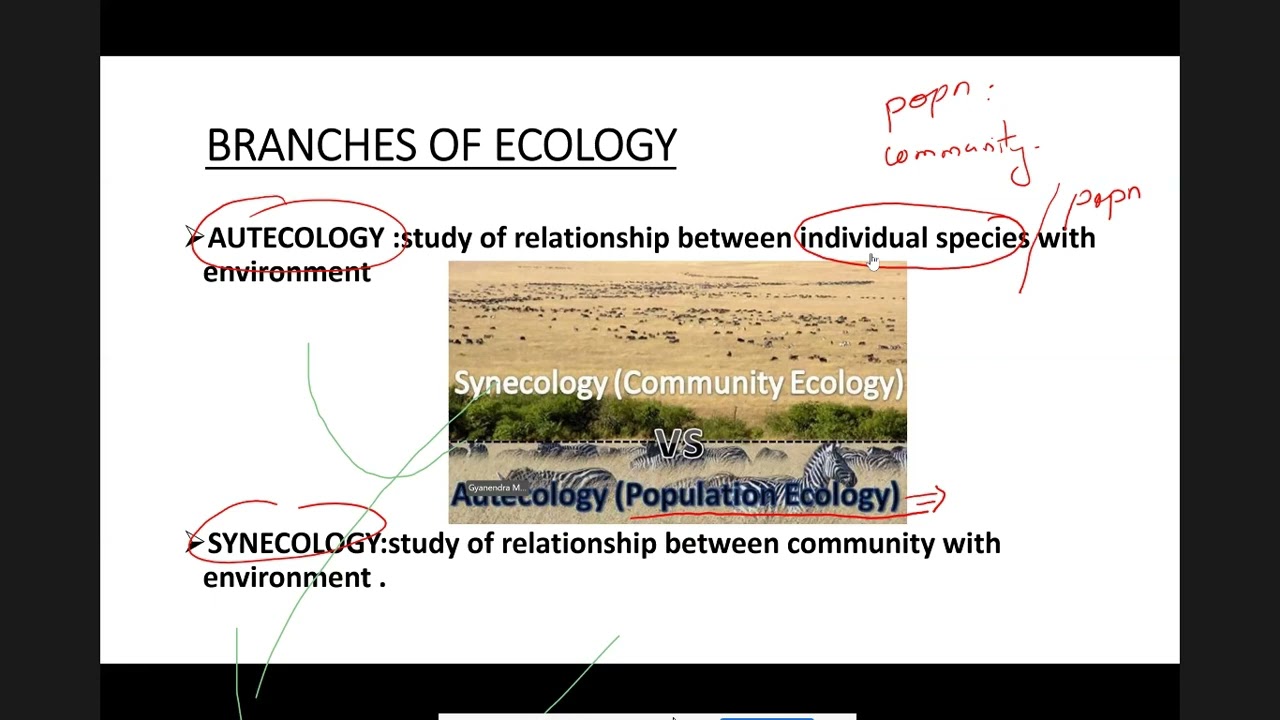
Several fundamental ecological terms are defined. The term "ecology" is derived from the Greek word "oikos". The video defines key terms such as population (a collection of individuals of the same species), community (a collection of different species), biome (a large landscape with similar environmental conditions), and biosphere (the total area occupied by living beings). The biosphere includes the hydrosphere, atmosphere, and lithosphere. Biota is defined as the living beings of a particular area.
Terrestrial Ecosystems and Biomes
The discussion moves to terrestrial ecosystems, mentioning examples such as the taiga and tropical rainforests, including the Amazon rainforest in South America.
Carrying Capacity and Biotic Potential
The video defines carrying capacity as the maximum number of individuals of a species that an ecosystem can support for a healthy life. Biotic potential is described as the natural capacity of a species to reproduce under ideal conditions.
Keystone Species and Endemic Species
A keystone species is defined as a species that has a disproportionately large effect on its environment relative to its abundance. Predators or tertiary consumers are often keystone species. An endemic species is restricted to a particular area.
Ecotone Definition
An ecotone is a transition area between two different ecosystems. An example of an ecotone is where a river meets the ocean (estuary).
Ecological Niche
The ecological niche is the role of a species in the environment. No two species can occupy the same ecological niche. The niche includes the physical space a species occupies and its role in the community.
Ecosystems: Structure and Function
An ecosystem is a self-maintained condition. The concept of the ecosystem was introduced by A.G. Tansley. An ecosystem has both structural (abiotic and biotic factors) and functional aspects (energy flow and nutrient cycling). Ecosystems are mainly concerned with the flow of energy and the recycling of materials.
Ecosystem Stability and Diversity
Ecosystem stability is related to diversity. Artificial ecosystems are generally unstable. Tropical rainforests exhibit maximum stability, biodiversity, annual rainfall, productivity, and stratification.
Energy Flow in Ecosystems
The flow of energy in an ecosystem is unidirectional, while biogeochemical cycles (water, carbon, nitrogen) are cyclic or multi-directional.
Micro and Macro Ecosystems
The video touches on the concept of ecosystem size, differentiating between micro-ecosystems (like a pond) and macro-ecosystems (like a forest or tropical rainforest).
Climatic Factors: Sunlight and Solar Energy
Climatic factors, including sunlight, heat, temperature, humidity, and pressure, are discussed. Light is a form of energy that is converted into chemical energy through photosynthesis. Sunlight is crucial for ecosystems.
Temperature as a Climatic Factor
Temperature is another key climatic factor. Organisms can be classified based on their tolerance to temperature ranges: stenothermal (narrow range) and eurythermal (wide range).
Rainfall and its Influence
Rainfall is a critical climatic factor that mainly determines the natural plant community.

