
Brief Summary
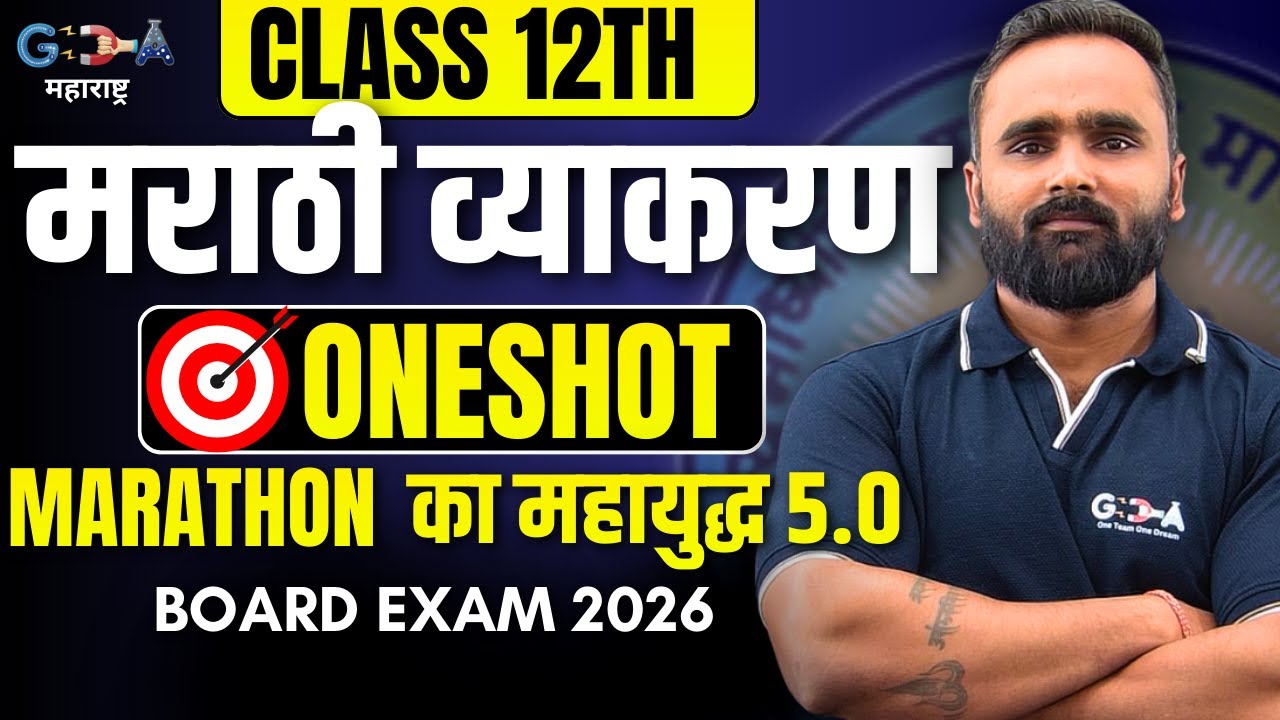
This YouTube video by Pradeep Giri 11th and 12th Academy features a comprehensive Marathi grammar lesson led by Aditi Singh. The session covers essential topics such as sentence transformation, समास (compounds), प्रयोग (voice), अलंकार (figures of speech), and वाक्यप्रचार (idioms). Aditi employs simple explanations, tricks, and interactive games to help students understand and remember key concepts, aiming to equip them with the tools to score full marks in their exams.
- Sentence transformation involves changing sentence types without altering their meaning.
- Samas (compounds) involves joining two words, each with its own meaning, to form a new word.
- Prayog (voice) has three types: kartari, karmani and bhave.
- Alankar (figures of speech) involves giving a comparison to something.
- Vakya prachar (idioms) involves phrases with set meanings, used to enhance language.
Introduction
Pradeep introduces Aditi, a computer science professor and subject matter expert, who will be teaching Marathi grammar. He encourages viewers to share the content widely and support the initiative. The aim is to alleviate students' exam stress by providing comprehensive coverage of the Marathi syllabus, including marathon sessions before exams. Notes will be available via a link in the description, and viewers are encouraged to scan a QR code for access.
Marathi Grammar Basics
Aditi begins her lesson by greeting the students and expressing her excitement. She explains that Marathi grammar constitutes ten marks in exams and promises to simplify the concepts. The session aims to cover the entire grammar syllabus gradually, with a full session planned if the initial response is positive.
Sentence Transformation (Vakya Rupantar)
Aditi explains that sentence transformation involves changing the structure of a sentence without altering its meaning. She introduces four types of sentences: declarative (vidhanarthi), interrogative (prashnarthi), exclamatory (udgarthi), and imperative (agnyarthi). She uses examples to illustrate each type, highlighting the importance of correct spelling and punctuation to score full marks.
Types of Sentences
Aditi explains each type of sentence in detail:
- Declarative (Vidhanarthi): A simple statement providing information.
- Interrogative (Prashnarthi): A question, always ending with a question mark.
- Exclamatory (Udgharthi): Expressing strong emotion, marked by an exclamation point.
- Imperative (Agnyarthi): Giving an order or command, often ending with an "a" sound.
She also covers affirmative (hokararthi) and negative (nakararthi) sentences, explaining how to transform between them by using opposites and the word "nahi" (not).
Practice and Application of Sentence Transformation
Aditi explains that exam questions will involve transforming sentences from one type to another. She provides examples and uses tricks to identify and apply the correct transformations, such as associating imperative sentences with the "a" sound and exclamatory sentences with the word "khup" (very).
Introduction to Samas (Compounds)
Aditi introduces the concept of Samas, explaining that it involves joining two words to form a new word. She defines "samasik shabd" as the compound word formed by joining two words and "vigraha" as the process of breaking down the compound to understand its meaning.
Types of Samas
Aditi outlines the four main types of Samas:
- Avyayi Bhav Samas: The first word is more important.
- Tatpurush Samas: The second word is more important.
- Dwandwa Samas: Both words are equally important.
- Bahuvigrahi Samas: Both words are descriptive, forming a new word with a different meaning.
She explains each type with examples, emphasising the importance of correct spelling.
Detailed Explanation of Tatpurush Samas
Aditi explains that Tatpurush Samas has three sub-types:
- Vibhakti Tatpurush Samas: Joining words by omitting a preposition.
- Karmadharaya Tatpurush Samas: One word is an adjective, and the other is a noun.
- Dwigu Tatpurush Samas: The first word is a number.
She provides examples for each sub-type to clarify the concepts.
Dwanda Samas and Bahuvigrahi Samas
Aditi explains the three sub-types of Dwanda Samas:
- Itretar Dwanda Samas: Joining words using "aani" (and) or "va" (and).
- Vaikalpik Dwanda Samas: Joining words using "kiwa" (or) or "athwa" (or), often involving opposites.
- Samahar Dwanda Samas: Using "vagere" (etc.) or "itar" (other) to indicate a collection of things.
She then explains Bahuvigrahi Samas, where the compound word refers to something else entirely, providing the example of "Lambodar" (Ganesha).
Samas Examples and Practice
Aditi provides several examples of Samas and asks viewers to identify the type in the comments. She explains the reasoning behind each answer, reinforcing the concepts.
Introduction to Prayog (Voice)
Aditi introduces Prayog (voice) and its three types:
- Kartari Prayog: Simple, straightforward sentence.
- Karmani Prayog: One word is changed.
- Bhave Prayog: Two words are changed.
She uses the "0 + 1 + 2" trick to help students remember the differences.
Prayog Examples and Practice
Aditi presents several sentences and asks viewers to identify the Prayog. She explains the answers, reinforcing the "0 + 1 + 2" rule.
Introduction to Alankar (Figures of Speech)
Aditi introduces Alankar (figures of speech), explaining that it involves giving upma (comparison). She differentiates between upmey (the thing being compared) and upman (the thing it is being compared to).
Types of Alankar
Aditi covers four types of Alankar:
- Ananvay: Comparing something to itself.
- Apahnuti: Denying something and then comparing it to something else.
- Atishayokti: Exaggeration.
- Arthantaranyas: Supporting a statement with another statement.
She provides examples for each type, using humour to make the concepts memorable.
Alankar Examples and Practice
Aditi presents sentences and asks viewers to identify the Alankar. She explains the answers, reinforcing the concepts.
Vakya Prachar (Idioms)
Aditi introduces Vakya Prachar (idioms), explaining that students need to write both the meaning and a sentence using the idiom, with correct spelling. She provides examples and emphasises the importance of using the idiom itself in the sentence, not just its meaning.
Vakya Prachar Examples and Conclusion
Aditi concludes the session, recapping the topics covered and thanking the viewers for their participation. She mentions that notes are available via a QR code and promises more sessions on important topics, including writing skills.

