
Brief Summary
The video discusses the withdrawal of Mercedes-Benz from its joint venture in Beijing, triggered by the Chinese government's demand to appoint a Communist Party committee secretary to the company's board of directors. This decision highlights the clash between Western corporate governance and China's increasing political control over businesses. The video also touches upon the broader implications of this event, including the impact on local tax revenue and employment, the changing dynamics of foreign investment in China, and the geopolitical tensions influencing business decisions.
- Mercedes-Benz shut down its Beijing factory due to demands for Communist Party influence in corporate governance.
- The withdrawal reflects broader geopolitical tensions and China's economic slowdown.
- Germany's shifting stance on China, influenced by technology disputes and the Russia-Ukraine war, played a crucial role in Mercedes-Benz's decision.
Mercedes-Benz Shuts Down Beijing Factory
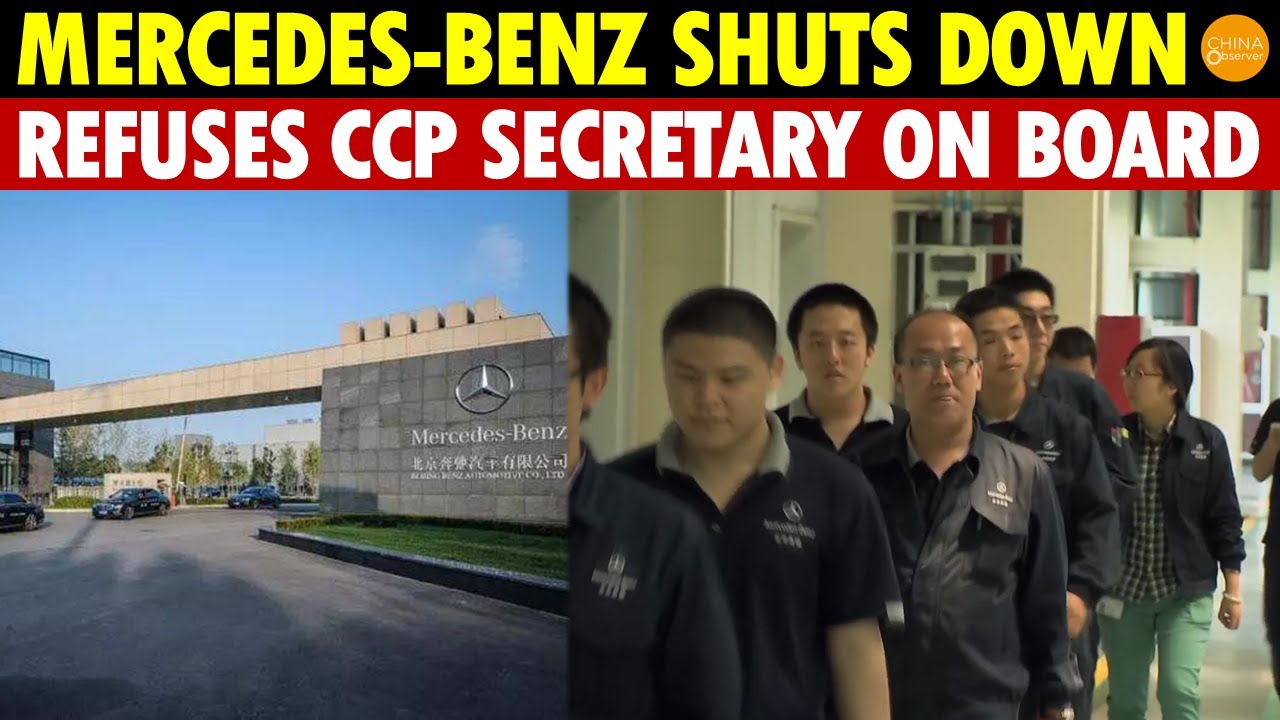
Mercedes-Benz has shut down its factory in Beijing, with over 3,000 workers returning home. This closure was prompted by the Chinese partner's insistence on appointing a Communist Party committee secretary to the company's board of directors, which Mercedes-Benz viewed as an unacceptable intrusion into its corporate governance. The company chose to withdraw its investment rather than comply with this demand. This decision has sparked widespread discussion about the implications of foreign companies operating in China and the conditions they face.
Impact of Mercedes-Benz's Departure
The departure of Mercedes-Benz has left many workers frustrated, as they now recognise the superior employment standards previously offered by the foreign-invested company, such as overtime pay and full social insurance contributions. The closure is expected to cause a significant drop in tax revenue for the Shuni district, estimated to be at least 1 billion UN, and will negatively affect local businesses that relied on the factory. This situation has drawn comparisons to other instances of foreign companies leaving China, highlighting the loss of fair labour practices and standards.
Clash of Corporate Governance and Political Influence
Beijing Mercedes-Benz was once considered a model of Sino-German cooperation, but this changed when Chinese authorities began enforcing full party coverage in all enterprises. The demand to establish a trade union and appoint a party branch secretary to the board was rejected by the German side as interference in management and a violation of the original agreement. Mercedes-Benz ultimately decided to withdraw rather than surrender control, viewing the demand as a threat to its global corporate governance, potentially leading to compliance fractures, leakage of critical technology, and undermining shareholder interests.
Broader Geopolitical and Economic Context
Analysts see Mercedes-Benz's decision as part of broader geopolitical tensions and China's economic slowdown. The global automotive market is projected to remain sluggish, with luxury car sales in China declining. Domestic competitors like BYD are gaining market share, while Mercedes-Benz has reported a drop in net profit and revenue from China. These pressures, combined with the enforcement of party building policies, contributed to the company's decision to exit the Beijing joint venture.
Historical Overview of Beijing Mercedes-Benz
Established in 2005, Beijing Mercedes-Benz was a joint venture among BAIC Group, Daimler AG, and Daimler Greater China Investment Company. It grew into one of Mercedes-Benz's largest production bases, operating three main production platforms and even exporting engine components back to Germany. By 2022, its annual industrial output value topped 200 billion yen, accounting for a significant portion of Mercedes-Benz's global production capacity. However, starting in 2023, the company's performance began to decline, with sales dropping sharply amid broader economic challenges and increasing competition.
China's "Overtaking on a Bend" Strategy
The Chinese government's imposition of unpopular measures on foreign companies is seen as part of its "overtaking on a bend" strategy. This involves long-term infiltration, cultivating influence, acquiring technology, securing control of critical supply chains, and ultimately moving in for outright dominance. The demand to place a party committee secretary on the board of Beijing Mercedes-Benz represents the final phase of this approach, based on the belief that Mercedes-Benz can no longer function without the Chinese market.
Mercedes-Benz's Investment and the Subsequent Demand
Despite Mercedes-Benz's strong brand advantage in China, the company faced increasing pressure from authorities. In 2025, Mercedes-Benz announced a significant investment in China, signalling its reliance on the Chinese market. Shortly after this commitment, authorities demanded the appointment of a party committee secretary to the board, a move seen as deliberate timing to exploit the company's vulnerability. However, unforeseen developments, including China's economic downturn and geopolitical shifts, altered the landscape.
Shifting Geopolitical Landscape and Germany's Response
China's economic challenges, coupled with trade tensions and its support for Russia in the Ukraine war, have led to a reassessment of relations between Germany and China. The conflict in Ukraine has compelled Germany to reassess the post-war global order, placing European firms like Mercedes-Benz in a precarious position. The potential for re-entering the European market, including Russia, has become a pressing goal, potentially offsetting revenue lost in China.
Technology Disputes and Supply Chain Concerns
The long-running clash between China's Wingtech and Dutch chipmaker Nexperia, with Germany at the centre, highlights concerns over technology transfers and supply chain vulnerabilities. The Dutch government's intervention to seize control of Nexperia, aimed at preventing the transfer of critical operations to China, underscores the risks to Europe's automotive supply chain and technological sovereignty. These moves threaten not only the supply chains of Germany's automotive industry but also the core industrial strengths of the German economy.
Future Outlook and China's Diplomatic Tactics
While the future of Mercedes-Benz in China remains uncertain, Germany's political and corporate leaders have undergone a profound transformation, fully grasping the intent behind China's maneuvers. China's diplomatic tactics, such as projecting an image of unbroken victory while employing pressure tactics, are likely being used to influence Mercedes-Benz executives. Despite potential obstacles, Germany stands ready to bear any cost to escape China's grasp, refusing to revive the worship of Marxism on its soil.

