
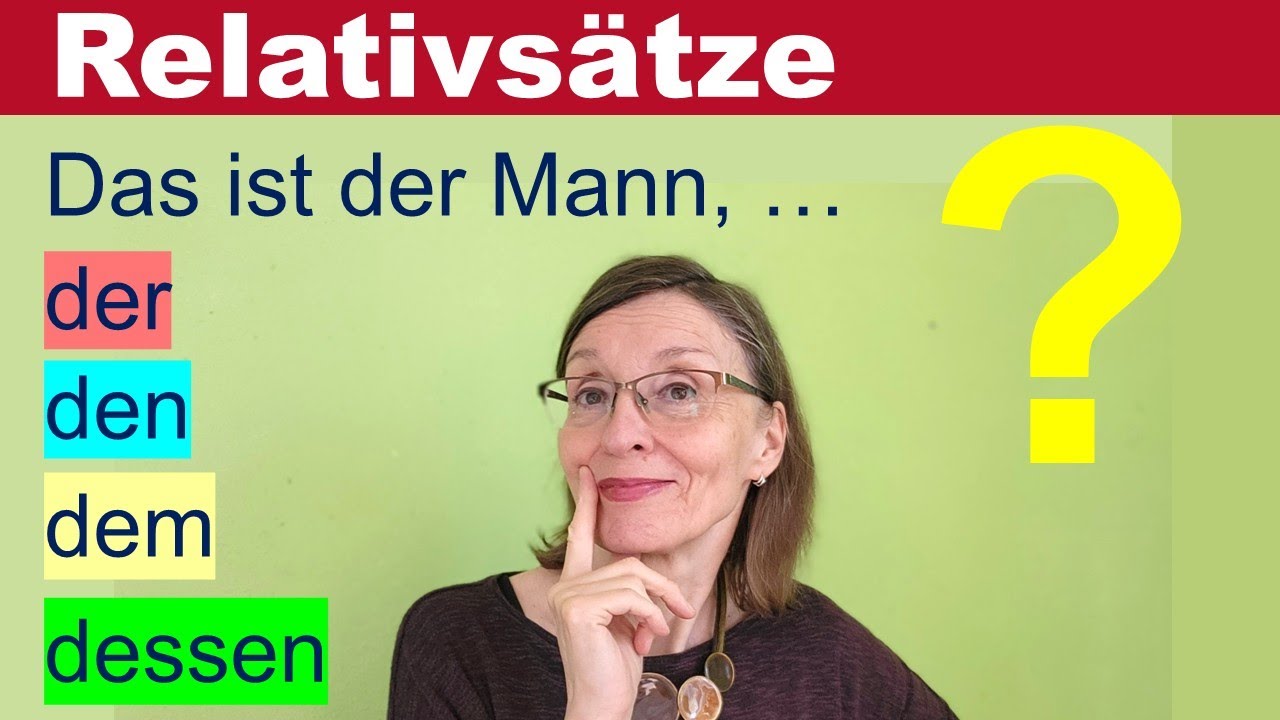
Brief Summary
This video provides a comprehensive guide to understanding and forming relative clauses in German. It covers the purpose of relative clauses, their structure, and how they function with different cases (nominative, accusative, dative, and genitive). The video includes numerous examples and practice exercises to reinforce learning.
- Relative clauses provide additional information about a noun.
- They are formed using relative pronouns that correspond to the case of the noun they modify.
- The verb in a relative clause is always at the end.
- The video covers nominative, accusative, dative and genitive cases.
Why Use Relative Clauses?
Relative clauses are used to provide more detail about a noun. Instead of using two separate sentences to describe a noun, a relative clause combines the information into one sentence. For example, instead of saying "He is visiting his girlfriend. His girlfriend works in Berlin," you can say "He is visiting his girlfriend, who works in Berlin." The clause after the comma is the relative clause, which explains the noun "girlfriend" in more detail.
How to Form Relative Clauses
Relative clauses are formed by placing a comma after the main clause, followed by a relative pronoun and the rest of the clause, with the verb at the end. The relative pronoun connects the relative clause to the main clause and refers back to the noun being described. The relative pronoun takes the form of the definite article, but its function is to connect the clauses. For example, "He visits his girlfriend, who works in Berlin." Here, "die" acts as a relative pronoun connecting the clauses.
Examples with Masculine, Neuter and Plural Words
The video provides examples using masculine, neuter and plural words to illustrate how relative clauses are formed with different genders and numbers. For masculine nouns: "That's the dog that barks very loudly." For neuter nouns: "She reads the book that is lying on the table." For plural nouns: "I know the girls who can dance very well." These examples demonstrate the consistent structure of relative clauses, regardless of the noun's gender or number.
Using Indefinite Articles and Possessive Pronouns
Nouns in the main clause can be used with indefinite articles or possessive pronouns. For example, "This is your son, who is studying in Vienna." Or, "Last year, a restaurant that only offers cold dishes won." Regardless of whether the main clause uses a definite article, indefinite article, or possessive pronoun, the relative pronoun in the relative clause always takes the form of the definite article. This is because it functions as a connector rather than an article.
Positioning Relative Clauses with Separable Verbs
When a separable verb is used, a verb or part of a verb can stand between the noun and the relative clause. For example, "He hangs up the laundry that has been collected for the children." Similarly, advertising phrases in the main clause usually appear directly after the noun. For modal verbs in different tenses: "We want to buy the game, which is very useful for children." "We bought the game, which is very useful for children." "We will buy the game, which is very useful for children."
Inserting Relative Clauses into the Main Clause
When more information is added, the relative clause needs to be brought closer to the noun it describes by incorporating it into the main clause. For example, instead of saying "The game that took place in the stadium yesterday was very exciting," the relative clause is inserted: "The game that took place in the stadium yesterday, was very exciting." Commas are placed around the relative clause to separate it from the main clause.
Cases in Main and Relative Clauses: Nominative, Accusative, Dative, Genitive
The noun in the main clause and the relative pronoun do not have to be in the same case. The video explains how to form relative clauses when the noun in the main clause is in the accusative, dative, or genitive case.
Accusative Case
When the noun in the main clause is in the accusative case, the relative pronoun still takes the form of the definite article, but it must agree in case. For example, "I see the man who is crossing the street." Here, "den Mann" is in the accusative case in the main clause, and "der" is the relative pronoun in the nominative case.
Dative Case
When the noun in the main clause is in the dative case, the relative pronoun takes the dative form. For example, "I'm giving the book to the colleague who is new to the company." Here, "dem Kollegen" is in the dative case, and "der" is the relative pronoun in the nominative case. In the dative plural, "denen" is used instead of "den" as the relative pronoun.
Genitive Case
The genitive case is more complex and typically used at a higher level of German. The relative pronouns in the genitive case are "dessen" for masculine and neuter nouns and "deren" for feminine and plural nouns. For example, "I like the house whose facade is painted green." Here, "dessen" indicates possession.
Summary of Relative Clauses
Relative clauses explain a noun in more detail and should be placed directly after the noun, except when verb parts or second verbs intervene. They are subordinate clauses, with the verb at the end, and the relative pronoun takes the form of the definite article in the appropriate case. If unsure of the correct relative pronoun, rephrase the relative clause into a main clause to determine the correct case.

