
Brief Summary
This video explains seafloor spreading and its connection to plate tectonics, highlighting evidence that supports the theory. It begins with Alfred Wegener's continental drift theory and then presents four key pieces of evidence for seafloor spreading: the geological features of the ocean floor, the age of seafloor rock, the thickness of sediment layers, and patterns of seafloor magnetism. The video details how these discoveries, often aided by wartime technology, confirmed that the seafloor is spreading, thus validating plate tectonics.
- The ocean floor has active geological features, not a flat desert.
- Rock age increases away from mid-ocean ridges.
- Sediment thickness increases away from mid-ocean ridges.
- Magnetic patterns on either side of ridges match.
Introduction to Seafloor Spreading and Continental Drift
The video introduces the concept of seafloor spreading as a key element of plate tectonics. It starts by referencing Alfred Wegener, a German meteorologist from the early 1900s, who proposed the idea of continental drift. Wegener suggested that continents are not stationary but slowly move and interact with each other over vast periods. The video sets the stage to explore the evidence that supports both continental drift and the related process of seafloor spreading.
Mapping the Ocean Floor
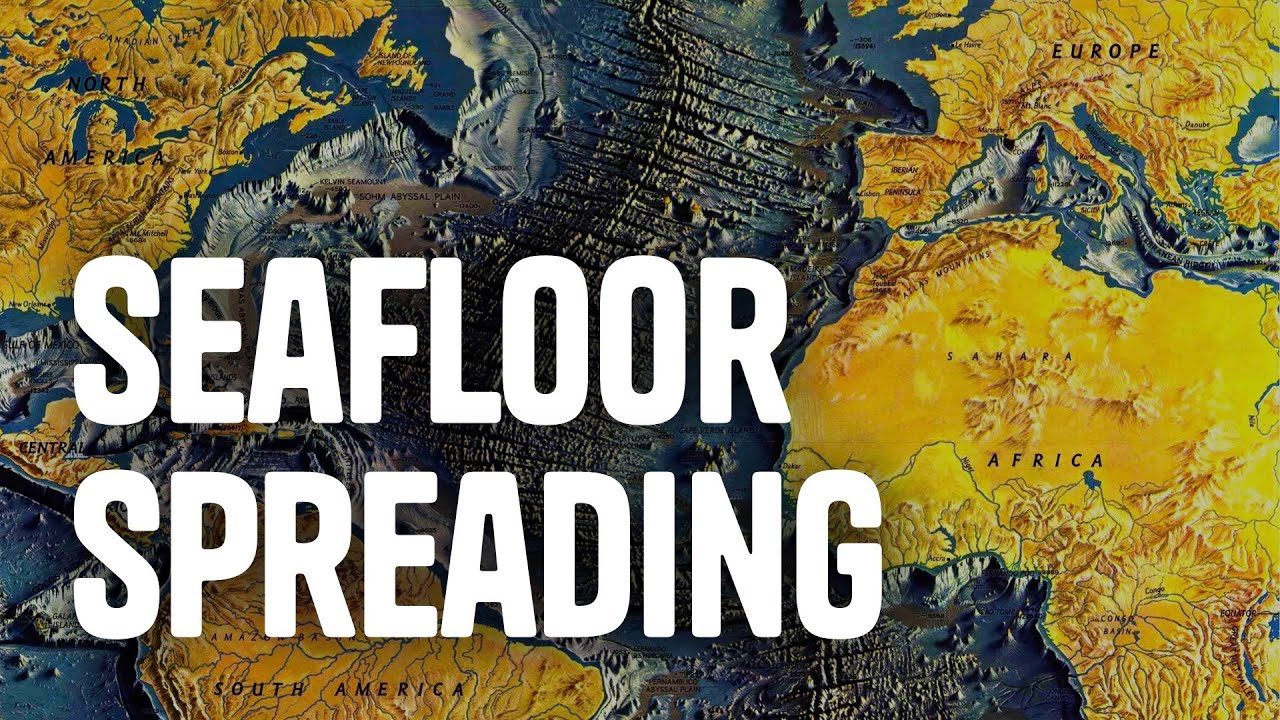
The video discusses the evolution of ocean floor mapping. Early methods like line sounding provided crude and limited data. The establishment of the Department of the Navy Office of Naval Research in the US led to science-driven efforts to map the ocean floor more accurately. Marie Tharp and Bruce Heezen created the first bathymetric map of the Atlantic Ocean in the 1950s using sonar technology. These maps revealed that the seafloor is not a flat expanse but a dynamic area with mountains, cracks, trenches, earthquakes, and volcanoes.
Geological Features as Evidence
Following Tharp and Heezen's work, scientists like Robert Dietz and Harry Hess further described the geological structures on the ocean floor. A profile from North America to Europe reveals flat areas and a central mountain range in the Atlantic Ocean. This observation supports the idea that there are active fractures in the lithosphere, mimicking the shape of continental coastlines. Hess proposed that magma from underground chambers rises through cracks, pushing plates apart at spreading centres or divergent plate boundaries.
Age of Seafloor Rock
The video explains how the age of seafloor rock supports seafloor spreading. Mapping the seafloor's age shows that the youngest rock is found along the mid-ocean ridge (shown in red), with the rock becoming progressively older further away from the ridge (through orange, yellow, green, and blue). This age distribution pattern is consistent with the theory that new rock is formed at the ridge and then moves away as the seafloor spreads.
Sediment Thickness as Evidence
The video details how sediment thickness provides further evidence for seafloor spreading. Scientists theorised that sediment layers should be thinner near the mid-ocean ridge and thicker further away, as older rock would have more time to accumulate sediment. Studies of the seafloor confirmed this, with sediment thickness increasing with distance from the ridges. Maps showing sediment thickness, with colours indicating different thicknesses, support this conclusion.
Magnetic Patterns and Reversals
During World War II, the study of magnetism to detect sea mines and submarines led to a fascinating discovery. Scientists found alternating bands or stripes of magnetism on the seafloor. This phenomenon is linked to Earth's magnetic field, which is generated by the movement of molten metals in the outer core. The Earth's magnetic north and south poles periodically switch in magnetic reversals.
Magnetic Reversals and Seafloor Spreading
The video explains how magnetic reversals are recorded in the rock on either side of mid-ocean ridges. As magma rises and solidifies, minerals align with Earth's magnetic field, creating a record of the field's orientation at the time of formation. These magnetic patterns match up perfectly on either side of the ridge, providing strong evidence for seafloor spreading. The only way this pattern could exist is if the seafloor is spreading, making this a key piece of supporting evidence.
Conclusion: Evidence for Seafloor Spreading and Plate Tectonics
The video concludes by summarising the four key pieces of evidence that support seafloor spreading: active fractures in the lithosphere mimicking continental coastlines, increasing age of seafloor rock away from mid-ocean ridges, increasing thickness of sediment layers away from mid-ocean ridges, and matching patterns of seafloor magnetism on either side of the ridges. This evidence confirms that the oceans are spreading apart and that continental drift and plate tectonics are real phenomena.

