
Brief Summary
This video explains operant conditioning, a method of learning that uses consequences to modify behaviour. It covers the four types of operant conditioning: positive reinforcement, negative reinforcement, positive punishment, and negative punishment. The video also discusses the work of B.F. Skinner and his Skinner Box experiments, as well as the ABCs of behaviour (antecedent, behaviour, consequence) and schedules of reinforcement. Finally, it touches on the applications of operant conditioning in various fields and suggests a classroom exercise to demonstrate positive reinforcement.
- Operant conditioning uses consequences to increase or decrease behaviours.
- B.F. Skinner's experiments with the Skinner Box demonstrated these principles.
- The ABCs of behaviour (antecedent, behaviour, consequence) are key to understanding conditioning.
- Schedules of reinforcement affect the strength and predictability of behaviour.
Introduction to Operant Conditioning
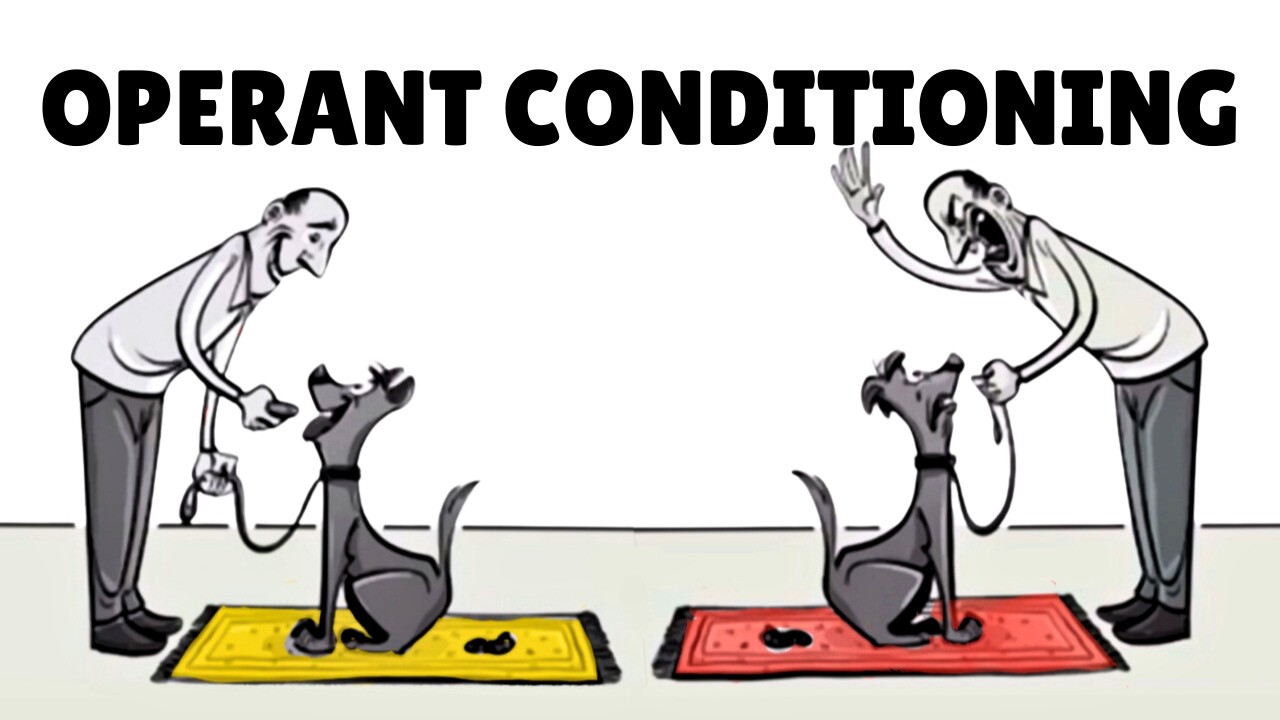
Operant conditioning is a method used to modify behaviour by adding a consequence to either increase or decrease a specific action. If a behaviour is reinforced, it's more likely to occur again, while punishment makes it less likely. Reinforcement and punishment can be either positive (adding something) or negative (removing something), resulting in four different ways to influence behaviour. If all manipulation stops, the conditioned behaviour will eventually disappear, a process known as extinction.
The Four Types of Conditioning
The video outlines the four types of operant conditioning. Positive reinforcement involves adding something pleasant, such as a treat, to increase a behaviour. Negative reinforcement increases a behaviour by removing something unpleasant, like taking off a leash. Positive punishment adds an unpleasant consequence to decrease a behaviour. Negative punishment decreases a behaviour by removing something pleasant, such as a favourite toy.
Skinner Box and the ABCs of Behaviour
Edward L. Thorndike first studied operant conditioning, but B.F. Skinner later popularised it. Skinner believed that organisms behave naturally until they encounter a stimulus that leads to conditioning and a change in behaviour. He tested this using the Skinner Box, where a rat could press a lever to release food. Conditioning occurs through the ABCs of behaviour: antecedent (the rat hits the lever), behaviour (the rat keeps pressing the lever), and consequence (food is released).
Schedules of Reinforcement
The strength of the conditioned response depends on the schedule of reinforcement. Consistent reinforcement leads to predictable behaviour, while random reinforcement results in erratic behaviour. Skinner, a professor of psychology and proponent of behaviourism, believed that only visible behaviour could be studied scientifically and that free will was an illusion, as behaviour is either random or a reaction to the environment.
Applications and Classroom Exercise
Skinner's work laid the foundation for behavioural therapy, military drills, and animal training. The video suggests a classroom exercise to demonstrate positive reinforcement: one person leaves the room while the others decide on a task. When the person returns, they are guided to complete the task using applause as positive reinforcement, increasing the applause when they are on the right track and reducing it when they are not.

