
Brief Summary
This lecture explores the application of motor control principles to sports, focusing on skill acquisition, underlying motor skills, and learning patterns. It uses the tennis serve as a case study to demonstrate needs analysis, phase breakdown, key variable identification, and appropriate tools and techniques for analysis. The lecture also addresses biomechanical considerations for para-athletes, emphasising the importance of understanding impairments, training modifications, equipment, and injury prevention.
- Skill acquisition and learning patterns are crucial for effective coaching.
- Analysing movement involves breaking down skills into phases and identifying key variables.
- Para-athletes require specific considerations due to varied physical impairments and adaptations.
Motor Control Considerations in Sport
From a motor control perspective, skill acquisition involves understanding the learning process, adaptability, and the foundation of skills like hand-eye coordination. It's important to consider how an individual acquires a skill, how to teach it, and how to provide feedback. Analysing the underlying fine and gross motor skills helps understand learning patterns and adjust coaching cues accordingly. Feedback patterns are also crucial, creating a give-and-take dynamic between coach and athlete.
Needs Analysis: Tennis Serve Example
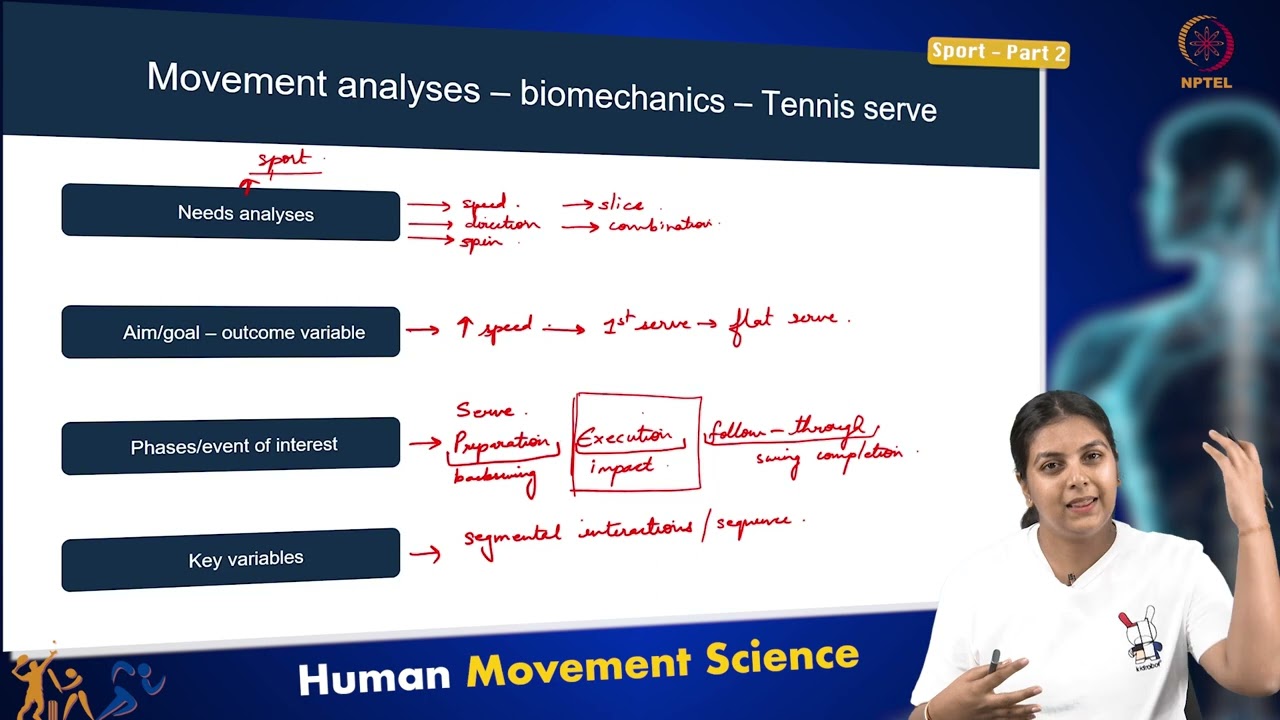
A needs analysis for a tennis serve involves identifying the demands of the skill, such as speed, direction, and spin. For the purpose of this analysis, the aim is to increase speed, particularly for the first or flat serve. To achieve this, the serve is broken down into phases: preparation (backswing), execution (impact), and follow-through (swing completion).
Key Variables and Analysis Techniques
Key variables in the execution phase include segmental interaction (sequence of body movements), joint angles, loading patterns, and joint torques. Segmental interaction involves transmitting force from the ground up through the body to the racket and ball. Tools and techniques for quantitative analysis include 3D motion analysis and inertial sensors, while qualitative analysis can use video cameras from sagittal, posterior, and top views. Statistical analysis, such as correlations and regression, can help understand the relationship between variables and outcomes.
Performance, Injury Patterns, and Equipment Adaptations
Analysing movement patterns can reveal both performance and injury patterns. Fundamental movements, like throwing, can be related to the serve. Equipment adaptations, such as changes in racket size, shape, strings, or grip, can also impact performance and injury risk. Performance and injury depend on these factors and how movement analysis is conducted.
Functional Anatomy of a Tennis Serve
Functional anatomy involves analysing joint actions and muscle involvement during the serve. For example, at the top of the backswing, the elbow and knees are in flexion, about to extend. Major muscles involved include elbow extensors (triceps), hip extensors, and knee extensors (quadriceps). Understanding muscle contractions (concentric and eccentric) and muscular strength is crucial. Range of motion, particularly lumbar extension and rotation, is also important. Anatomical discrepancies, such as limb length differences or muscular weaknesses, should be considered.
Coaching Science Perspective
From a coaching science perspective, increasing serve speed involves technique drills and strength training. Foot placement and the presence of a jump are style components that may or may not need to be changed. Teaching cues and feedback should be tailored to the athlete's learning style. Drills, practice matches, and targets can be used to improve speed, direction, and spin.
Biomechanical Considerations for Para-Athletes
Para-athletes present unique challenges due to varied physical impairments and required adaptations. Understanding the nature of the impairment (e.g., amputation, spinal cord injury) is crucial and requires collaboration with sports medicine professionals. Biomechanical analysis should identify modified movement patterns, loading patterns, force production, and movement compensations.
Training Modifications and Equipment
Training programs should be modified to accommodate unique biomechanical capabilities and improve skill development. Balance and stability are important considerations within the context of the athlete's impairments. Equipment and assistive devices, such as wheelchairs or prosthetics, need to be understood and optimised. Modified sporting gear may also be necessary to cater to specific needs and abilities.
Injury Prevention and Rehabilitation for Para-Athletes
Injury prevention and rehabilitation strategies should be based on biomechanical assessments, movement screening, and strength testing. Identifying potential injury risk factors and specific impairments is crucial for tailoring prevention programs. Collaboration with medical doctors and engineers is essential for a comprehensive and integrated approach.
Coaching Considerations for Para-Athletes
Progressions should be gradual, considering the nature of impairments and the athlete's skill level. Allow enough time for skill acquisition and muscular adaptations before moving to the next progression. Prioritise proper technique and form to avoid compensation patterns. Monitor workload and intensity to avoid overstressing joints. Communication with coaches and understanding equipment optimisation are also important.

