
Brief Summary
This video explores the advancements in human movement science, highlighting key fields and technologies driving progress. It covers biomechanical modelling and simulation, novel prostheses and assistive devices, wearable sensors, and the impact of other disciplines like computer science, materials science, and ergonomics. The importance of user-centric design and the integration of technology to improve the quality of life for individuals with disabilities are also emphasised.
- Advancements in biomechanical modelling and simulation enable a deeper understanding of human movement dynamics and predictive modelling.
- Novel prostheses and assistive devices, driven by material science and manufacturing technologies, aim to improve the function and quality of life for people with disabilities.
- Wearable sensors and advancements in wireless communication provide accessible and democratised data for understanding and improving human movement.
Introduction to Novel Fields in Human Movement Science
The video introduces several novel fields significantly supporting and advancing human movement science. These include biomechanical modelling and simulation, virtual and augmented reality, 3D printing, wearable sensors, novel rehabilitation devices, advancements in force plate technologies, novel prostheses and assistive devices, and genomics. Motion capture advancements are not covered, as they were discussed in a previous session on AI and ML, specifically pose estimation.
Key Fields Advancing Human Movement Science
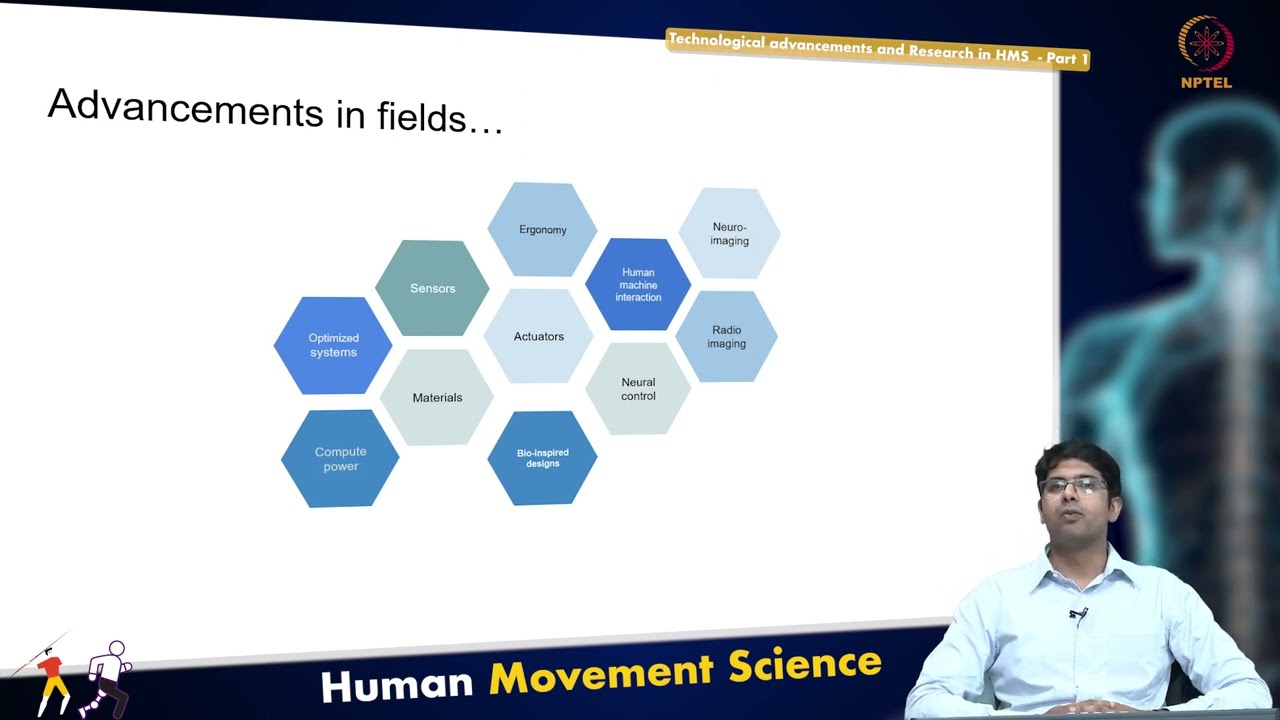
Advancements in human movement science are driven by progress in various key fields. Actuators have seen a significant increase in density, and increased compute power enables complex modelling, AI/ML applications, data mining, and storage of large biomechanical and video datasets. Bio-inspired designs, mimicking biological phenomena, have led to systems that work in cohesion with the human body, such as velcro straps derived from gecko palms and compliant prostheses inspired by animal and human behaviour. Sensors are now ubiquitous, and neuro control allows devices to be controlled using information from neurons, leading to advances in prosthetics and assistive technologies. Lightweight materials like carbon fibre have been crucial in designing lightweight devices, such as wheelchairs weighing only a few kilograms. Imaging techniques, including high-resolution MRIs and EEGs, enable the study of brain structure and activity during tasks. Ergonomics, through the development of ergonomical chairs, provides preventive healthcare by aligning daily activities with the body's movements and structure. Personalised and optimised systems allow for the design of individualised devices, such as specialised prostheses for running or wheelchairs for Paralympic sports. Radio imaging advancements enable the capture of individual bones during movement, providing precise models of the skeletal system and muscle interactions. Human-machine interaction, fuelled by robotics, is leading to automated and semi-automated workflows where humans and machines work together, leveraging human judgment for fine-tuned tasks.
Biomechanical Modelling and Simulation
Biomechanical modelling and simulation are crucial preliminary steps in understanding human movement. These models improve the understanding of movement dynamics by representing the human body as a combination of rigid segments linked by joints. Physical and mathematical models quantify movements based on physics principles, allowing for a good understanding of human movement patterns. Predictive modelling uses physics, electronics, or mathematical principles to model behaviour and predict outcomes based on environmental and initial conditions. Digital twins, mathematical equivalents of major and minor bodily functions, serve as experimental platforms to study changes without affecting the original organism. These models can predict individual capabilities based on statistical analysis, such as the SLIP model for representing running across various organisms. Neuromuscular models, like those in OpenSim, and prosthesis interaction models allow for preliminary analysis of new designs in a digital realm, reducing the need for constant experiments on real people. Statistical software like R and computational tools like MATLAB and GNU Octave aid in predictive modelling and mathematical analysis. Pose estimation, a data-driven model, uses images and video data to derive statistical models for machine learning and AI-based applications.
Novel Prostheses and Assistive Devices
The development of novel prostheses and assistive devices has a significant impact on integrating people with disabilities into society and improving their quality of life. The International Labor Organization and WHO estimate that a substantial percentage of a country's GDP is lost due to the lack of integration of people with disabilities. Advancements in materials, such as carbon fibre and metal alloys, along with manufacturing technologies, have led to the development of lightweight and functional devices. Lightweight wheelchairs, though expensive, offer improved autonomy compared to cheaper, less functional hospital-grade wheelchairs. Actuated prostheses, powered by motors or hydraulic systems and controlled by neuromuscular interfaces like EMG sensors, are replacing passive devices. Similarly, actuated assistive devices, such as power-assisted wheelchairs, provide assistance to users, allowing them to remain active for longer periods. Exoskeletons, wearable devices that enhance or enable load-bearing and movement capabilities, have applications ranging from rehabilitation to performance enhancement in industry. User experience is central to the design of these devices, requiring an understanding of both user requirements and the biomechanics of human movement. Technological advancements facilitate the development of accessible and approachable devices, translating research into practical solutions.
Wearable Sensors
Advancements in wearable technology have been driven by the miniaturisation and combination of sensors, which can now be deployed on devices like smartwatches or embedded in tissues. Wearable patch sensors can measure EMG or skin functions, while sports helmets embedded with IMUs assess impact characteristics to minimise injury risk. Sensors are ubiquitous in phones and specialised hardware, requiring lower power for improved performance. Smartwatches track daily activity, providing insights into heart rate and movement. The application of human movement science principles helps in understanding and utilising the data collected by these sensors. Clinical research has also benefited from advancements in wearable technology, with wireless IMU and EMG sensors replacing wired electrodes. These wireless sensors capture muscle activity and segment kinematics, enabling the development of data-driven musculoskeletal models without affecting user performance. Miniaturisation of sensors and improvements in wireless communication protocols have democratised data availability, making it accessible to a wider population through open-source software.

