
Brief Summary
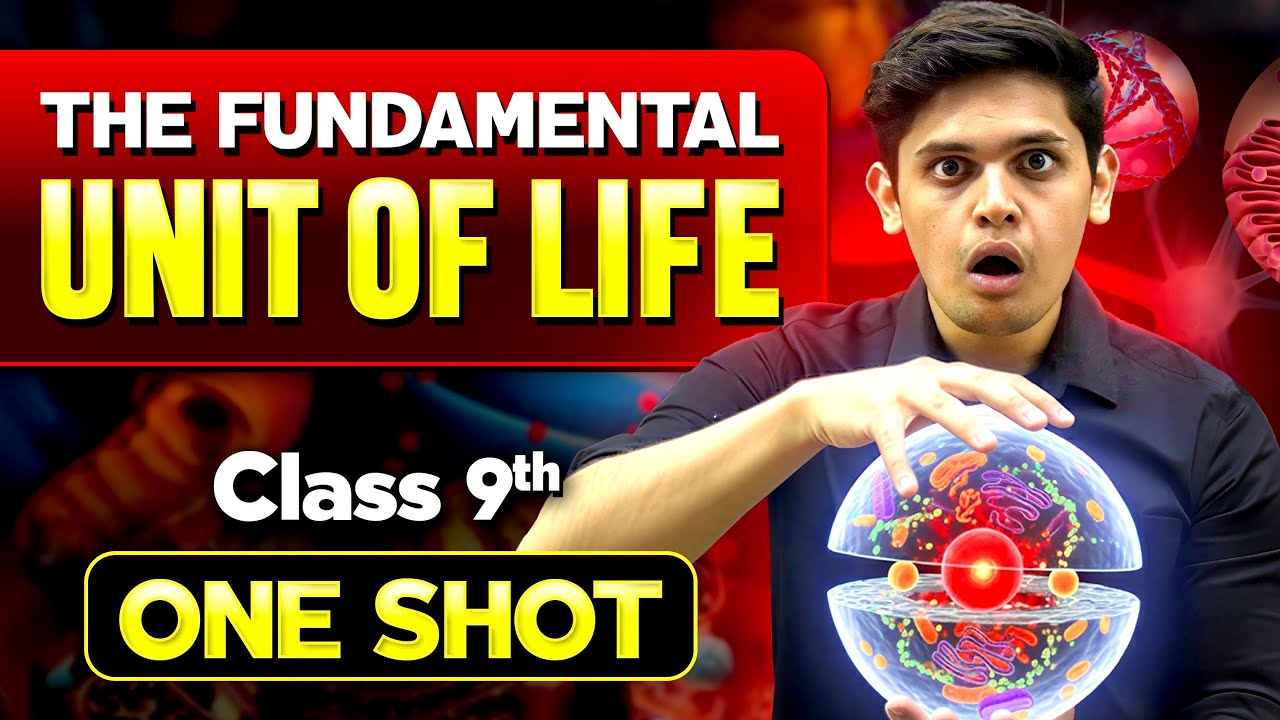
This YouTube video provides a comprehensive one-shot explanation of the chapter "Fundamental Unit of Life" for class 9th science students. The lecture covers cell biology, including cell structure, function, and types, with a focus on making the topic engaging and easy to understand. It includes a detailed discussion of cell organelles, their functions, and differences between prokaryotic and eukaryotic cells.
- Introduction to cells and their importance.
- Detailed explanation of cell organelles and their functions.
- Differences between plant and animal cells, prokaryotic and eukaryotic cells.
Introduction
The video introduces a one-shot explanation of the "Fundamental Unit of Life" chapter for class 9th science, aiming to make science enjoyable and understandable. The instructor, Prashant Bhaiya, promises to cover every line of the NCERT textbook, ensuring students grasp the concepts thoroughly. He encourages students to actively participate by taking notes and asking questions, assuring them that science can be fun and engaging.
Lecture Guidelines and Prashant Bhaiya's Introduction
Prashant Bhaiya outlines the lecture's structure, mentioning that slides and notes will be available in the description or on Telegram. He advises students to take rough notes during the session for better understanding and quick revision. Prashant Bhaiya introduces himself, highlighting his IIT JEE qualification and his experience teaching classes 10th, 11th, and 12th.
Introduction to Cell
The lecture begins by defining cells as the fundamental units of life, distinguishing them from atoms, which compose non-living things. Cells are the building blocks of living organisms, and the video addresses why cells are called the fundamental unit of life and building blocks of life, explaining how cells form tissues, organs, organ systems, and ultimately, organisms. The concept of cells replicating themselves is introduced, drawing a parallel to students copying each other's work.
Discovery of Cell
The video transitions to the history of cell discovery, starting with Robert Hooke, who first observed cells (though dead) in a cork slice. It then discusses Antonie van Leeuwenhoek, who observed living cells under a microscope for the first time. The lecture also mentions Robert Brown's discovery of the nucleus and Parkinji's research on protoplasm.
Cell Theory
The explanation of the cell theory, highlighting the contributions of Schleiden, Schwann, and Virchow. Schleiden stated that all plants are composed of cells, Schwann noted that all animals are made of cells, and Virchow added that new cells arise from pre-existing cells through cell division. The three key points of the cell theory are summarised: all living organisms are composed of cells, organisms can be unicellular or multicellular, and new cells arise from pre-existing cells through cell division.
Cell: Size, Shape and Numbers
The lecture discusses the diversity in cell size, shape, and numbers. It differentiates between unicellular and multicellular organisms, providing examples such as bacteria and protozoa for unicellular organisms and plants and animals for multicellular organisms. Various cell shapes, like nerve cells and ovum, are shown, and the largest (ostrich egg) and smallest (mycoplasma) cells are identified.
Components of Cell
The basic components of a cell are introduced: the plasma membrane (cell membrane), nucleus, cytoplasm, and cell organelles. Plant cells also have a cell wall, providing extra protection. The importance of accurate labelling in cell diagrams is emphasised.
Plasma Membrane or Cell Membrane
The plasma membrane, or cell membrane, is described as the outermost covering of the cell, acting as a bodyguard that regulates the entry and exit of substances. It is selectively permeable, allowing only certain substances to pass through. The membrane is composed of lipids and proteins. The lecture explains the difference between passive and active transport, with examples, and introduces the concepts of diffusion and osmosis.
Diffusion and Osmosis
Diffusion is defined as the movement of substances (solid, liquid, or gas) from a region of higher concentration to a region of lower concentration. Osmosis is specifically the passage of water molecules across a semi-permeable membrane from a solution with high water concentration to a solution with low water concentration. The lecture differentiates between endosmosis (water entering the cell) and exocytosis (water leaving the cell).
Hypertonic, Hypotonic and Isotonic Solutions
The video explains hypertonic, hypotonic, and isotonic solutions. A hypertonic solution has a higher solute concentration, causing cells to shrink. A hypotonic solution has a lower solute concentration, causing cells to swell. An isotonic solution has the same solute concentration as the cell, resulting in no net movement of water. A trick to remember hypotonic solution is Hippo (hippo potamus) which swells.
Endocytosis and Exocytosis
Endocytosis is the process by which cells take in substances by engulfing them in the cell membrane, while exocytosis is the process by which cells expel substances by fusing vesicles with the cell membrane.
Cell Wall
The cell wall, found in plant cells, is made of cellulose and provides Z Plus security. Plasmolysis, the shrinkage of the living part of the cell, is explained in the context of the cell wall's rigidity. The functions of the cell wall include providing rigidity, strength, and preventing the cell from bursting due to osmosis. The composition of cell walls in plants, fungi, and bacteria is also detailed.
Nucleus
The nucleus, the brain of the cell, has a double-layered nuclear membrane with pores. It contains chromatin (randomly distributed DNA) and chromosomes (coiled DNA during cell division). The importance of DNA in determining physical characteristics is highlighted. The full form of DNA (deoxyribonucleic acid) is provided.
Chromatin and Chromosome
Chromatin is the random distribution of DNA within the nucleus, while chromosomes are the coiled form of DNA that appears during cell division. Chromosomes play a crucial role in heredity.
Prokaryotic and Eukaryotic Cells
Prokaryotic cells are small and lack a well-defined nucleus and membrane-bound organelles, while eukaryotic cells are large and have a well-defined nucleus and membrane-bound organelles. The nuclear region in prokaryotic cells is called a nucleoid. The differences between prokaryotic and eukaryotic cells are summarised in a table, and a diagram of a bacterial cell (prokaryotic) is shown.
Cell Organelles
The lecture transitions to a discussion of cell organelles, starting with cytoplasm, the fluid content enclosed by the cell membrane. A story is used to explain the functions of various cell organelles, comparing the cell to a factory.
Ribosomes
Ribosomes are described as protein factories, responsible for protein synthesis. They lack a membrane and are found in both prokaryotic and eukaryotic cells.
Endoplasmic Reticulum (ER)
The endoplasmic reticulum (ER) is a network of membrane-bound tubes and sheets within the cell. There are two types: rough endoplasmic reticulum (RER), which has ribosomes on its surface and synthesises proteins, and smooth endoplasmic reticulum (SER), which lacks ribosomes and synthesises lipids. The differences between RER and SER are detailed, including their roles in detoxification.
Golgi Apparatus
The Golgi apparatus is responsible for packaging, modifying, and transporting proteins and lipids. It is named after Camillo Golgi. The Golgi apparatus also plays a role in the formation of lysosomes.
Lysosomes
Lysosomes contain digestive enzymes and are responsible for breaking down waste materials and cellular debris. They are referred to as suicide bags because they can digest the entire cell if it is damaged or malfunctioning. Lysosomes are formed with the help of the Golgi apparatus.
Vacuoles
Vacuoles are storage sacs within the cell, surrounded by a membrane called the tonoplast. They are large in plant cells and small in animal cells. Vacuoles store essential substances and provide support and rigidity to plant cells. In unicellular organisms, vacuoles help in removing waste.
Mitochondria
Mitochondria are the powerhouses of the cell, responsible for energy production in the form of ATP (adenosine triphosphate). They have their own DNA and ribosomes, making them unique.
Plastids
Plastids are organelles found only in plant cells. They also have their own DNA and are of three types: chromoplasts (coloured plastids), chloroplasts (containing chlorophyll for photosynthesis), and leucoplasts (colourless plastids for storage).
Cell Organelles Summary
A recap of the cell organelles and their functions, reinforcing the story-based explanation.
Double Membrane Bound Nucleus
A summary of cell organelles based on their membrane structure: double membrane-bound (nucleus, mitochondria, plastids), single membrane (vacuoles, lysosomes, Golgi apparatus, endoplasmic reticulum), and membrane-less (ribosomes, centrosomes).
Cell Shape
A table summarising the differences between plant and animal cells, including cell shape, cell wall, cell membrane, endoplasmic reticulum, nucleus, lysosomes, Golgi apparatus, cytoplasm, ribosomes, plastids, vacuoles, cilia, mitochondria, and mode of nutrition.
Cell Division
Cell division is the process through which new cells are formed. The lecture differentiates between mitosis and meiosis. Mitosis results in two daughter cells with the same number of chromosomes as the parent cell and is involved in growth and repair. Meiosis results in four daughter cells with half the number of chromosomes as the parent cell and is involved in sexual reproduction.
Cell Death Key
The chapter concludes with a few questions to test understanding, including scenarios involving cell behaviour in different solutions and the impact of removing cell organelles. The video ends with a motivational message, encouraging viewers to become the powerhouse of their own lives.

