
Brief Summary
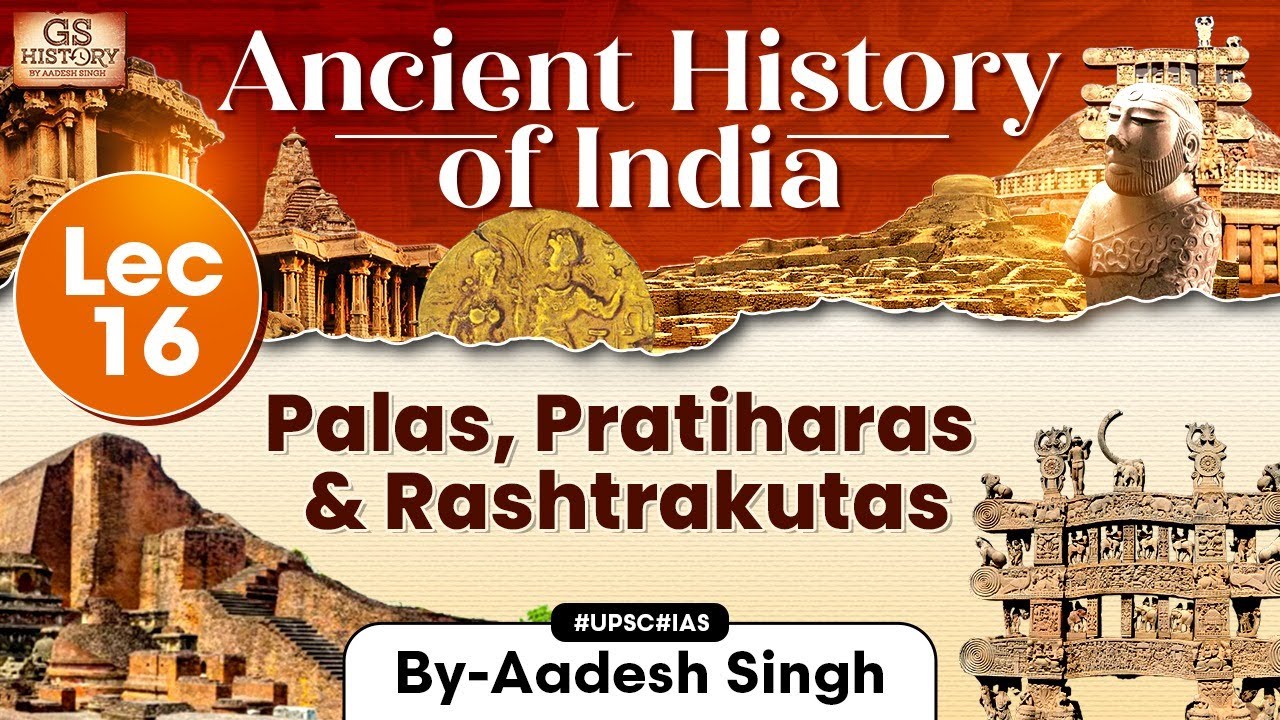
This video discusses the struggle for Kannauj between the Palas, Pratiharas, and Rashtrakutas from 800 to 1000 AD. It covers the importance of Kannauj, the rise and fall of each empire, their contributions to art, literature, and religion, and the overall impact of their conflicts on North India.
- Kannauj's strategic and economic importance as a center of trade and power.
- The rise and fall of the Palas, Pratiharas, and Rashtrakutas.
- The cultural and administrative contributions of these empires.
- The impact of their conflicts on the political landscape of North India.
Domination Over Kannauj
After the decline of Harsha's empire in the 7th century, North India saw the rise of several large kingdoms. The Ganga Valley was crucial for empires like the Guptas and Harsha due to its population and resources, making it a hub for trade and commerce. Kannauj, situated in the Ganga Valley, emerged as a strategic center after Harsha's decline. Its location on the banks of the Ganga provided a height advantage, and it was a major trade and communication hub. Controlling Kannauj meant controlling the Ganga Valley, symbolizing rule over North India, similar to Magadha in the past.
The Palas
Following Harsha's death, North India faced political confusion. Lalitaditya of Kashmir briefly controlled Punjab and Kannauj. The Palas rose to power amid this vacuum, clashing with the Pratiharas for control over the region from Banaras to South Bihar. In 750 AD, Gopala founded the Pala Empire, unifying Bengal and controlling Magadha. His son, Dharmapala, expanded the empire, taking advantage of conflicts between the Pratiharas and Rashtrakutas to seize Kannauj. Dharmapala's rule extended to the northwest, but the Pratiharas, under Nagabhatta II, later defeated him. The Palas then focused on expanding eastward, with Devapala extending control over Assam and parts of Odisha. The Palas were patrons of Buddhist learning, reviving Nalanda University and establishing Vikramshila University. They also maintained cultural ties with Tibet and supported various religions, fostering religious diversity. They gave grants to Brahmins, which led to agricultural expansion in Bengal and increased trade and cultural contacts with Southeast Asian countries, resulting in an influx of gold and silver.
The Pratiharas
The Pratiharas, also known as Gurjara-Pratiharas, ruled Kannauj for an extended period. They originated from the Gurjaras, pastoral and warrior-like people. They established principalities in Rajasthan and clashed with the Rashtrakutas for control over Malwa, Gujarat, and eventually Kannauj. Nagabhatta I gained prominence and resisted Arab expansion from Sindh. The early Pratihara rulers faced defeats against the Rashtrakutas. King Bhoja is considered the real founder and greatest ruler of the Pratihara Empire. He rebuilt the empire and recovered Kannauj around 836 AD, making it the capital for about 100 years. Bhoja's attempts to expand eastward were thwarted by the Pala ruler Devapala, leading him to focus on the Deccan, Central India, and Gujarat, resulting in renewed conflict with the Rashtrakutas. Bhoja, a devotee of Vishnu, adopted the title "Adi Varaha." His son, Mahendrapala I, expanded the empire further, with inscriptions found in East Punjab, Awadh, and Kathiawar. Arab travelers testified to the empire's power and vastness. The Pratiharas were patrons of learning and literature, with the poet Rajasekhara in the court of Mahipala. They built fine buildings and temples in Kannauj. Despite hostility with the Arab rulers of Sindh, scholars and goods continued to move through the region. The Rashtrakuta king Indra III attacked and destroyed Kannauj, weakening the Pratihara Empire. The loss of Gujarat, a hub for overseas trade, dealt a significant blow to the Pratiharas. The Pratihara empire dissolved after Krishna III of the Rashtrakutas defeated the Pratihara ruler.
The Rashtrakutas
While the Palas and Pratiharas ruled in North India, the Rashtrakutas dominated the Deccan. Dantidurga established the kingdom in the mid-8th century, with its capital at Manyakheta (modern Malkhed). The Rashtrakutas quickly dominated northern Maharashtra and fought with the Pratiharas for control of Gujarat and Malwa. They also clashed with the Eastern Chalukyas of Andhra Pradesh and the Pallavas and Pandyas in the South. Govinda III and Amoghavarsha are considered the greatest Rashtrakuta rulers. Govinda III launched successful campaigns against Nagabhatta of Kannauj and annexed Malwa before turning south. Amoghavarsha ruled for 64 years, focusing on religion and literature rather than war. He authored the first book on poetics in Kannada and built the capital city of Manyakheta. Indra III suppressed rebellions and re-established the empire, defeating the Pala ruler Mahipala and capturing Kannauj in 915. Krishna III defeated the Cholas in 949 and captured the northern part of their empire. The Rashtrakuta Empire ended in 972 when their capital, Malkhed, was attacked and destroyed. The Rashtrakutas were religiously tolerant, patronizing Shaivism, Vaishnavism, and Jainism. They allowed Arab traders to settle and preach Islam, promoting foreign trade. They were also great patrons of art and literature, with Sanskrit scholars and poets writing in Prakrit and Apabhramsa in their court.
Life During These Three Kingdoms
The administration in these kingdoms was similar to that of the Gupta Empire, Harsha's kingdom, and the Chalukyas of the Deccan. The king was the head of administration and commander-in-chief of the army. The position of the king was hereditary, and he was assisted by ministers responsible for revenue, treasury, foreign affairs, the army, the judiciary, and religious matters. The kingdoms had large and well-organized armies consisting of cavalry, infantry, and elephants. The administered territories were divided into provinces (Rashtra), districts (Mandala or Vishaya), and clusters of villages (Patala). Village administration was managed by a headman assisted by village elders (Gram Mahajan). Trade and commerce declined in North India between 740 and 1000 AD due to the collapse of trade with the Roman Empire and disruptions caused by the rise of Islam. The decline in foreign trade led to a decrease in gold coins. However, trade between South India and Southeast Asian countries increased during this period.
Conclusion
The video concludes by summarizing the early medieval history of North India from 800 to 1000 AD. The rise of the Palas, Pratiharas, and Rashtrakutas and their struggle for dominance shaped the political landscape. Despite continuous conflicts, life remained stable, and there was growth in temples, art, and literature. The struggle for Kannauj lasted for 200 years, weakening all three empires and leading to political disintegration in North India. This situation, combined with political changes in West and Central Asia, paved the way for Islamic invaders to establish dominance in North India.

