
Brief Summary
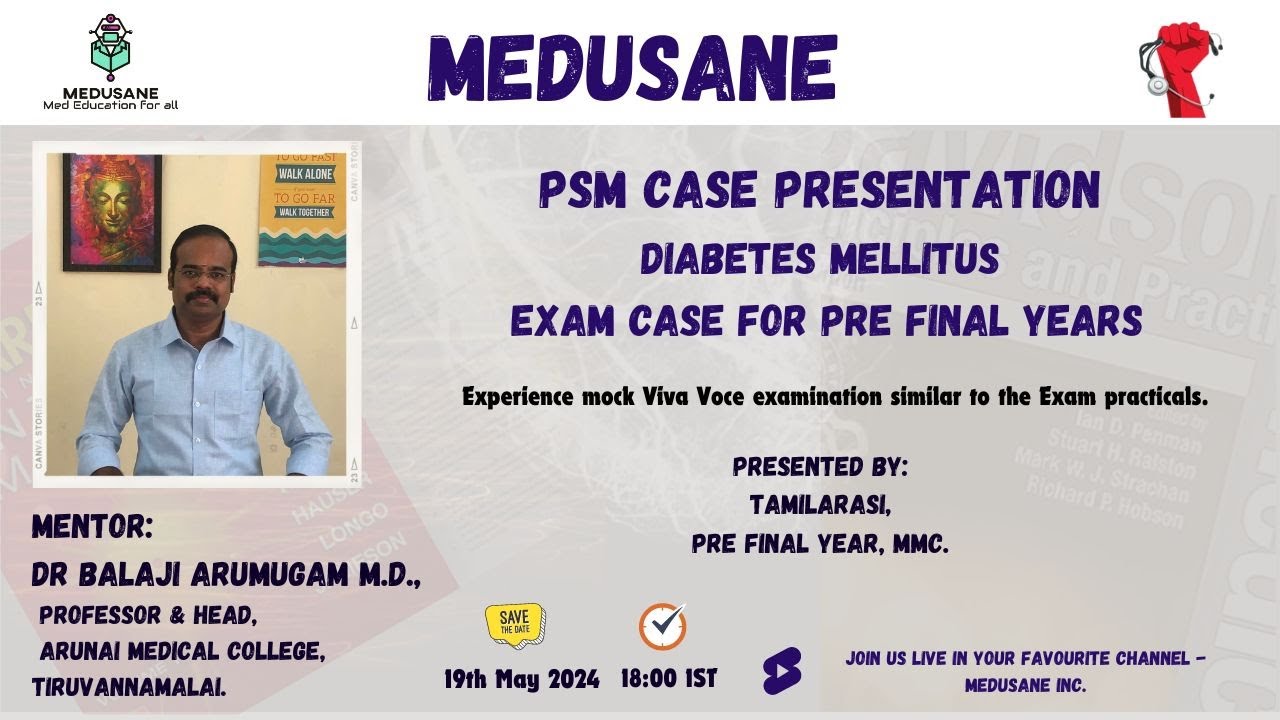
This video features a PSM case presentation on diabetes mellitus by Tami, a third-year MMC student, with Dr. Balaji Arugam and Dr. R. Raghunandan providing guidance and insights. The presentation covers a 37-year-old male patient with diabetes, hypertension, and a history of stroke, focusing on his medical history, personal history, environmental factors, and clinical diagnosis. Key points include discussions on social economic status, dietary habits, obesity assessment, and levels of prevention.
- Detailed case presentation of a 37-year-old male with diabetes mellitus.
- Discussion on social economic status and its impact on healthcare access.
- Focus on dietary habits, obesity assessment, and lifestyle modifications.
- Insights on levels of prevention and management strategies for diabetes.
Introduction and Welcome
Dr. R. Raghunandan welcomes Professor Dr. Balaji Arugam, Head of the Department of Community Medicine at Arun Medical College, to present a PSM case on diabetes mellitus. He expresses gratitude for Dr. Balaji's presence and acknowledges his previous lectures on epidemiology available on their YouTube channel. Tami, a third-year MMC student, is introduced to present the case.
Patient History and Presenting Illness
Tami presents the case of Mr. Mageswaran, a 37-year-old male carpenter, who came with complaints of stomach pain, painful urination, and vomiting. The patient's history includes abdominal pain, burning micturition, and blurring of vision. He has a known history of diabetes mellitus for two years and hypertension for one year, along with a stroke six years ago.
Questions on Patient History
Dr. Balaji questions the patient's history of stroke, inquiring about the status of paralysis and any available medical reports. He also asks about the significance of bilateral pitting edema and any cardiac conditions. Tami explains that the patient was stable during examination, and details about the stroke were not readily available.
Personal and Family History
The patient consumes a mixed diet and has a history of alcohol intake but no smoking or substance abuse. His diet history, calculated using the 24-hour dietary recall method, shows a deficit in calorie and protein intake. The patient's father was diabetic. The family is nuclear with a total income of ₹30,000, placing them in the upper lower class according to the modified kuppuswamy scale.
Social Economic Status and Environmental History
Dr. Balaji discusses various social economic status scales, including the modified kuppuswamy scale and the UD classification. He emphasizes the importance of assessing social economic status to understand affordability and disparities in healthcare access. The patient uses canned water for drinking and well water for other purposes. The toilet is separate and outside the house, with proper drainage and waste disposal systems in place.
Environmental History and Personal Hygiene
The patient lives in a pucca house with adequate lighting and ventilation. The kitchen is separate with an exhaust system, and LPG is used as fuel. Personal hygiene practices include hand washing before cooking and after using the toilet. Dr. Balaji defines adequate lighting and ventilation, emphasizing the importance of indoor air quality.
Summary of History and General Examination
Tami summarizes the patient's history, including his age, complaints, past medical history, social economic status, and environmental conditions. The general examination reveals that the patient is conscious and oriented. Vitals are within normal range, except for peripheral pulses not being felt. Anthropometry indicates a normal BMI.
Anthropometry and Obesity Assessment
Dr. Balaji discusses the purpose of anthropometric measurements, emphasizing the assessment of obesity. He explains the WHO classification of BMI and introduces the concepts of Android and Gynoid obesity. He highlights the importance of waist circumference and waist-hip ratio in assessing abdominal obesity and the risk of metabolic syndrome.
Blood Pressure Measurement and Hypertension
Dr. Balaji discusses the WHO guidelines for blood pressure measurement, recommending at least three readings. He introduces the "rule of halves" and mentions World Hypertension Day. He also explains the Iceberg phenomenon in the context of hypertension and diabetes, highlighting the large number of undiagnosed cases.
Investigations and Individual Advice
Tami lists the investigations to be conducted, including fasting blood glucose, postprandial blood sugar, HbA1c, and lipid profile. She advises the patient to adhere to medications, recognize signs of hypoglycemia, carry an ID card, and adopt lifestyle modifications such as brisk walking and a balanced diet.
Dietary Advice and Self-Care
Dr. Balaji discusses the concept of a prudent diet and dietary goals for preventing non-communicable diseases. He introduces the "Rule of 100" for maintaining blood sugar and cholesterol levels. Tami emphasizes self-care, including adherence to diet and drug regimens, regular checkups, and foot examinations.
Family and Community Level Interventions
The presentation suggests individual screening for family members and motivating the patient to maintain a positive attitude. At the community level, early diagnosis, prompt treatment, and health education are emphasized. The level of prevention applied in this case is secondary prevention, utilizing programs like the National Program for Prevention and Control of Non-Communicable Diseases.
Levels of Prevention and Complications
Dr. Balaji discusses the levels of prevention, noting that the patient may have complications of type 2 diabetes, such as retinopathy. He explains the importance of secondary prevention in diagnosing diseases early and preventing irreversible damage. Tertiary prevention measures include disability limitation and rehabilitation.
Type 1 vs. Type 2 Diabetes and Risk Factors
Dr. Balaji differentiates between type 1 and type 2 diabetes, highlighting the multifactorial causation of non-communicable diseases. He identifies modifiable and non-modifiable risk factors in the patient's case, such as family history and dietary habits.
Summary and Concluding Remarks
Dr. Balaji summarizes the key questions examiners often ask in community medicine, including risk factors, metabolic syndrome, obesity assessment, and gaps in non-communicable diseases. He mentions the Tamil Nadu level program (Mak) for house visits by peripheral health workers. He thanks Tami for the presentation and Dr. Paran and Dr. Raghunandan for the opportunity.
Closing and Gratitude
Dr. Raghunandan expresses gratitude to Dr. Balaji for the informative session and to Tami for the presentation. He hopes the session will be useful for students preparing for their exams. Dr. Balaji thanks everyone for the opportunity and concludes the meeting.

