
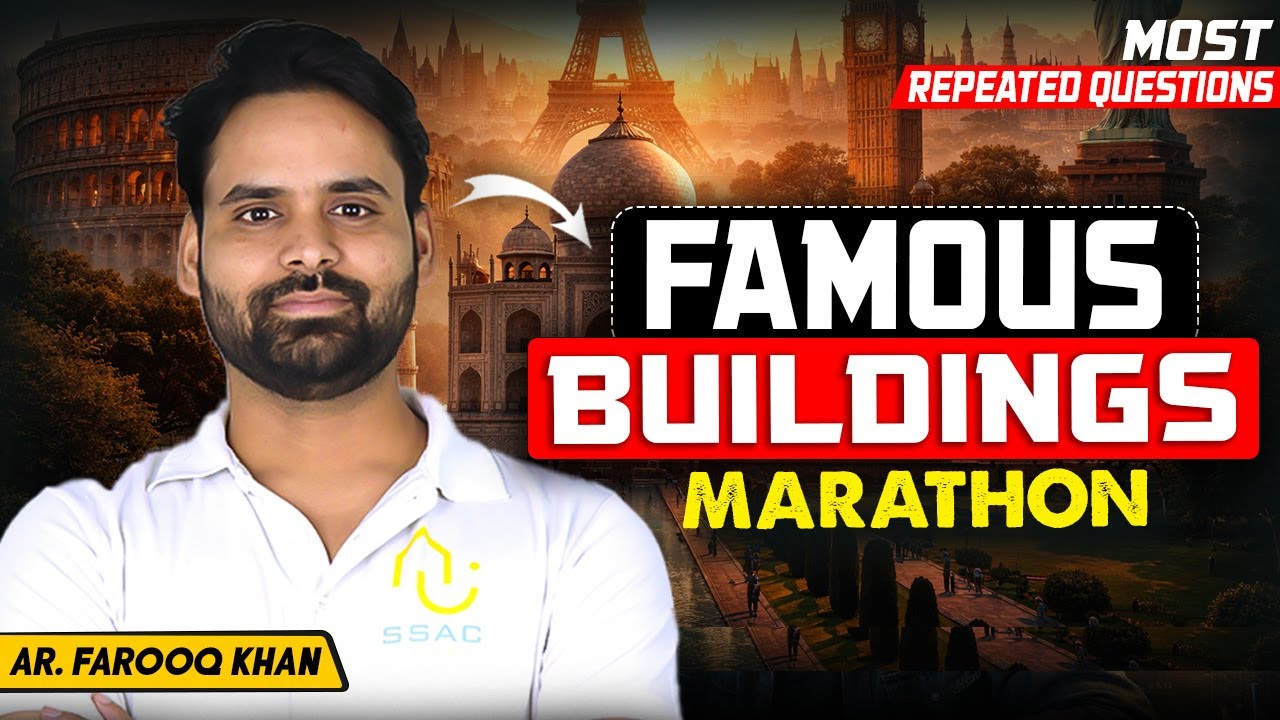
Brief Summary
Alright, so this video is all about cracking the JEE B.Arch exam, focusing on famous buildings and monuments from India and around the world. It's like a crash course to help you remember all those important structures for the exam. They're covering both Indian and foreign buildings, giving you the lowdown on their names, architects, and why they're significant.
- Covers important buildings and monuments from India and the world.
- Focuses on key details like names, architects, and significance for the JEE B.Arch exam.
- Offers tips and tricks to remember the buildings and their details.
Introduction to the Marathon Series
The video kicks off a marathon series aimed at helping students ace the JEE B.Arch Paper 2 exam. This first episode is all about covering the most important and famous buildings from India and around the world. If you're feeling stressed about remembering all these buildings, don't worry! By watching this episode till the end, you'll have this topic covered. This series is super helpful, especially with the exam coming up soon.
Famous Indian Buildings and Monuments
This section dives into famous Indian buildings and monuments, a topic that frequently pops up in the exam. You'll likely find two to four questions on this in every paper. First up is the Taj Mahal Palace Hotel in Mumbai. Remember its name and the architects, Rao Saheb Vaidya and D.N. Mirza. Next, there's the Infosys Campus in Pune, designed by Hafeez Contractor, a well-known architect from Mumbai. Then, they discuss the Chhatrapati Shivaji Maharaj Terminus (CSMT), designed by Frederick William Stevens.
More Indian Architectural Marvels
Moving on, the video highlights the Bibi Ka Maqbara in Aurangabad, often called the "Taj of the Poor" due to its resemblance to the Taj Mahal. It's an example of Mughal architecture. Then there's the Aga Khan Palace, where Mahatma Gandhi was once held as a prisoner. Shifting focus to Rajasthan, they talk about the Lake Palace in Udaipur, located in the middle of a lake, and Hawa Mahal, known as the "Palace of Winds" because of its many windows.
Stepwells, Forts, and Temples of Rajasthan
The discussion continues with the Chand Baori stepwell in Rajasthan, used for rainwater harvesting and as a cool resting place. Next is the Mehrangarh Fort in Jodhpur, surrounded by many stories. Then, they talk about the Dilwara Temples, a group of five temples dedicated to the Jain Tirthankaras, known for their white marble architecture.
Monuments of Delhi and Important Exam Tips
Now, they shift to Delhi, starting with the Rashtrapati Bhavan, the official residence of the President of India, designed by Sir Edwin Lutyens. Remember, Lutyens designed Delhi, while Le Corbusier designed Chandigarh. The video emphasizes that while they're covering important buildings, there are many more facts and points that are important for the exam. They also mention that if you're serious about JEE B.Arch Attempt 2, you should join their live classes for detailed coverage.
Delhi's Red Fort and Other Landmarks
The video highlights the importance of distinguishing between the Red Fort in Delhi and the Agra Fort, as a similar question was asked in the previous year's JEE exam. Next, they discuss the Lotus Temple in Delhi, known for its 27 petals, designed by Fariborz Sahba. They also mention the Jama Masjid, Delhi's largest mosque, and the Qutub Minar, built by Qutubuddin Aibak.
Lost Architecture and Iconic Institutes
The discussion touches on the Hall of Nations, a building that was demolished for political reasons, designed by Raj Rewal. Then, they talk about the IIM Ahmedabad, designed by Louis Kahn, emphasizing its importance for the exam. They also mention that there are many concepts about this building that need to be understood in detail, for which you can join their live classes.
Stepwells, Temples, and Motivation
The video moves on to Rani ki Vav, a stepwell, and the Sabarmati Ashram in Ahmedabad, designed by Charles Correa. Then, they differentiate between the Sun Temple in Modhera, Gujarat, and the Sun Temple in Konark, Odisha. They also showcase the results of students from Sketch School of Art and Creativity, to motivate the viewers.
Temples of Odisha and Colonial Architecture of Kolkata
They discuss the Lingaraj Temple in Odisha and the Udayagiri and Khandagiri Caves. Shifting focus to Kolkata, known as the "City of Joy" for its colonial architecture, they highlight the Victoria Memorial, designed by William Emerson. They also mention the Golden Temple in Amritsar, known for the gold used in its construction.
Palaces, Temples, and Architectural Styles
The video covers the Mysore Palace in Karnataka, known for its Indo-Saracenic style, and the Gol Gumbaz in Bijapur, famous for its unsupported dome. Then, they discuss the Brihadeeswarar Temple in Tamil Nadu, built by Raja Raja Chola I, and explain the difference between Nagara and Dravidian architectural styles. They also mention the Meenakshi Temple in Madurai, an example of Dravidian architecture.
Taj Mahal, Ram Mandir and Foreign Buildings
The video discusses the Taj Mahal in Agra, built by Shah Jahan, and the Ram Mandir in Ayodhya, designed by Chandrakant B. Sompura. Shifting focus to foreign buildings, they highlight the Burj Khalifa, Burj Al Arab designed by Tom Wright and Adrian Smith, and the CN Tower designed by John Andrews.
Famous Buildings Around the World
The video continues with famous buildings around the world, including the CCTV Headquarters in Beijing, designed by Rem Koolhaas, and the Eiffel Tower in Paris, designed by Gustave Eiffel. They also mention the Petronas Twin Towers in Kuala Lumpur, designed by Cesar Pelli, and the Doge's Palace in Italy, built in the Gothic style.
Opera Houses, Museums, and Organic Architecture
The discussion includes the Sydney Opera House, an art center designed by Jørn Utzon, and the Guggenheim Museum in New York, designed by Frank Lloyd Wright. They also highlight Fallingwater, an example of organic architecture designed by Frank Lloyd Wright, and Sagrada Familia, a building in Barcelona designed by Antoni Gaudí that is still under construction.
Cathedrals, Centers, and Towers
The video covers the Notre-Dame Cathedral in Paris, known for its rose window, and the Heydar Aliyev Center, designed by Zaha Hadid. They also mention the Cathedral of Brasília, designed by Oscar Niemeyer, and the 30 St Mary Axe, also known as the Gherkin Tower.
Palaces, Arenas, and Statues
The discussion includes the Palace of Versailles, an example of French architecture, and the Colosseum in Rome, used for gladiator fights. They also mention the Hagia Sophia in Turkey, an example of Byzantine architecture, and the Statue of Liberty, gifted by France to the United States.
Greek Architecture and Modern Marvels
The video covers the Parthenon, an example of Greek architecture, and the Burj Al Arab in Dubai, designed by Tom Wright. They also mention the Milwaukee Art Museum, with different parts designed by Eero Saarinen, Santiago Calatrava, and David Kahler.
Dancing Houses, Cathedrals, and Capitals
The discussion includes the Dancing House in Prague, designed by Vlado Milunić and Frank Gehry, and the Cologne Cathedral, an example of Gothic architecture. They also mention the Dome of the Rock in Jerusalem, Casa Mila designed by Antoni Gaudí, and St. Paul's Cathedral in London, designed by Sir Christopher Wren.
White Houses, Leaning Towers, and More
The video covers the White House in Washington, D.C., designed by James Hoban, and the Leaning Tower of Pisa, an example of Romanesque architecture. They also mention St. Basil's Cathedral in Moscow, the Empire State Building in New York, designed by William F. Lamb, and the Space Needle in Seattle.
Gothic Architecture and Modern Towers
The discussion includes the Milan Cathedral, an example of Gothic architecture, and the Great Wall of China. They also mention Taipei 101 in Taiwan, designed by C.Y. Lee & Partners.
Chandigarh: The Planned City
The video shifts focus to Chandigarh, a planned city designed by Le Corbusier. They highlight that Chandigarh is the first planned city after independence.
Capital Complex and Secretariat Building
The discussion includes the Capital Complex in Chandigarh, a UNESCO World Heritage Site designed by Le Corbusier, and the Secretariat Building, an example of Brutalist architecture also designed by Le Corbusier.
Legislative Assembly, High Court, and Open Hand Monument
The video covers the Legislative Assembly in Chandigarh, designed by Le Corbusier, and the Punjab and Haryana High Court, also designed by Le Corbusier and an example of Brutalist architecture. Finally, they discuss the Open Hand Monument, a symbol of Chandigarh representing "open to give and open to receive."
Conclusion and Call to Action
The video concludes with a recap of the famous Indian and foreign buildings covered in the episode. It encourages viewers to revise these buildings before the exam and invites those serious about JEE B.Arch Paper 2 to join Sketch School of Art and Creativity for detailed preparation. They offer a free demo class to those interested in learning more about their teaching methods.

