
Brief Summary
Alright, so, the video is about Putin's visit to Beijing and the broader implications for the Russia-China relationship and the global world order. It talks about how Putin and President Xi are good friends but have different ideas on how the world should be run. The video also discusses the economic cooperation between China and Russia, tensions in their relationship, and Putin's grand strategy to undermine the US dollar.
- Putin and Xi are friends, but have different visions for the world.
- China benefits more from the economic relationship.
- Putin's ultimate goal is to destroy the US dollar's dominance.
Announcements and Overview
Okay, so, next Thursday is the last class and the final examination will be held on the same day. The format will be similar to the midterm. If you're watching on YouTube, leave your questions in the comment section for review. Next Tuesday, there will be an overview of everything learned so far, along with predictions for the next 5 to 10 years. Today's topic is Putin's visit to Beijing.
Putin's Visit to Beijing
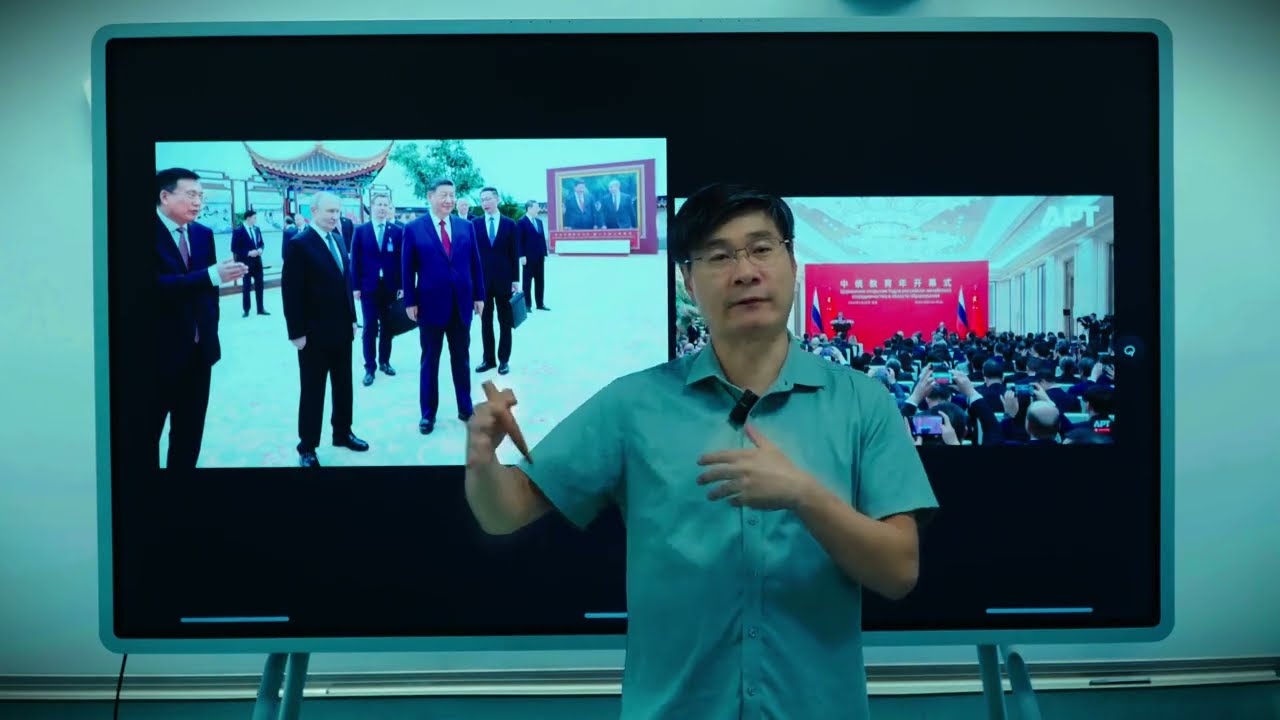
Putin visited Beijing and met with President Xi, marking his 25th visit to China. They emphasized their friendship and announced a year of education exchange between Russia and China to enhance people-to-people connections. The main takeaway from their meeting was their differing views on a multipolar world. President Xi wants to maintain the current UN-based international order, while Putin wants Russia and China to lead the new multipolar world.
Differing Perspectives on the Multipolar World
President Xi and Putin both support a multipolar world with more exchanges and research. Xi is concerned about global turbulence and the "law of the jungle," emphasizing the importance of the UN's authority and opposing unilateralism, hegemony, and the resurgence of fascism and militarism, specifically in Germany and Japan. Putin is more specific about cooperation areas like the Russia-China summer games and media collaboration. He stresses independent foreign policies while working together for global stability, with Moscow and Beijing jointly defending international law and the UN charter.
Joint Statement and China's Stance
Russia and China advocate for a multipolar world, adhering to principles like open trade, national sovereignty, consensus-based decision-making through the UN, and respecting diverse civilizations. President Xi believes the world is far from tranquil, with unilateralism and hegemonism causing harm. He asserts that China and Russia, as UN Security Council members, must defend international fairness, oppose unilateral bullying, and resist attempts to negate World War II outcomes or revive fascism and militarism, aiming for a more just global governance system.
Takeaways from President Xi's Words
President Xi sees the US, Russia, and China as allies who won World War II and should remain in charge. He views Japan, Germany, and Israel as potential threats trying to overturn the World War II order. Unilateral actions, like the US attacking Venezuela or Iran, are considered bad, and even Russia's actions in Ukraine are questionable under this framework. Despite appearing unified, China and Russia's relationship isn't as simple as it seems.
Economic Cooperation and Tensions
Economic cooperation between China and Russia isn't as smooth as expected. China needs energy from Russia, but the Power of Siberia 2 pipeline agreement hasn't been signed because China doesn't want to become too dependent on Russia and is still negotiating price and volume. On Iran, Russia is supportive of Iran, condemning US bombing, while China is more diplomatic, showing that China doesn't want to participate in disputes among different nations.
Trade Routes and Dependence
China seeks a northern sea route with Russia to avoid the Malacca dilemma, where the US could block Chinese trade. However, this makes China dependent on Russia. China benefits more from the relationship, exporting vehicles, electronics, and machinery to Russia in exchange for energy resources. Russia's share in Chinese imports and exports is small, but Russia is highly dependent on China due to Western sanctions. Chinese investors aren't very interested in investing in Russia, partly due to respecting Western sanctions and Russia's unfriendly business environment.
Chinese Investment and Interest in USD
Chinese investors prefer USD over the ruble, which is a central dilemma in the Russia-China relationship. Despite increased Chinese visitors to Russia, the numbers don't compare to those studying in America. Chinese people are more interested in the West, making the Russia-China relationship seem top-down, mandated by the government, while the US-China relationship is bottom-up, driven by individual choices.
Historical Context: Bretton Woods System
To understand this, we need to go back to World War II. After the war, the US had factories but needed buyers. The Bretton Woods system was created where Europeans and Asians would buy American goods with US dollars lent to them, backed by gold. This was great for America from 1950-1970, but prosperity led to corruption.
Decline of the Gold Standard and the Petro Dollar
Europe and Japan started making better, cheaper products, and America became a debtor nation. The US printed more money, leading to problems. In 1971, Nixon removed the US from the gold standard. To solve this, Saudi Arabia and China were brought into the system, creating the petrodollar, where oil was sold only in US dollars.
The US Dollar as Global Reserve Currency
The US dollar became the global reserve currency, a unique situation in history. This was an accident of World War II and is terrible for America. It requires printing lots of dollars, causing inflation, an open capital account, and financialization, shifting the economy from manufacturing to gambling. Easy money became addictive, leading to expansion and war to protect the US dollar.
China's Role and the Monetization of Power
To create more demand for the US dollar, America destroyed its middle class and transferred manufacturing to China, providing technology, capital, and market access. The war in Iran aims to force everyone to be more dependent on the system. China agreed because the US dollar monetized power, allowing Chinese elites to store their wealth in US dollars and export it to the US.
Putin's Mission: Destroy the US Dollar
The American and Chinese elites benefited from this system. Putin needs to destroy the US dollar as the global reserve currency to establish a new world order. This means destroying demand for the US dollar. Many Americans also believe the world reserve currency is bad for the US, causing corruption and unnecessary wars, but they are addicted to it.
Forced Withdrawal and Putin's Grand Strategy
The only solution is a forced withdrawal, denying America's capacity to print money by destroying global demand for the dollar. This will cause short-term pain but may save America in the long term. Putin's strategy involves forming relationships with sanctioned nations and breaking away nations dependent on America to destabilize global trade and the US dollar.
Key Players: Iran and North Korea
The key players are Russia, Belarus, Iran, and North Korea. Putin signed a mutual defense pact with North Korea, which already has a pact with China. North Korea has been supportive of Russia's war in Ukraine, sending troops. Despite being poor, North Korean soldiers are willing to fight to the end, making them a key asset.
North Korea's Strategic Advantage
Despite being much poorer than South Korea, North Korea could defeat it in a war because societies that win wars have energy, openness, and cohesion, which are more likely in poorer societies. North Korea could create tension in Southeast Asia by threatening to attack Seoul, forcing South Korea to pay them, which would involve Japan and the US.
Germany and Europe's Situation
Germany, dependent on cheap Russian energy, has been hurt by sanctions and now buys more expensive American LNG. Immigration is also a problem. The AFD, opposing immigration and the war in Ukraine, has seen a surge in popularity. Germany is increasing military spending and plans to have troops in Ukraine by 2029, moving towards total war.
Russia's Plan for Europe
Russia doesn't want to fight Europe but understands a civil war is brewing. Putin wants to force Germany into a war of attrition, creating political tension and allowing right-wing, pro-Russia parties like the AFD to come into power, forming an alliance between Europe, Germany, and Russia.
The Global South and Africa
Support for Putin in the global south increased after the invasion of Ukraine because Russia is seen as standing up to Western imperialism. Support is particularly high in Africa, which has been subject to Western imperialism. Russia uses a full-spectrum strategy in Africa, including military cooperation, nuclear power plant construction, and propaganda.
India, Iran, and Israel
India and Russia are becoming closer due to sanctioned Russian oil being sold to India. Russia wants laborers from India. Iran is key to Russia's global trade, making it a target for American attacks. Israel is important as the American fortress in the region, checking Russian influence.
Japan's Dilemma
The US wants to use Japan to balance China, but Japan doesn't like being a vassal state. The war in Iran is forcing Japan to rethink its priorities. Japan is dependent on energy imports and doesn't want to be completely dependent on the US for oil, remembering the embargo before World War II. Japan also buys US treasuries as a bribe for protection, using the yen carry trade, but this is causing problems for the Japanese economy.
America's Looming Crisis
America needs countries like Japan and China to keep buying US treasuries. As more people sell US dollars and refuse to buy US treasuries, problems arise, like increasing debt interest. America needs to act now to move down the treasury rate by forcing people to buy US treasuries. This is a war between Putin and Trump, where Putin is trying to get people to not buy US treasuries, and Trump is trying to force them to buy US treasuries.
America's Potential End
If trends continue, America will print more money, increasing debt. People will stop buying US treasuries, and the interest rate will go up. The US can't default on its debt domestically because it would cause a revolution. The only option is to force people overseas to buy US dollars through war. Putin understands that stopping foreign countries from buying US dollars will cause America to collapse.
Russia's Role and China's Perspective
Russia isn't trying to become the new world leader but wants to get rid of the "school bully" (America) for more freedom. China prefers America as the global policeman over Russia. The Russia-China relationship is tenuous and unstable, with their interests not converging in the long term. Putin's plan is to remain friends with China and keep them neutral.
The Impact on America's Military and Global Police Position
A nation's military comes from its nation-state. If America is in a revolution, the military will retreat. If the military stays overseas, it will need a nation-state as its host, potentially splitting off and supporting Japan, Germany, and Israel.

