
Brief Summary
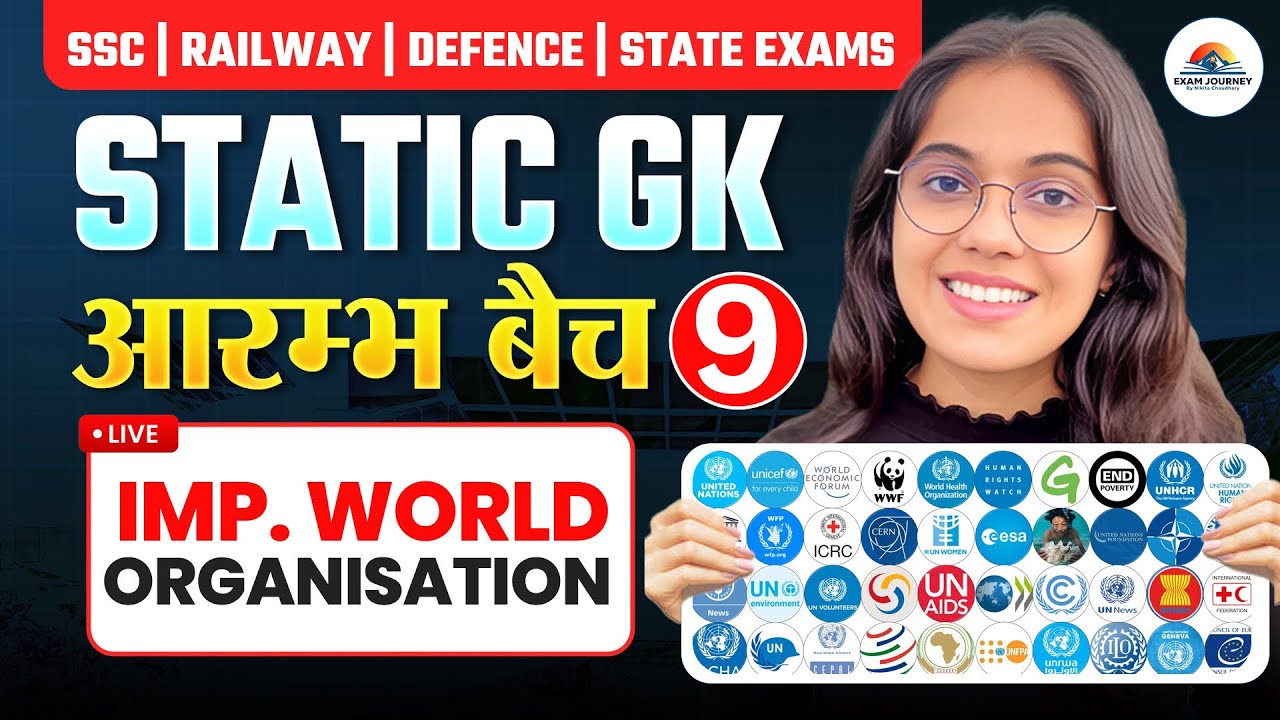
In this session, Nikita Chaudhary introduces the ninth class of the Arambh batch, focusing on important international organizations. The video discusses their headquarters, functions, and member countries, addressing the increasing tensions between India and Pakistan and reminding viewers about staying safe and verifying news before sharing. Key organizations like the United Nations, World Health Organization, and others are explained along with their establishment dates and critical roles.
- Importance of international organizations in exams
- Overview of significant world organizations with specific details
Introduction to International Organizations
Nikita welcomes viewers and emphasizes the focus on vital international organizations in the ninth class. She underlines the need for students to pay attention to their studies with dedication and honesty.
Current Events and Safety Precautions
Nikita discusses the increasing tensions between India and Pakistan and urges viewers to remain safe. She advises against opening unknown messages or files, as they could compromise one's identity. She highlights the importance of relying on verified news sources, such as government sites, to avoid misinformation.
Class Updates and Importance of Learning
Nikita provides updates on the Arambh batch, explaining that previous classes were missed due to health issues. She stresses the importance of learning about significant world organizations, which often feature in exams.
United Nations: An Overview
The UN was established in 1945 to maintain international peace following the World Wars. Its headquarters is in New York City, and it comprises 193 member countries, with South Sudan being the latest member from 2011. The UN's official languages include English and French.
UN's Major Organs
The UN consists of six main organs: the General Assembly (a legislative body), the Security Council (responsible for maintaining international peace), the Economic and Social Council, the Trusteeship Council, the International Court of Justice (ICJ), and the UN Secretariat.
USC: Security Council
The UN Security Council (USC) has 15 members, including 5 permanent members with veto power: USA, UK, Russia, China, and France. The first veto was exercised by the USA, while the Soviet Union used it the most before its dissolution.
International Organizations and Their Functions
Nikita reviews various organizations established after significant events, including the International Labor Organization (ILO), World Bank, and others - discussing their headquarters and the importance of knowing when they were formed.
World Health Organization (WHO)
The WHO, established on April 7, 1948, is crucial in public health. The date is significant as it is celebrated as World Health Day. Its headquarters is in Geneva, Switzerland.
Food Organizations and Environmental Organizations
Nikita talks about the Food and Agriculture Organization (FAO) and World Meteorological Organization (WMO), and also mentions the United Nations Environment Programme (UNEP), which was created in 1972 to focus on environmental issues.
NATO and INTERPOL
NATO, formed in 1949, is a military alliance that provides collective defense among its members. INTERPOL, established in 1923, facilitates international police cooperation to apprehend criminals.
SAARC, BRICS, and ASEAN
Nikita provides insights into SAARC, formed in 1985, comprising South Asian countries, and BRICS, established in 2009 with an initial focus on Brazil, Russia, India, and China, later expanding to include South Africa. ASEAN focuses on Southeast Asian nations and was founded in 1967.
G7 and G20
The G7, initially G8, is a group of powerful economies. G20, where India has hosted a summit, includes 20 countries and the European Union. The composition of G20 was expanded to include the African Union.
Additional Organizations
Nikita summarizes other important organizations including OPEC (1960) for oil-exporting countries, and the Asian Development Bank (1966), providing updates on their headquarters and roles.
Conclusion and Exam Preparation
Nikita wraps up the session with reminders to prepare diligently for exams, emphasizing the importance of summarizing notes effectively without overwhelming amounts of text. She encourages viewers to stay aware of current events and uphold patriotism amidst challenges.

