
Brief Summary
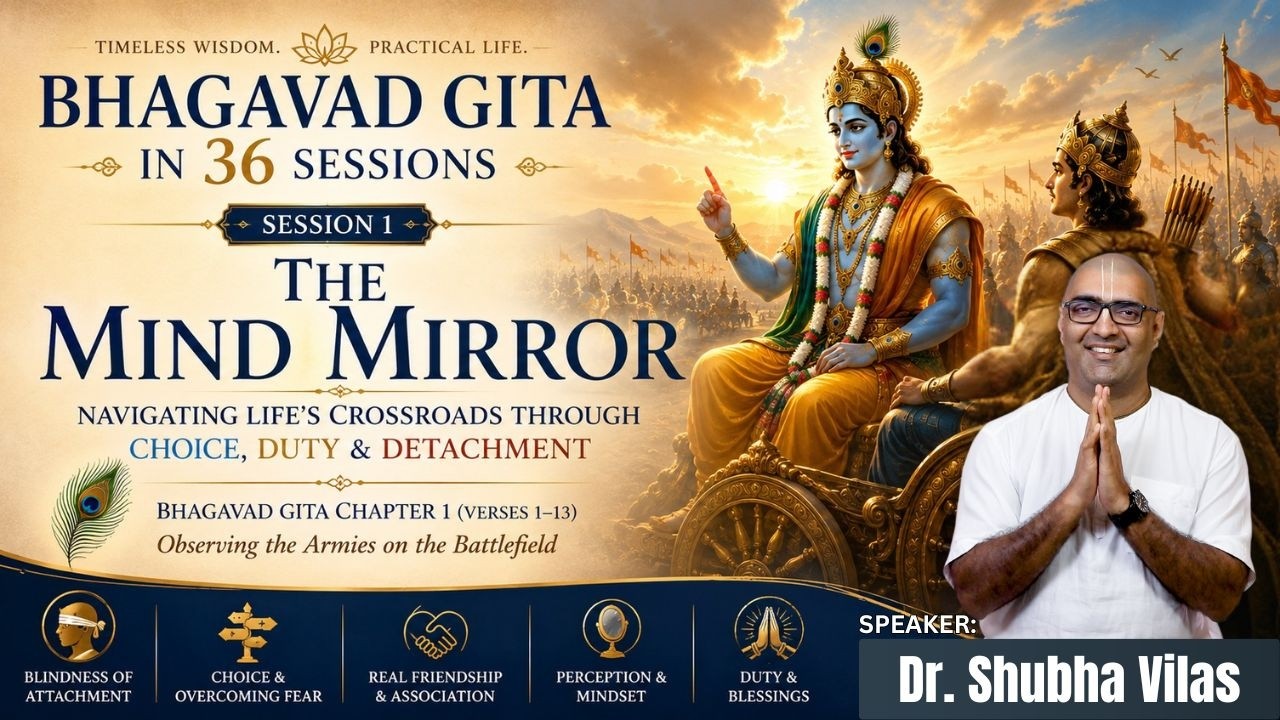
In this video, Shubha Vilas introduces his Bhagavad Gita classes that will span over 36 sessions, where he will provide an overview of all 18 chapters of the Gita. The session emphasizes understanding the context of the Gita, particularly focusing on the character of Dhritarashtra and the significance of the battle of Kurukshetra. Approaching the text both for novices and experts, the teachings intend to reveal deeper philosophical insights and practical applications of the Gita in everyday life.
- Overview of 36 sessions for the Bhagavad Gita
- Focus on initial context and characters, particularly Dhritarashtra
Introduction and Overview of the Bhagavad Gita Classes
Shubha Vilas expresses gratitude to the participants and announces that this batch of Bhagavad Gita classes will cover the entire text in 36 sessions. Each chapter will generally take two sessions, with some requiring only one and others possibly three. He encourages participants of all knowledge levels to engage with the material. A previous course on self-discovery is mentioned as beneficial for newcomers.
Context of the Bhagavad Gita
Vilas starts discussing Chapter One of the Bhagavad Gita, which opens with the words of Dhritarashtra, the blind king. This sets the context for the Gita, as it reflects failure in responsibility and awareness. Dhritarashtra symbolizes ignorance and attachment, highlighting the importance of taking responsibility for one’s actions and the consequences of being blind to dharma (righteousness).
The Significance of Dhritarashtra
The discussion revolves around the negative attributes represented by Dhritarashtra and highlights the blindness metaphorically connecting to the apathy towards dharma. The teachings suggest that everyone carries some baggage but emphasizes that the Gita is about transcending that baggage and becoming aware of higher principles of life.
The Nature of Duty and Dharma
Vilas elaborates on the concept of dharma, explaining that it is not merely about religion, but understanding one's true self and duties. The analogy of sugar and salt is used to explain that just as sugar must always be sweet, humans must adhere to their inherent duty, which can only be achieved through understanding one's true identity.
The Assembly on the Battlefield
The scene transitions to the battlefield of Kurukshetra, where Dhritarashtra, aware that a war is about to commence between his sons (Kauravas) and the sons of Pandu (Pandavas), asks Sanjaya what they are doing. This signifies the beginning of conflict, symbolizing larger philosophical and existential battles that individuals face within their lives.
Duryodhana's Dilemma
Duryodhana, the principal antagonist, is portrayed as he witnesses the formation of the Pandavas' army. His surprise and fear reflect the recognition of not only numerical strength but the moral superiority of the Pandavas, which is highlighted through the traits of their leaders like Bhima. The complexity of his character is explored as he reacts to the proactive and united front the Pandavas present.
Bhishma and Duryodhana
Duryodhana approaches Bhishma, the revered Kaurava commander, to express his concerns about the battle preparations. His actions portray fear masked under bravado, indicating the inner conflicts he experiences before the clash, which reflect human insecurities in the face of moral dilemmas.
Sound and Symbolism in War
As preparations commence, the sounding of conch shells symbolizes the commencement of battle and the dynamics of the war. Different characters and their respective conch shells are introduced, highlighting their roles and the significance of sound in instilling morale and indicating readiness for conflict.
The Significance of Krishna's Role
Krishna's presence and his humble role as Arjun's charioteer are emphasized to showcase the essence of true leadership and guidance. His position implies a divine orchestration of the events, symbolizing the need for surrender and trust in divine wisdom, paralleling Arjun's moral and emotional struggles he is about to face.
Arjuna’s Conflict and Resolution
At the climax, Arjun requests to be taken to the center of the battlefield, where he faces his most significant fears and attachments—symbolized by Bhishma and Dronacharya. This moment signifies a pivotal point where personal and spiritual growth begin through confronting what one fears most. The session sets the stage for further exploration of these themes in upcoming classes.
Conclusion and Forward Look
The session concludes with an outline of the next session's schedule and the topics that will be covered. Shubha Vilas expresses enthusiasm for engaging further with participants in understanding the depth of the Bhagavad Gita in future classes.

