
Brief Summary
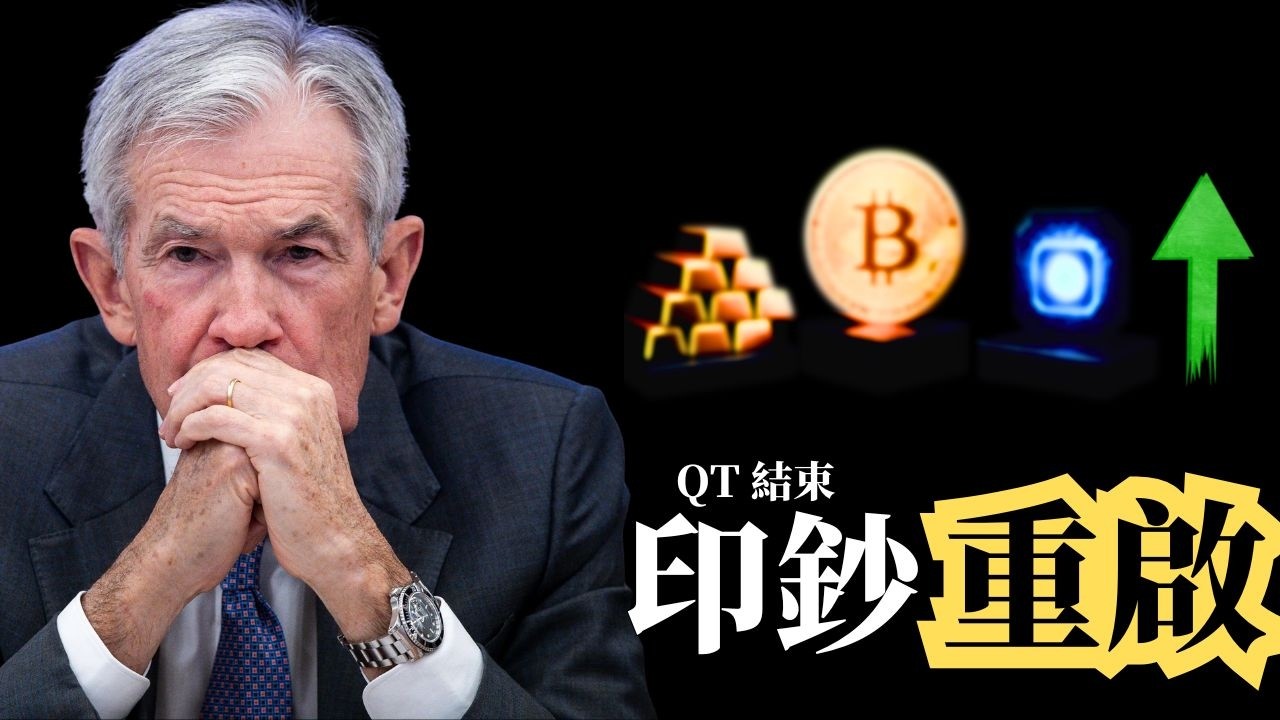
This video discusses the upcoming end of quantitative tightening (QT) by the Federal Reserve and its potential impact on financial markets. It suggests that the Fed's actions are driven by the need to stabilize the financial system rather than solely focusing on economic conditions. The video also explores potential investment strategies, emphasizing the importance of a balanced approach with core and satellite assets to navigate the expected "melt-up" in asset prices.
- The Federal Reserve is ending quantitative tightening (QT) in December, which will inject liquidity into the market.
- This action is primarily to stabilize the financial system, not just to stimulate the economy.
- A "melt-up" in asset prices is anticipated, driven by increased liquidity and political factors.
- Investment strategies should include a mix of core and satellite assets, focusing on cryptocurrencies, gold, and hard asset stocks.
- Avoiding high-leverage contracts and resisting the urge to short bubbles are crucial for wealth preservation.
市場的兩極分化與被忽視的轉折點
The financial market is currently polarized, with some predicting economic collapse and others anticipating a continued bull market. However, the speaker believes both viewpoints miss a crucial turning point: the Federal Reserve's upcoming end to quantitative tightening (QT) in December. This event, often overlooked by retail investors, is more significant than interest rate cuts.
華爾街押注12月:QT結束與流動性回歸
Wall Street is betting heavily on a December rate cut, with expectations surging from 38% to nearly 86% in a week, alongside hedge funds making significant purchases. This is because the end of QT effectively removes a drain on market liquidity, potentially triggering a surge in asset prices similar to what was observed when the money printer was turned on in 2020. The speaker warns that past investment strategies may not be effective in the current environment.
底層邏輯:為何FED不救經濟卻要救金融管路?
The Federal Reserve's decision to end QT and potentially restart easing is not primarily aimed at saving the economy but at rescuing the financial plumbing. The financial system is likened to an engine, with bank reserves acting as lubricating oil. The Fed's QT has been draining this "oil," pushing the system toward a critical point where it risks stalling.
紐約聯儲主席的暗示:資產負債表即將擴張
New York Fed President John Williams has hinted that the Fed's balance sheet will soon need to expand again, which essentially means printing more money. The speaker emphasizes the importance of understanding the underlying logic behind the Fed's actions by looking at history to predict future scenarios.
歷史重演:2019年回購危機與印鈔機重啟
The current situation is compared to 2019 when a repo market collapse forced the Fed to reverse course and start printing money again. During that time, overnight lending rates spiked to 18%. Key liquidity indicators are flashing warning signs, leading to a surge in expectations for a December rate cut. The speaker believes the Fed has no choice but to ease monetary policy.
Ray Dalio的預言:資產熔漲(Melt-up)即將到來
Ray Dalio predicts a "melt-up" in asset prices due to the combination of high debt, persistent inflation, and the Fed's likely return to quantitative easing (QE). This scenario would lead to asset prices becoming detached from economic fundamentals. The speaker emphasizes that understanding this trend alone is not enough to guarantee profits; a well-defined trading system is essential.
政治催化劑:2026年川普可能的經濟哲學影響
A significant catalyst for further asset appreciation could be the U.S. political landscape, particularly the potential appointment of a new, dovish Federal Reserve chair in 2026 by a President Trump. Trump's preference for low interest rates, a weaker dollar, and a rising stock market could lead to the Fed tolerating higher inflation to maintain market宽松. The speaker suggests that bad economic news, such as rising unemployment, might be interpreted as positive for financial markets because it would pressure the Fed to ease policy.
警告:光看懂趨勢不代表能賺錢
Understanding market trends is insufficient for making profits; a robust trading system is necessary. The speaker promotes a free checklist to diagnose shortcomings in decision-making processes and a mini-course to install a system for maintaining composure in the market.
避坑指南一:拒絕二元思維,採用「核心+衛星」配置
To survive in the financial markets, avoiding pitfalls is more important than generating profits. The first pitfall to avoid is binary thinking. Instead of an all-in or all-out approach, the speaker recommends a core and satellite asset allocation strategy. Core assets, such as U.S. tech (QQQ), bonds, and gold, form the foundation, while satellite assets, comprising 10-20% of the portfolio, are used for opportunistic investments.
避坑指南二:遠離高槓桿合約與業配陷阱
The second pitfall to avoid is high-leverage contracts. Even moderate leverage can lead to significant losses if the market moves against the position. The speaker advises against using high leverage, especially in volatile markets like cryptocurrencies, where sudden "flush outs" can liquidate positions.
避坑指南三:你不是天才,千萬別做空泡沫
The third pitfall is attempting to short bubbles. The speaker cautions against trying to be the smartest person in the room and betting against a rising market fueled by government stimulus and easy money. The market can remain irrational longer than one can remain solvent, so it's best to ride the trend until the music stops.
進攻資產:加密貨幣(流動性的海綿)
Cryptocurrencies, particularly Bitcoin and Ethereum, are identified as "liquidity sponges" that can absorb excess liquidity from the market when the money printer restarts. While they offer high potential returns, they should only be a small part of the portfolio due to their volatility and other risks. Cryptocurrencies are considered a high-beta asset suitable for aggressive growth.
防守資產:黃金(通脹失控的逃生梯)
Gold is presented as a hedge against runaway inflation and a store of value in times of economic uncertainty. It serves as a "last resort" insurance policy for a portfolio. While gold may not offer explosive growth, it can preserve purchasing power and protect against currency devaluation. The speaker suggests considering gold mining stocks (GDX) as a way to capitalize on stable gold prices.
核心資產:硬資產股票(現金流與實體增長)
Hard asset stocks, particularly in infrastructure, utilities, and energy, are identified as core holdings that offer real cash flow and exposure to tangible growth. These sectors are expected to benefit from increased capital expenditure and reindustrialization efforts. The speaker advises against investing in companies that lack genuine cash flow and are primarily engaged in financial engineering.
總結:QT結束只是序幕,行動三部曲
The end of QT is just the beginning, with political shifts being the next key factor to watch. The speaker outlines a three-step action plan: complete a free trading advantage checklist, attend an upcoming live stream analyzing AI bubble assets, and consider joining a mini-course on expected value thinking to build a robust trading system. The goal is to avoid being "transferred" in the upcoming wealth transfer game.

