
Brief Summary
This video discusses projects, strategy, and KPIs, emphasizing their importance in organizational performance. It covers how projects contribute to strategy, the different levels of performance management, and how to measure performance effectively. The video also provides guidance on structuring an assignment to analyze an organization's performance, including selecting a company, discussing strategic objectives, and making recommendations for improvement.
- Projects and strategy are crucial for organizational performance.
- Performance management should be proactive and provide focus.
- The assignment requires analyzing an organization's performance and making recommendations.
Projects and Strategy
Strategy implementation can be viewed as both an operations event and a project management activity. Creating a project team to deliver strategic objectives doesn't necessarily change an organization's structure from functional to matrix; it simply creates a temporary team. Projects can significantly contribute to strategy by building capability and increasing organizational development. When examining a strategic project, it's important to distinguish between projects for customers and projects that build internal capability, focusing on growth rather than immediate revenue recognition.
Project Management Categorization
Project management and strategy are categorized into programs (groups of projects), portfolios (groups of projects and programs managed to achieve strategic objectives), and projects (temporary endeavors with unique outcomes). Strategic objectives aimed at building value can be delivered through project management. It's crucial to differentiate between strategic projects under a portfolio and projects focused on revenue generation.
Measuring Performance with KPIs
Measuring performance is essential for improving KPIs related to operational performance and strategic objectives. Performance management should proactively drive the achievement of organizational objectives by providing focus and direction. An effective performance management system breaks down objectives to ensure clarity at all organizational levels, and measuring performance establishes a baseline for assessing improvements.
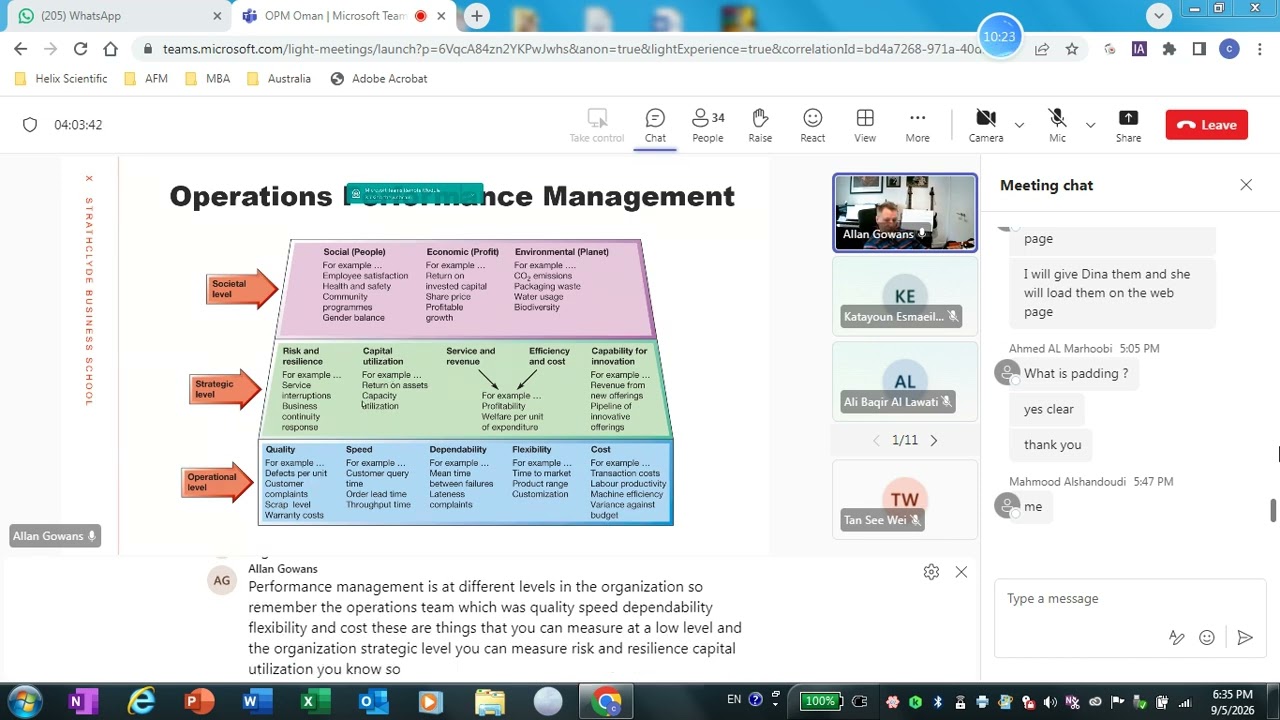
Performance Management Levels
Performance management occurs at different levels within an organization. At a lower level, operations themes like quality, speed, dependability, flexibility, and cost are measured. At a strategic level, risk and resilience, capital utilization, service and revenue efficiency, and cost are measured. Growth at the strategic level is assessed by revenue, operating profit, free cash flow, and innovation capability.
Effective Performance Measurement
Targets are crucial for understanding performance and progress, but they must be measurable and specific. Measuring something that doesn't impact the organization is pointless. Targets should align with strategic objectives, moving from division to department to team levels. Different types of measures include usage, inputs, and outputs, which can be used to identify the effectiveness of conversion processes.
Problems with Traditional Performance Management
Traditional performance management can be too focused on limited areas like finance, making it difficult for those in operational roles to understand how to influence financial outcomes. Performance measures need to be simplified and relevant to the specific roles within the organization. It's important to consider financial, internal operational, and customer perspectives when measuring performance.
Customer Perspective and Net Promoter Score (NPS)
Customer satisfaction can be measured through surveys, which can be turned into KPIs like the Net Promoter Score (NPS). NPS is a mechanism for taking customer feedback and weighting it to target improvements. Improving NPS can lead to increased revenue. Internal operations can be measured through inventory terms, managed working capital, and cash flow.
Aligning KPIs with Strategic Objectives
When writing a report, it's important to identify if the measured KPIs influence financial movement. If not, consider measuring something else that aligns with strategic objectives. The report should analyze the company's actions and make recommendations or agree with them. A balanced scorecard pulls together financial performance, internal performance, and customer expectations.
Shareholder and Customer Perspectives
Shareholders view a company based on its ability to make money, generate cash, and grow. Analysts value a company based on its performance and alignment of strategy with the external market. Customer feedback on product quality, selection, price, functionality, service, and brand allows for creating change levers to redefine the company's image and build relationships.
Internal Processes and Learning Growth
Internal processes, including operational, supply chain, engineering, production, distribution, customer management, innovation, and regulatory processes, should be efficient. Tools like total quality management, Six Sigma, and continuous improvement can drive better risk performance measures. Learning and growth involve building capability and creating value through human capital utilization and development, which can be influenced by training, infrastructure investment, and recruiting growth.
Truth Testing KPIs
It's crucial to truth test KPIs to ensure they have a purpose and are worth measuring. Leaders should avoid measuring things they can influence if it doesn't make a difference to the strategic direction. Measure something that impacts your strategic direction.
Recommended Reading
Recommended reading includes chapters from "Payton and Operations Management" and "Project Management by Meredith." These resources can be referenced to build up the assignment.
Assignment Overview
The assignment aims to assess skills in analyzing organizational performance and understanding operations and project management in a practical context. The first step is to identify an organization to analyze, preferably one where you can access good information. The objective is to analyze the chosen organization's performance and demonstrate an understanding of how it works practically, using selected class material.
Assignment Structure
The recommended report structure includes an introduction to the company, its strategic objectives (mission, vision, values), and organizational structure. Then, focus on either project management or operations management. For operations management, discuss the conversion process. For project management, discuss time, scope, cost, risk management, and project delivery.
Operations Management Focus
If focusing on operations management, discuss the main five performance objectives: speed, quality, dependability, flexibility, and cost. Explain how each is measured and how the performance is assessed.
Recommendation and Conclusion
After analyzing the organization, make a recommendation on what the business should do to better align with its strategic objectives. The report should include a discussion and analysis, followed by a recommendation and conclusion. The report should be no more than 2,500 words, excluding tables, graphs, and references. An executive summary and abstract are not required.
Reflective Log and Assignment Parts
The assignment has two parts: an analysis and a reflective model. Use Gibbs' reflective cycle for the reflective piece. The first part is 2,500 words, and the second part is 400-500 words, totaling about 3,000 words. Both parts should be submitted together.
Applying Models and Bias
It's acceptable to be biased towards operations or project management based on the organization's structure. If the organization has a functional structure, bias towards operations management is fine. If it's a matrix structure, discuss both elements. If it's a project management organization, discuss the project management tools used or those that should be used.
Content of the Reflective Part
The reflective part should demonstrate the value gained from the class and how it benefited you. This can be a conversation or a topic covered during the class. The reflective part should show that you are taking something from the class, whether good or not. Use the Gibbs reflective process to structure the reflective piece.
Governmental Entity Assignment Structure
For a governmental entity, follow the same structure as everyone else: discuss strategic objectives, organizational structure, and then pick a project. Use the literature on time, cost, scope, and risk management to describe the project.
Mixing Operational and Project Management
If covering both project management and operations, be mindful of the 2,500-word limit. Cover the conversion process and four Vs for operations, and walk through a project for revenue recognition. Ensure a clear distinction between the operation and how revenue is recognized from project delivery.
Selecting a Company for Analysis
The key is to get access to the information. If you have no input to a company, it might be difficult to write a report. Base your decision on whether you can access the right level of information to write a meaningful report, including KPIs.
Anonymizing the Company
You need to anonymize the company as it can't get shared in the public domain. If you want to anonymize it, you just need to make sure you can write it appropriately.
Local Counselor Session and Contact Information
The local counselor can help with questions during the next session. Contact the instructor for clarity if needed. The instructor works for a company called T and will generally respond later in the evening. The assignment due date is June 1st.

