
Brief Summary
This video provides a detailed explanation of the "lower core golf swing," focusing on how golfers can achieve effortless power through proper techniques and body mechanics. Key points include:
- The swing is powered by ground reaction forces, not arm strength.
- The swing relies on a strong foundation composed of leveraging the ground, early hip rotation, and deep back swing.
- The importance of a proper follow-through to maintain balance and efficiency.
Introduction to the Lower Core Golf Swing
The video begins by introducing the concept of the lower core golf swing, highlighting its focus on creating effortless power. It emphasizes that achieving consistency like professional golfers requires understanding how speed is generated, specifically through leveraging the ground rather than overexerting using the arms.
The Lower Core Golfer Concept
The presenter defines a lower core golfer as someone whose swing is built on three essential pillars: using the ground for leverage, executing a significant hip turn, and establishing depth in the backswing. These elements work together to produce a powerful rotary motion, which is crucial for a successful swing.
Setting Up the Swing: Address Position and Takeaway
At the address position (P1), the golfer should hinge from the hips rather than bending from the waist, with the spine tilting to allow the chest to be positioned over the ball. The focus should be on feeling the pressure in the feet, creating a preloaded athletic stance. The takeaway should initiate with a pelvic rotation rather than arm movement, using the torso to keep the club at a low position and build torque.
The Ascent: Building Depth in the Backswing
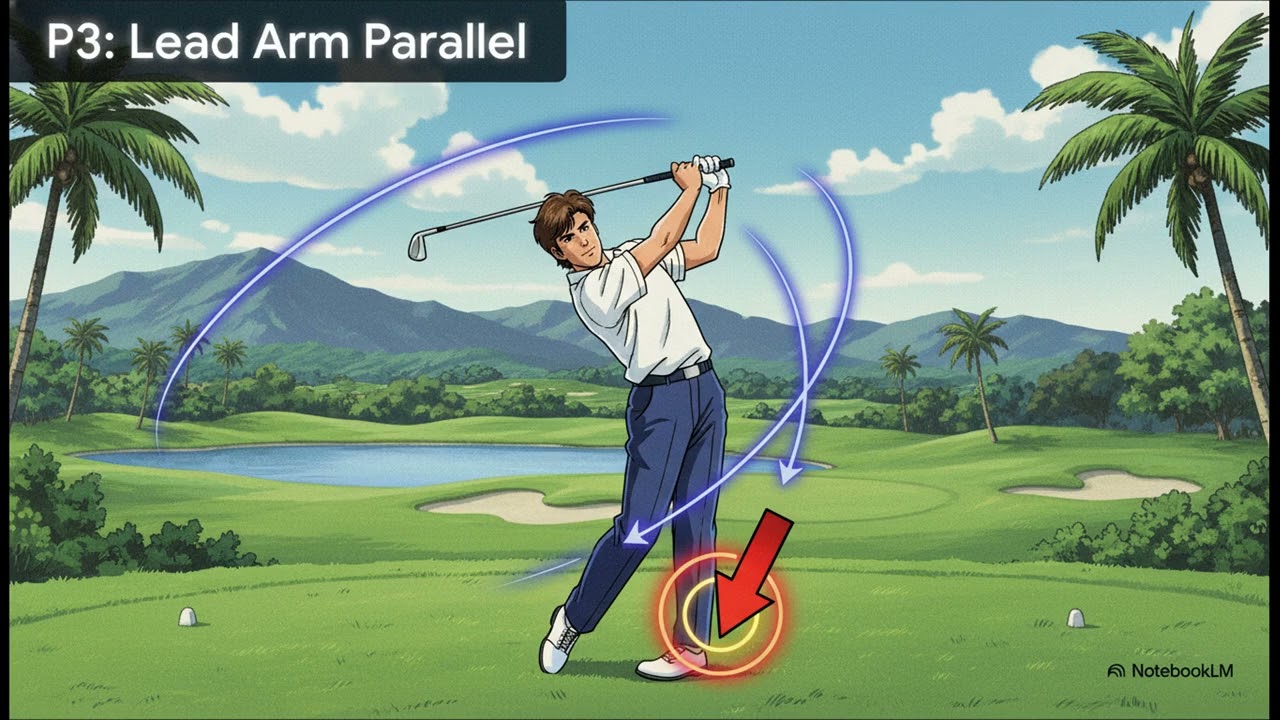
During the ascent of the backswing, the aim is to create depth to store rotational energy. As the lead arm reaches parallel to the ground, the hands should move around the body, creating width and depth rather than height. This motion loads pressure into the trail leg, setting the golfer up for a powerful swing.
The Top of the Backswing
At the top of the backswing, the hands should be positioned deep behind the trail shoulder, with significant hip rotation (about 45°). This arrangement allows for optimal space for the arms while simultaneously loading weight into the trail leg, preparing the golfer for an explosive downswing.
The Downswing: Transitioning Power
The downswing begins with the lower body, particularly the trail hip and leg driving toward the target, while the upper body remains coiled. This motion naturally positions the club for an inside path without effort, emphasizing the importance of the transition sequence to build torque.
Impact and Energy Transfer
The impact phase is marked by the trail foot pushing off the ground, transferring energy through the body. The hips are open, while the bracing of the lead leg acts as a break, slingshotting the club through the ball for maximum speed. This technique results in a forward shaft lean that creates a compressed strike.
Follow Through and Finish
The follow-through is not merely aesthetic but is a natural outcome of an efficient swing. Following impact, the club continues on a rotary arc around the body, with the golfer ending in a balanced position that exhibits an upright posture and weight distribution on the lead leg. This reflects the successful integration of ground power into the swing mechanics.
Conclusion: Constructing Your Powerful Swing
The video concludes by summarizing the blueprint for the lower core swing, emphasizing that real power comes from the ground. The backswing focuses on coiling to store energy, while the downswing relies on unwinding this energy for an efficient swing. The importance of the finish position is reiterated, showcasing balance and the effective use of rotation in golf.

