
Brief Summary
This video analyzes the concept of non-player characters (NPCs) in real life, exploring indicators of who might possess a "divine spark" or soul versus those who are more akin to automatons. It examines various datasets and theories, including the Myer-Briggs Type Indicator (MBTI), near-death experiences (NDEs), the Gnostic view of souls, terminal lucidity, visualization abilities (hyperphantasia vs. aphantasia), and the Mandela effect, to explore the idea that not all individuals possess the same level of consciousness or spiritual awareness. The video suggests that a minority of people exhibit traits of transcendence, inner awareness, and pattern recognition, while the majority function on a more material, sensory level.
- MBTI intuitives are more likely to be "player characters" while sensors are more likely to be NPCs.
- Near-death experiences and terminal lucidity are not universal, suggesting varying levels of spiritual connection.
- Aphantasia, or the lack of visualization, may correlate with reduced empathy and a more "NPC-like" existence.
Intro
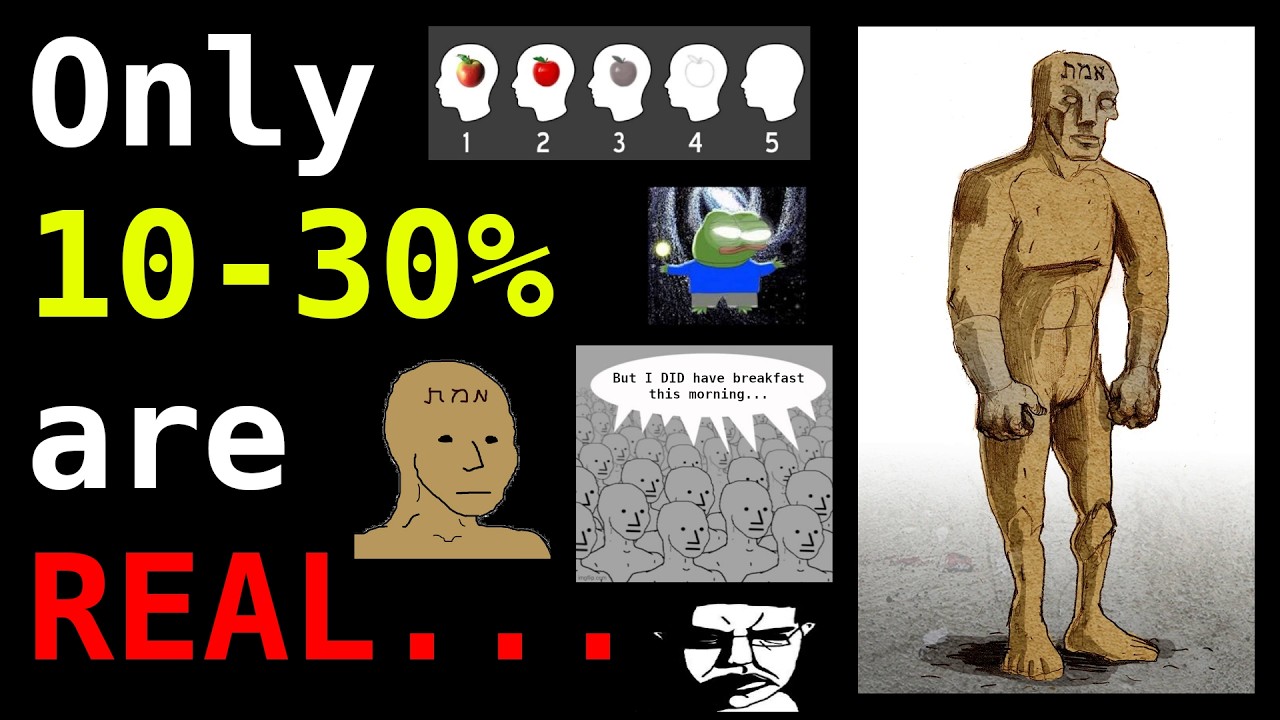
The video introduces a comprehensive analysis of a collage image that explores different aspects of non-player characters (NPCs) and indicators that differentiate them from player characters. The image is divided into sections, each analyzed separately in the video.
MBTI N (intuition) vs S (sensing) Types
This section focuses on the Myer-Briggs Type Indicator (MBTI), specifically the sensing (S) versus intuition (N) polarity. Sensing types focus on concrete details, present reality, and practical applications, often lacking curiosity for knowledge without immediate material payoff. They describe things literally. Intuitive types imagine possibilities, see the bigger picture, enjoy ideas for their own sake, and describe things figuratively. Sensors focus on the present moment and tangible details, resembling an animal's view of the world, reacting to stimuli without imagining possibilities. Intuitives focus on abstract concepts, hidden meanings, and future possibilities, gathering information through a "sixth sense" and recognizing patterns. Intuitives enjoy imaginative explanations and can read between the lines, unlike NPCs who cannot go beyond the literal meaning. Statistics show that intuitives are a minority (26-27%) while sensors make up the majority (70-75%) of the population, indicating a societal preference for sensing.
UFO Abductees and the Soul/Spark
This segment discusses UFO abductions in relation to the existence of the soul. A UFO abduction researcher, using hypnosis, communicated with souls inside human bodies and found that only 25% of humans have a soul, which aligns with the MBTI data. Souls attach to bodies via DNA. Alien abductees are the ones who have souls, which other human beings don't possess. Approximately 70 to 75% of people would be non-player characters, lacking spirit, the divine spark, or the soul.
Eliminating the soul with medicine (Rudolf Steiner)
This section explores Rudolph Steiner's views on eliminating the soul with medicine. Steiner stated that in the future, medicine and vaccines would be used to prevent humans from developing the thought of the existence of soul and spirit. Materialistic doctors would be entrusted with removing the soul of humanity, making the atheric body loose in the physical body. This would lead to people becoming automatons, focused purely on materialistic feelings and unable to rise to the spiritual. The vaccine becomes a kind of arromanique force.
Inner monologue and NDEs
This segment discusses the inner monologue in relation to near-death experiences (NDEs). Only 30 to 50% of people regularly think to themselves in internal monologues. Estimates vary, but approximately 5 to 20% of the general population report experiencing an NDE. For individuals who have experienced cardiac arrest, the percentage is higher, ranging from about 10% to 23%. Everyone else sees black or they say they saw nothing after death. The ability to have a near-death experience may be correlated with the ability to have a soul.
Gnostic soul heirarchy (pneumatics, psychics, hylics)
This section delves into the Gnostic view of souls, categorizing humans into Hilix, psychics, and pneumatics. Hilix are material beings focused on worldly matters, incapable of spiritual awareness. Psychics have some awareness of spiritual reality but are still tied to earthly life. Pneumatics are fully spiritual beings who have attained gnosis and can escape the material realm. Hilik personality traits include a material focus, superficial inquiry, a utilitarian approach, action-oriented behavior, dualistic thinking, disinterest in spirituality, adaptive values, conformity, temporal fixation, sensory dominance, and reactive consciousness. The spirit rebels against the imprisonment of this reality. NPCs can't go off script because they're of the world, made of matter.
Terminal lucidity (near-death lucidity/mental clarity)
This segment explores the phenomenon of terminal lucidity, an unexpected return of consciousness and mental clarity shortly before death in individuals with severe psychiatric or neurological disorders. Near-death experiences have been reported worldwide independent of culture. Mental clarity returns as the body dies and the spirit is bursting at the seams preparing to leave. Out of a 100 deaths that happened in the hospice, six cases experienced terminal lucidity. Considering the historical condition of the patient, lucidity of this degree at the end of life is unexplainable by science because it is not a naturally founded phenomena but a supernaturally founded one. Approximately 10% exhibited terminal lucidity. The figure of 10% matches the data set convergence range of 10 to 30% as seen with other NPC related phenomena.
Visualization abilities (hyperphantasia vs aphantasia)
This section discusses the role of visualization in determining whether someone is a player character or an NPC. The ability to observe one's cognition differentiates a real person from an NPC. Hyperphantasia is the ability to visualize things extremely vividly, while aphantasia is the complete lack of the ability to visualize. The ability to visualize can produce bodily responses. People with aphantasia don't sweat when they read a very scary story. 10% of the world's population has hyperfantasia. People who experience extra vivid imagery are often in the arts and may experience heightened emotions. Aphantasia also hinders her ability to roleplay with her children. Conscious sensory imagery is not a prerequisite for human cognition. The natural interpretation is that in the absence of imagery, the impact of emotive language is reduced because imagery typically mediates between verbal description and emotional response. The majority of the population could be psychopaths, but they're because of the fact that they're good at putting on a mask.
General overview/dataset convergence and the mandela effect
This section provides a general overview of the topics discussed and explores the Mandela effect. The basic question is whether we can find population-level markers that correlate with who has a divine spark. Near-death experiences, MBTI intuition versus sensing, and inner monologue are discussed as indicators. The convergence is that a minority, 10 to 30%, show traits of transcendence, inner awareness, or pattern recognition. The majority, 70 to 90%, functions on a more material sensory level without reflective depth. The Mandela effect only seems to affect NPCs, which are the demi urges material spiritless minions. NPCs function as stabilizers. They always quote unquote remember the new script correctly, preventing reality from unraveling. The Mandela effect could be seen as archic edits to the script of the cosmos.

