
Brief Summary
This dialogue explores the intersection of mysticism, science, and non-duality through the lenses of analytic idealism and Advaita Vedanta. Bernardo Kastrup and Swami Sarvapriyananda discuss consciousness, its role in their respective traditions, and its relation to phenomenal reality, unconsciousness, and artificial intelligence. They also tackle the hard problem of consciousness, the contemporary meaning crisis, and the nature of reality, offering insights into the limitations of materialism and the search for meaning in a world increasingly shaped by scientific and technological advancements.
- Analytic idealism posits that all reality is experiential, with the physical world being a dashboard representation of underlying mental states.
- Advaita Vedanta identifies one limitless consciousness or being that appears as mind, body, and world, emphasizing the realization of the underlying reality.
- Both philosophies agree that consciousness is fundamental, and what we perceive as unconsciousness is simply elements of consciousness not immediately accessible.
- The hard problem of consciousness is seen as a contradiction arising from a materialist viewpoint.
- The dialogue touches on the meaning crisis, attributing it to historical and socio-economic factors, and suggests a shift towards a new worldview.
Introduction
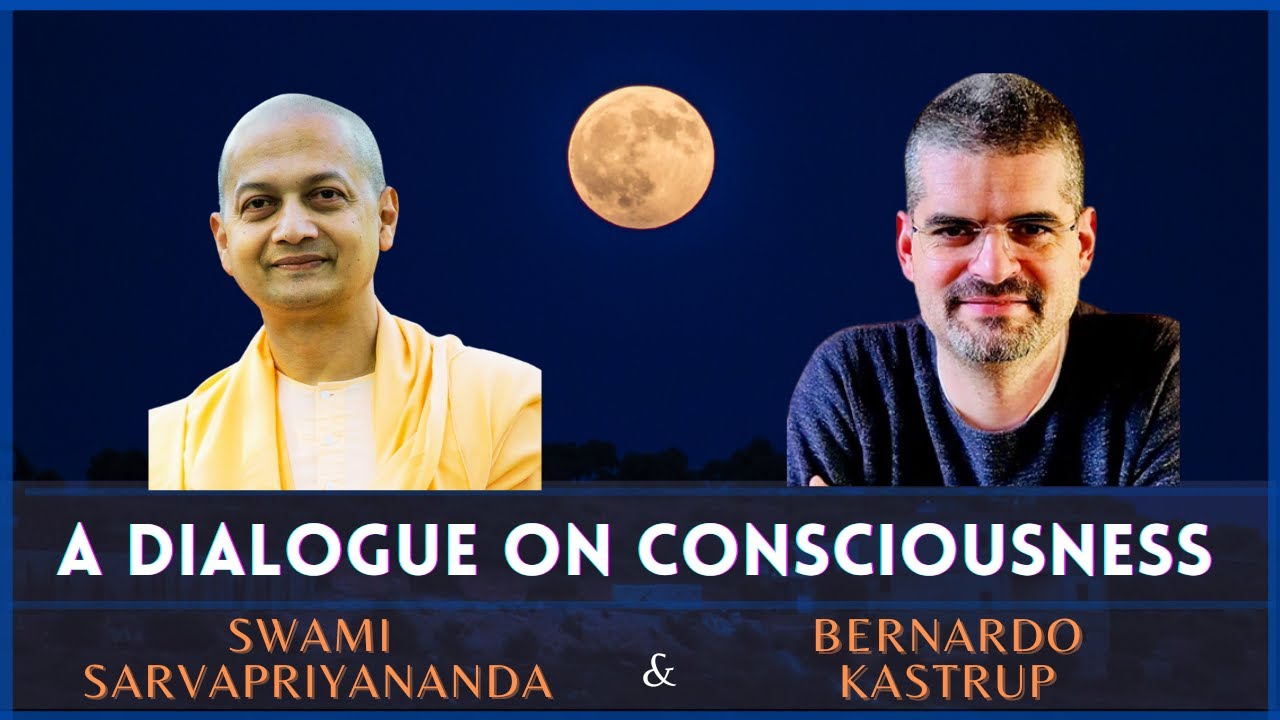
The moderator introduces the theme of the dialogue: mysticism, science, and non-duality. The discussion will cover the speakers' respective traditions—analytic idealism and Advaita Vedanta—and zoom in on the meaning of consciousness, its role in these traditions, similarities between the two, the concept of the unconscious, phenomenal reality, the hard problem of consciousness, artificial intelligence, and the contemporary meaning crisis. The speakers, Bernardo Kastrup and Swami Sarvapriyananda, are introduced with their backgrounds and contributions to their respective fields.
Analytic Idealism and Advaita Vedanta Summaries
Bernardo summarizes analytic idealism as the idea that all reality is experiential. The external world exists, but it is made of mental or conscious states. The physical world is a dashboard representation of this real world, created through our interaction with it. He uses the concept of dissociation from psychiatry to explain how we are dissociated complexes of one field of subjectivity, with biology and metabolism being the dashboard representation of this dissociation. Swami G summarizes Advaita Vedanta by stating that there is one limitless consciousness or being that appears as mind, body, and world, similar to a dream. He references the dream metaphor used in Advaita, where the dreamer is both the subject and object of the dream. He concludes that the underlying foundation of both philosophies is very similar: consciousness is all there is.
The Nature of Consciousness
Bernardo explains that asking "what is consciousness" seeks a reduction, but there must be a primitive that cannot be explained in terms of something else. He claims that consciousness, as a field of subjectivity, is that primitive, with everything else being excitations or configurations of consciousness. Swami G adds that consciousness is a fundamental reality that enables first-person experience. He quotes St. Augustine, who said that he knows what time is when he is not asked to explain it. He combines Bernardo's idea of consciousness as that of which everything else is an excitation with the concept of Atman to describe Brahman.
The Unconscious
Swami G distinguishes between consciousness and knowledge, explaining that there are things known and unknown, but all are appearances in consciousness. He uses the dream analogy to illustrate how the entirety of the known and unknown in a dream is a product of the dreaming mind. Bernardo uses scientific metaphors, stating that physicalism posits all there is is unconsciousness, which is self-contradictory because illusions must exist in consciousness. He explains that the unconscious can be an illusion, parts of consciousness that we don't know of. He uses the example of breathing, which we are always conscious of but not always explicitly aware of. He concludes that the unconscious is a mixture of lack of metacognition and lack of associative links, but it is not unconscious at all.
Phenomenal Reality
Swami G explains that Advaita, borrowing from Samkhya philosophy, defines consciousness as "not this," meaning whatever can be labeled as "this" in our experience is not consciousness. He says that material nature includes not only the physical universe but also the biological body and the mind. Advaita goes a step further, realizing that what appears as other than us is nothing but us. Bernardo states that matter is what conscious processes look like when observed from the outside, across a dissociative boundary. He says that what we consider the material world are contents of perception, experiential states that represent other conscious states.
The Persistence of Material Reality Notion
Swami G compares the question of material reality to the debate about the difference between waking and dreaming. He says that waking reality feels real, but when pushed to give reasons why, none of them really work. He shares an anecdote about a committed materialist who designed an experiment to prove that the world is not in consciousness, but Swami G pointed out that the experiment was designed and perceived within his consciousness. Bernardo adds that the materialist's experiment assumes that consciousness is restricted to individual living beings, which Advaita denies. He says that the shiny silver disc we experience as the moon does not exist when nobody is looking at it, but the conscious process that underlies what we call the moon does exist.
Why Materialism Persists
Bernardo argues that many who consider themselves materialists do not understand what materialism actually is. He explains that physicalism claims all experiential states are inside your head, which leads to the conclusion that the world as you perceive it is entirely inside your head. He says that materialism is incoherent because it claims the brain creates mental states but doesn't explain how. He attributes the persistence of materialism to historical, social, economic, political, and psychological reasons, including the church's domain over psyche and the bourgeoa's desire to rob the clergy of social and economic influence.
The Hard Problem of Consciousness
Bernardo defines the hard problem of consciousness as the fact that there is nothing about physical properties in terms of which we could deduce the qualities of experience. Swami G responds that from the Samkhya perspective, the subject and object are very different, and it makes no sense to say that the object will produce the subject. He says that the example of life does not apply here because life is also "this," an objective phenomenon, while consciousness is the pure subject. Bernardo states that the hard problem is not a problem to be solved but an internal contradiction of a silly line of thought. He says that we made a mistake in our thought line and resist acknowledging it.
Artificial Intelligence
Bernardo defines AI as a clever way of processing information and making decisions analogous to how humans do. He distinguishes between AI as a tool and AGI (artificial general intelligence), which claims that the AI is sentient and has a private subjective point of view. Swami G explains that in Advaita, the part of the mind that processes information is also an object that can be aware of. He says that intellect is a set of objective processes, so artificial intelligence is entirely within the realms of possibility. Bernardo says that when people claim AI might become conscious, they mean it generates private, dissociated consciousness. He argues that the argument for sentient AI is ludicrous because it conflates the simulation with the thing simulated.
AI Mimicking Spiritual Teachers
Swami G shares that a computer science group fed a large language model with 1,000 hours of his videos, creating an AI that can answer Advaita questions and provide its sources. He says that while this AI may be useful and give more detailed answers than he can, there is something that happens in the presence of a living teacher that playing back those things cannot do. He references the ancient masters who emphasized sitting near the teacher and absorbing their presence.
The Contemporary Meaning Crisis
Bernardo says that the meaning crisis is due to the belief in materialism, which began with science and the enlightenment and led to the bourgeoa's desire to rob the clergy of social and economic influence. He says that we got rid of the fear of what we will experience after we are dead, but we purchased this at a great price: our lives have become meaningless. Swami G adds that we are all searching for the "one" that will hold all the zeros of our lives together. He says that the more sensitive we are, the more we feel the emptiness of life, but we can't deny it forever.
Moksha
Swami G explains that moksha is liberation from the cycle of birth and death. He says that we are compulsively trying to fulfill ourselves, which makes us keep taking body after body. He says that we are already what we are seeking, and when we realize that, the process of multiple lifetimes will cease. He relates this to Jivanmukti, the goal of spirituality in Advaita Vedanta, where one is fully enlightened and free while living in this world.
Analytic Idealism Interpretation of Moksha
Bernardo explains that under analytic idealism, the personal self is not who you really are; it's just a dissociated process. He says that what you really are is the whole thing, and the journey of life is a journey of self-discovery. He says that analytic idealism concedes spacetime in order to be accessible, while Advaita goes straight to what it is, uncompromising.
Spiritual Practice and Neo-Advaita
Swami G says that spiritual practices are important to prepare us for enlightenment and to stabilize that wisdom. He says that Neo-Advaita, which does away with the path and says there is nothing to do, is both true and pernicious. It's true that you are Brahman, but it doesn't solve our problems. He says that traditional Advaita provides a matrix of spiritual practices to address ignorance, restless mind, and impure mind.
Science vs. Religion
Swami G asks Bernardo if analytic idealism will offer a believable, valuable truth, as science seems to have a monopoly on truth while religion offers something meaningful but may not be true. Bernardo responds that science is a method to predict what nature will do next, but it has nothing to say about what nature is. He says that science is a set of convenient pictures, not what nature is.

