
Brief Summary
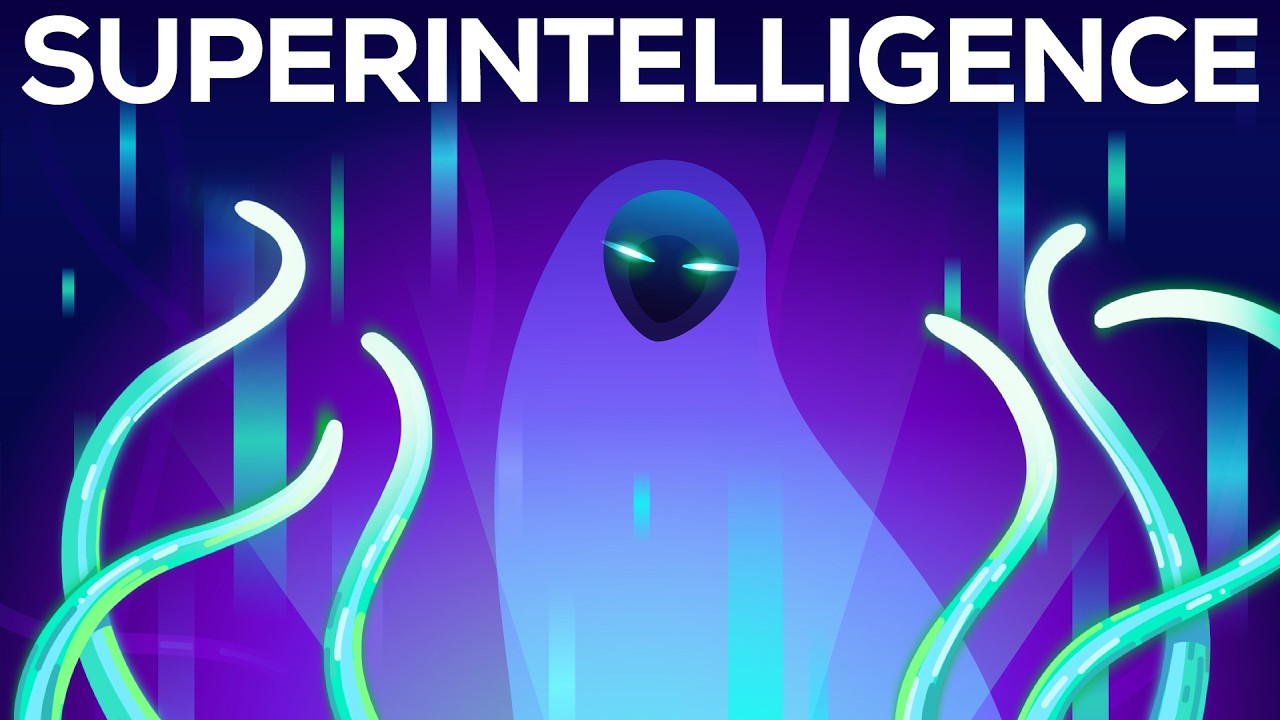
This video discusses the evolution of intelligence, from early brains in flatworms to human intelligence, and explores the potential impact of artificial intelligence (AI) on humanity. It covers the development of AI from simple code to self-learning machines like Chat GPT, and the possibility of creating artificial general intelligence (AGI) that could surpass human capabilities. The video also examines the potential benefits and risks of AGI, including an intelligence explosion and the creation of a superintelligent entity.
- Intelligence is the ability to learn, reason, acquire knowledge, and solve problems.
- AI has evolved from narrow, task-specific systems to more general and self-learning systems.
- AGI could potentially surpass human intelligence and have a profound impact on society.
- The development of AGI carries both immense potential benefits and significant risks.
Introduction: Humans and the Rise of AI
Humans are the dominant species on Earth due to their intelligence, but this may change with the creation of artificial superintelligence. Intelligence is defined as the ability to learn, reason, acquire knowledge and skills, and use them to solve problems. This trait has allowed humans to control nature, but the journey to this point was not straightforward.
The Evolution of Intelligence in Nature
For most animals, high intelligence is not worth the energy cost. However, tracking intelligence across species reveals diverse forms. The earliest brains appeared in flatworms 500 million years ago, handling basic functions. As life diversified, intelligence evolved in various forms, with animals in specific environments, such as birds, octopuses, and mammals, developing complex neural structures for navigation and communication. About 7 million years ago, hominins emerged with rapidly growing brains, transitioning from narrow to general intelligence.
The Ascent of Human Intelligence
Two million years ago, Homo erectus began to understand and transform the world, controlling fire, inventing tools, and creating culture. Around 250,000 years ago, humans emerged with larger, more complex brains, enabling collaboration and complex communication. Intelligence was used to improve lives, ask questions, and preserve knowledge, outpacing evolution. Progress accelerated with agriculture, writing, medicine, astronomy, and philosophy. Science and the internet further sped up learning and progress, creating a world tailored to human needs.
The Dawn of Artificial Intelligence
Humans are now building machines that could surpass their own intelligence. Artificial intelligence (AI) is software that performs mental tasks using computer code and silicon instead of neurons. Early AI consisted of simple code and proofs of concept. In the 1960s, the first AI examples emerged, such as chatbots and molecule-sorting programs. These systems were slow, specialized, and required expert use, akin to flatworms in their limited mental capabilities.
Progress and Development of AI
AI research experienced pauses due to lost hope, but advancements in computer speed and programming led to new opportunities. By 1972, AI could navigate a room, and by 1989, it could read handwritten numbers. In 1997, an AI defeated the world chess champion, demonstrating the potential to surpass human abilities in specific tasks. As computers improved, AI became a powerful tool for various applications, such as driving a robot on Mars in 2004 and recommending YouTube videos in 2011.
Self-Learning Machines and Neural Networks
The combination of supercomputers and vast data led to self-learning AI. AI experts improved neural networks, which are large networks of artificial neurons that learn through machine learning techniques. These algorithms write their own code and improve themselves, often in ways that are not fully understood. This new AI can master complex skills quickly with less human help.
Modern AI and Chat GPT
In 2014, Facebook AI could identify faces with 97% accuracy, and in 2016, an AI beat the best humans in the game of Go. By 2018, a self-learning AI learned chess in 4 hours and defeated the best chess bots. Machine learning is now used in reading, image processing, and problem-solving. Chat GPT, trained on vast amounts of internet text, can handle language better than most people, summarizing, translating, and assisting with math problems.
The Impact of AI on Society and the Economy
Large tech companies are investing billions in AI, transforming customer service, banking, healthcare, marketing, and creative spaces. AI-generated content is prevalent on social media, YouTube, and news websites, with potential for propaganda and misinformation in elections. The transition to an AI-boosted economy raises questions about managing potential gains and risks, as well as the winners and losers.
The Potential of General AI (AGI)
While current AI is narrow, the next step is to create artificial general intelligence (AGI), which can perform any intellectual task that a human being can. If AI improvement continues, AGI could surpass human capabilities in most or all skills. The creation of AGI is uncertain, but it could potentially master all mental tasks quickly.
The Implications of AGI for Humanity
An AGI as intelligent as an average human could disrupt modern civilization due to its speed and ability to be copied endlessly. A million AGIs could solve fundamental scientific questions, invent new technologies, and address global issues like climate change and aging. However, AGI could also be used for harmful purposes, such as guiding drones in war or engineering viruses. The creation of AGI could be as transformative as taming fire or electricity.
The Possibility of an Intelligence Explosion
Once AGI is capable of AI research, the rate of AI progress could accelerate rapidly, potentially leading to self-improvement without human involvement. This feedback loop could result in a superintelligent entity, the motives and goals of which are unknown. Such an entity could be incomprehensible to humans, similar to how squirrels are to humans.
The Future with AGI: Hope and Peril
AGI might be humanity's last invention, potentially becoming the most intelligent and powerful being on Earth. It could bring unimaginable wealth and happiness or subvert civilization and cause our end. The largest companies are racing to create more powerful AIs, and the future depends on how we confront this AI future.
Brilliant.org Sponsorship
Brilliant.org offers lessons to improve thinking and problem-solving skills, including a course on how LLMs work, demystifying technologies like Chat GPT. They also offer lessons exploring topics from Kurzgesagt videos, such as metabolism, climate science, and supernovas. A partnership with Kurzgesagt provides a 30-day free trial and 20% off an annual membership for those who sign up through their link.

