
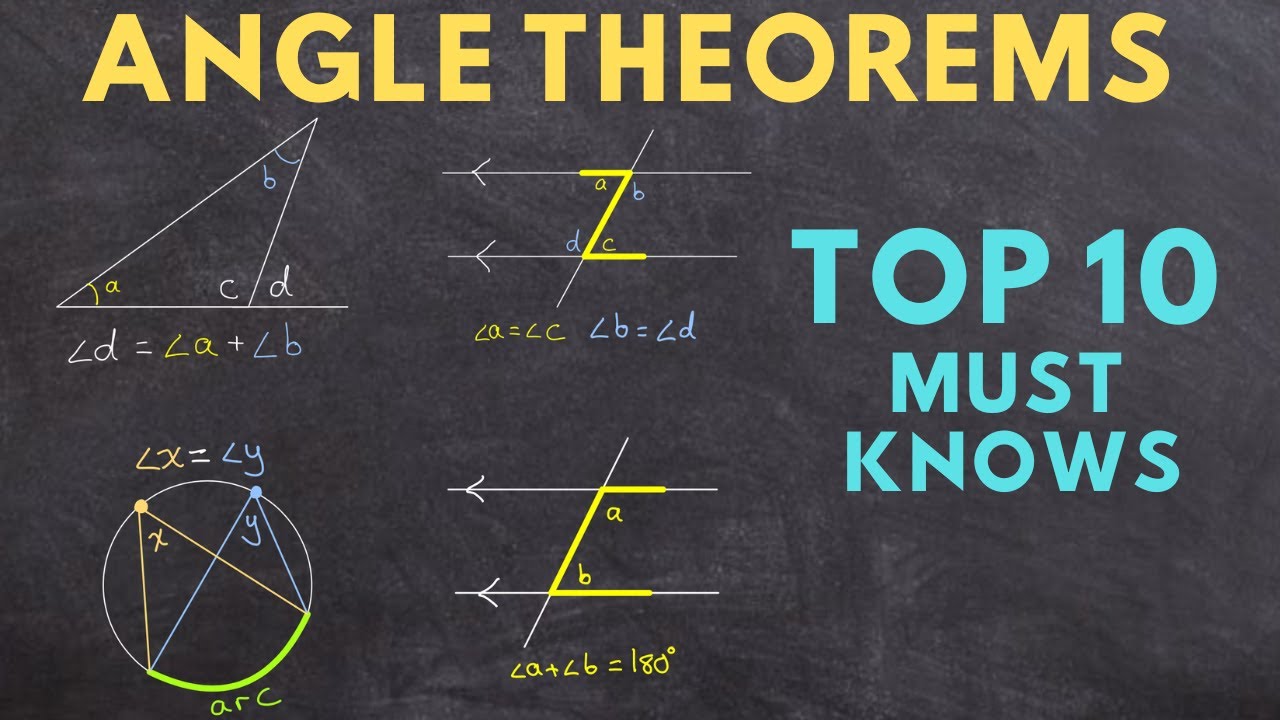
Brief Summary
This video provides a comprehensive overview of the top 10 most important angle theorems in geometry. It covers complementary and supplementary angles, angle sums in triangles and polygons, the isosceles triangle theorem, the exterior angle theorem, vertical angles, alternate angles, co-interior angles, corresponding angles, angles subtended by arcs in circles, and the relationship between angles at the center and circumference of a circle. The video includes examples and diagrams to illustrate each theorem, and concludes with a test to assess understanding.
- Complementary and supplementary angles,
- Angle sums in triangles and polygons,
- Isosceles triangle theorem, exterior angle theorem, vertical angles, alternate angles, co-interior angles, corresponding angles,
- Angles subtended by arcs in circles,
- Relationship between angles at the center and circumference of a circle.
Supplementary and Complementary
Complementary angles are two angles that add up to 90 degrees, forming a right angle when combined. For example, if one angle is 70 degrees, its complementary angle is 20 degrees. Supplementary angles are two angles that add up to 180 degrees, forming a straight line when combined. For instance, if one angle is 70 degrees, its supplementary angle is 110 degrees.
Sum of angles in a triangle and polygon
The sum of the three interior angles of any triangle is always 180 degrees. For example, if two angles of a triangle are 70 and 75 degrees, the third angle is 35 degrees. The sum of the interior angles of a polygon can be found using the formula (n-2) * 180 degrees, where n is the number of sides. For a five-sided polygon (pentagon), the sum of the interior angles is 540 degrees. The sum of the exterior angles of any polygon is always 360 degrees.
Isosceles Triangle Theorem
The Isosceles Triangle Theorem states that if two sides of a triangle are congruent (equal in length), then the angles opposite those sides are also congruent. If a triangle has two equal sides and one of the angles opposite those sides is 35 degrees, the other angle opposite the equal side is also 35 degrees. The third angle can be found by subtracting the sum of the two equal angles from 180 degrees.
Exterior Angle Theorem
The Exterior Angle Theorem states that the exterior angle of a triangle is equal to the sum of the two opposite interior angles. If an exterior angle of a triangle is 110 degrees and one of the opposite interior angles is 40 degrees, the other opposite interior angle is 70 degrees.
Vertical Angle Theorem
The Vertical Angle Theorem states that when two lines intersect, the angles opposite each other are equal. If two lines intersect and one angle is 61 degrees, the angle opposite it is also 61 degrees.
Alternate Angle Theorem
The Alternate Angle Theorem, a parallel line theorem, states that if two parallel lines are cut by a transversal, the alternate interior angles are equal, and the alternate exterior angles are equal. If one of the alternate interior angles is 110 degrees, the other alternate interior angle is also 110 degrees. Interior angles on the same side of the transversal are supplementary, adding up to 180 degrees.
Co Interior Angle Theorem
The Co-Interior Angle Theorem states that interior angles on the same side of a transversal add up to 180 degrees. If one co-interior angle is 75 degrees, the other is 105 degrees, forming a "C" pattern.
Corresponding Angle Theorem
The Corresponding Angle Theorem states that angles which occupy the same relative position at each intersection of the transversal with the two parallel lines are equal. If one angle is 41 degrees, the corresponding angle is also 41 degrees, forming an "F" pattern.
Angle subtended by arc of circle
Inscribed angles subtended by the same arc are equal. If two angles are subtended by the same arc, and one angle is 65 degrees, the other angle is also 65 degrees. An angle inscribed in a semicircle equals 90 degrees.
Angle at centre vs angle at circumference
The angle at the center of a circle is double the angle subtended by the same arc at any point on the circumference of the circle. If the angle at the center of the circle is 142 degrees, the angle at the circumference is 71 degrees.
Test on angle theorems
The video concludes with a test consisting of three questions to assess understanding of the angle theorems. Viewers are encouraged to find the missing angles and leave their answers in the comments.

