
Brief Summary
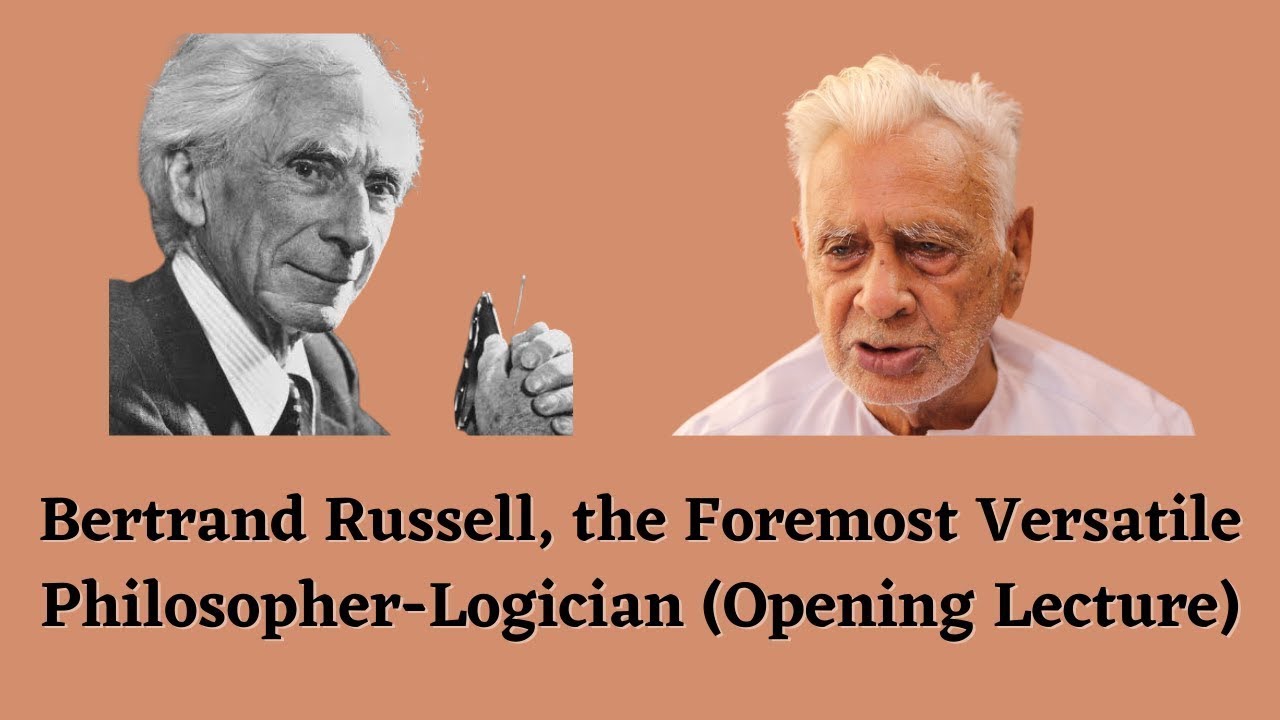
This video discusses the philosophical journey and contributions of Bertrand Russell, highlighting his evolving perspectives across various fields, including social policy, epistemology, mathematics, and logic. It emphasizes his commitment to scientific inquiry, his willingness to abandon old ideas in light of new evidence, and his significant contributions to modern logic and the analysis of language.
- Russell's philosophical views evolved over time, influenced by new evidence and scientific inquiry.
- He made significant contributions to modern logic, mathematics, and the analysis of language.
- Russell was committed to clarity and precision in philosophical and logical reasoning.
Introduction to Bertrand Russell
The video begins by explaining why Bertrand Russell was chosen as a subject, noting that he didn't adhere to a single philosophy but explored various fields, including social policy. Russell's initial work, including his book written in 1892, addressed social problems. He engaged with numerous social and political philosophies, distinguishing himself as a political philosopher.
Early Philosophical Works and Epistemology
Russell's early works explored empiricism, with different approaches. His perspective remained rooted in experience. In 1894, he published a book questioning the nature of knowledge and metaphysics. He questioned the existence and validity of metaphysics, marking a shift in his philosophical approach.
Evolution of Metaphysical Views
Russell examined the relationship between mind and matter, concluding that a supreme element integrates thoughts. His views continuously changed, making it difficult to define a singular "Russellian philosophy." His approach remained scientific, advocating for the abandonment of old ideas when confronted with new facts. He was willing to discard his own principles if they could not be logically proven.
Contributions to Mathematics
Russell made significant contributions to mathematics, particularly in modern algebra, laying a new foundation with Whitehead. They revised many old equations and methods. Russell posited that mathematics is not about objects but about relationships and forms. Mathematical propositions are always true because they are not tied to physical objects, about which we cannot be certain. Physical sciences, unlike mathematics, do not contain absolute truths.
The Nature of Truth in Mathematics and Physical Science
Russell and Whitehead questioned why mathematical judgments are always true, while those in physical sciences are experience-dependent and not absolutely true, yet not entirely false. They sought to understand how to attain certainty in knowledge.
Analysis of Language and Logic
Russell extensively analyzed language, leading to the development of modern logic from traditional logic. Examples are used to illustrate logical relationships, such as comparing "banana" and "apple" in terms of health benefits, to explain the complexities of logical statements.
Logical Analysis and Predicates
The discussion covers the use of terms and predicates in logical analysis, including the concept of identity between a triangle and a three-sided figure.
Clarity and Logical Atomism
Russell emphasized the importance of clarity in philosophical discourse, stating that clarity alone is not sufficient. He introduced the concept of logical atomism, distinguishing between physical and logical atoms. By analyzing objects in the physical world, we aim to identify irreducible elements. Complex sentences are reduced to simple present tense statements to verify their correspondence with facts. True statements are combined using principles of modern logic. The video concludes by encouraging viewers to contemplate these ideas further.

