
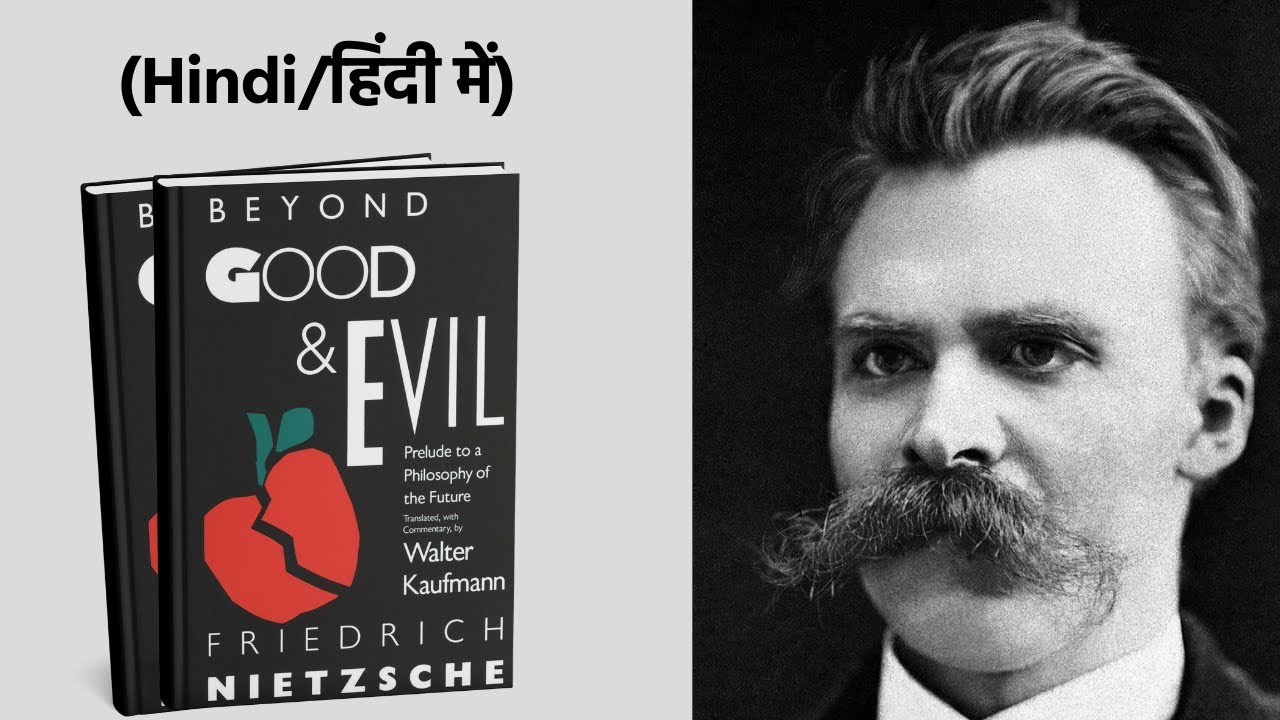
Brief Summary
This video provides a detailed summary of Friedrich Nietzsche's "Beyond Good and Evil." It explores Nietzsche's criticisms of traditional philosophy, morality, and religion, while introducing concepts like the will to power, the free spirit, and the revaluation of all values. The video also touches on Nietzsche's views on women, different European cultures, and the characteristics of a noble individual.
- Nietzsche critiques past philosophers for their dogmatic approaches to truth.
- He introduces the concept of the "free spirit" who questions traditional values.
- The video explores Nietzsche's idea of the "will to power" as a fundamental drive.
- It discusses Nietzsche's views on master and slave moralities.
- The summary includes Nietzsche's perspective on women, culture, and the characteristics of a noble individual.
Introduction
Nietzsche criticizes old philosophers for being out of touch with reality and too serious, suggesting they failed to understand truth, which he personifies as a woman. He argues that traditional notions of good and evil are constructs of the weak and that he aims to challenge this established system.
PREFACE: The Tension of the Soul
Nietzsche suggests that past philosophers, stuck in their dogmatic ways, were unable to grasp the essence of truth. Their rigid pursuit of truth was clumsy and unsuccessful. He expresses hope that humanity will recognize the weakness of the foundations upon which grand ideas are built, viewing old dogmas as childish acts rooted in superstition, linguistic trickery, or exaggerated self-importance. He acknowledges the value of past philosophical errors, such as Plato's concept of a pure spirit and inherent goodness, for paving the way for current understanding. Nietzsche highlights the tension within the European soul, born from the conflict between Christianity and classical thought, and identifies "free spirits" who seek to overcome this tension and aim for distant goals.
CHAPTER I: Prejudices of Philosophers
Nietzsche asserts that the will to truth drives people to dangerous endeavors. He questions the value of truth over falsehood, uncertainty, or ignorance. He challenges the notion that truth can only arise from its opposite, suggesting that falsehood, deception, and selfishness might be more valuable than truth and goodness. He argues that most conscious thinking is rooted in instinct, with philosophical justifications often masking physiological demands. Nietzsche suggests that the value of an idea lies in its ability to enhance or preserve life, even if it is false. He concludes that the recognition of falsehood as a condition of life is an attack on traditional philosophy, paving the way for a philosophy beyond good and evil.
CHAPTER II: The Free Spirit
Nietzsche argues that philosophers are often dishonest, disguising their personal desires and convictions as objective truths. He criticizes philosophers like Kant and Spinoza for using logic and mathematical formulas to mask their personal beliefs and vulnerabilities. He posits that every great philosophy is essentially an autobiography driven by a specific moral intention. He suggests that the impulse to knowledge is not the primary driver of philosophy but rather a tool used by other impulses. Nietzsche emphasizes that a philosopher's morality reveals their true nature. He contrasts Plato's grand style with Epicurus's mockery, highlighting the personal motivations behind philosophical endeavors. He also critiques the Stoics for attempting to impose their ideals on nature, revealing their "will to power." Nietzsche notes the ongoing debate about the real and apparent world, cautioning against simplistic interpretations driven solely by the will to truth. He identifies two types of thinkers: those who embrace nihilism out of weariness and those who seek to escape modern ideas by reverting to old beliefs. He suggests that the latter, with more courage, could forge new paths instead of retreating.
CHAPTER III: The Religious Mood
Nietzsche criticizes Kant's concept of synthetic judgments a priori as a convoluted explanation of inherent mental faculties, comparing it to a doctor attributing sleep to opium's "sleeping power." He suggests that such ideas persist because they are comforting and necessary for survival. He views German philosophy as a sedative for Europe, allowing people to ignore harsh realities. Nietzsche celebrates the decline of materialistic atomism, crediting Boscovich's challenge to the solidity of matter. He calls for the dismantling of "soul atomism," the Christian concept of an indestructible soul, advocating for a new understanding of the soul as a mortal structure of habits and passions. He critiques the idea of self-preservation as the primary instinct, asserting that the will to power is the fundamental drive of life. Nietzsche characterizes Christian faith as a form of intellectual suicide, involving the sacrifice of freedom, pride, and self-reliance. He interprets the image of "God on the cross" as a slave revolt against the values of the noble Romans, driven by resentment and a desire for certainty.
CHAPTER IV: Apophthegms and Interludes
Nietzsche touches on the connection between religious fervor and solitude, fasting, and sexual abstinence, questioning the cause-and-effect relationship. He suggests that the transformation of a bad person into a saint is not a miracle but a failure of understanding, rooted in the false dichotomy of good and evil. He contrasts the deep religious engagement of southern Europeans with the more superficial approach of northerners. Nietzsche praises the ancient Greeks for their gratitude towards nature and life, contrasting it with the fear-based religiosity that paved the way for Christianity. He identifies various forms of religious passion, from Luther's severity to the eroticism of female mystics, and notes the tendency of the Church to canonize such women. Nietzsche explores the paradoxical power of saints, who, by renouncing worldly comforts, inspire awe and fear in powerful individuals, who recognize in them a formidable "will to power."
CHAPTER V: The Natural History of Morals
Nietzsche praises the Old Testament for its grandeur and its capacity to inspire both fear and reverence, deeming it unsuitable for modern, domesticated individuals. He criticizes the combination of the Old and New Testaments into the Bible as a crime against the spirit. He attributes the rise of atheism to the demise of the fatherly image of God, along with the loss of belief in free will and divine intervention. Nietzsche notes the attack on the concept of the soul by contemporary philosophers, who seek to dismantle the foundations of Christian dogma. He outlines a progression of religious cruelty, from human sacrifice to the sacrifice of natural instincts and, finally, to the sacrifice of God for the sake of nothingness. Nietzsche describes his own journey into the depths of pessimism, beyond Buddha and Schopenhauer, where he discovered a new ideal: a person who embraces the world in its entirety and desires its eternal recurrence.
CHAPTER VI: We Scholars
Nietzsche argues that a true teacher is only serious when surrounded by students and that knowledge is less enjoyable without a sense of shame. He presents a series of aphorisms, exploring themes such as the nature of memory and pride, the importance of maintaining great emotions, and the relationship between sensuality and spirituality. He touches on the necessity of principles for justifying or concealing habits and the deceptive nature of self-knowledge. Nietzsche also discusses the complexities of love, the dangers of pity, and the importance of maintaining a critical distance from others. He emphasizes the value of honesty, even if it leads to misunderstanding, and the need to overcome one's own morality.
CHAPTER VII: Our Virtues
Nietzsche suggests that modern Europeans are overly refined and lack the raw instincts of earlier cultures. He criticizes the dominance of herd morality and the pursuit of equality, which he sees as a decline in human greatness. He contrasts this with his vision of new philosophers who will re-evaluate values and create new perspectives for the future. Nietzsche emphasizes the importance of danger, pressure, and suffering for human growth, advocating for the transformation of the will to live into the will to power. He identifies himself and his fellow "free spirits" as lovers of solitude who have transcended traditional notions of good and evil. He describes the soul as a hunting ground for psychologists, lamenting the lack of skilled assistants and the timidity of educated individuals. Nietzsche touches on the nature of Christian faith, the role of solitude and asceticism in religious experience, and the psychological complexities of saints.
CHAPTER VIII: Peoples and Countries
Nietzsche reflects on the influence of Richard Wagner's music, acknowledging its historical significance and its blend of various elements, but also noting its lack of beauty and its connection to the German soul. He laments the occasional relapse of even good Europeans into patriotic fervor, viewing it as a sign of intellectual weakness. Nietzsche critiques the homogenizing effects of progress and democracy, which he believes are creating a new class of slaves hungry for rulers. He warns that this system will inevitably lead to the rise of tyrants. He suggests that the mixing of races creates internal conflict, leading to either weakness or, in rare cases, the emergence of exceptional individuals who harness this conflict for greatness. Nietzsche reiterates his view that herd morality is rooted in fear and that the pursuit of progress is driven by a desire to eliminate fear.
CHAPTER IX: What is Noble?
Nietzsche reiterates his critique of modern ideas, which he sees as a form of herd morality that stifles individuality and greatness. He contrasts this with his vision of new philosophers who will challenge old values and create new paths for humanity. He emphasizes the need for strong leaders with "steeled consciences" and a willingness to take on great responsibility. Nietzsche expresses concern about the potential for universal degeneration and calls for a new hatred directed towards the socialist ideal of creating a domesticated, equalized humanity. He laments the growing influence of science over philosophy, viewing it as a dangerous trend that threatens to reduce philosophy to a mere theory of knowledge. Nietzsche describes the challenges facing aspiring philosophers, including the overwhelming amount of scientific knowledge and the pressure to conform to societal expectations. He emphasizes the importance of embracing danger and engaging fully in life.
FROM THE HEIGHTS: The Song of Zarathustra
Nietzsche emphasizes that a philosopher's true task is to create values and shape the future, not merely to interpret or analyze the past. He argues that the philosopher is inherently opposed to their time and must challenge its ideals. He defines greatness as the capacity to embrace all aspects of existence and to take on the greatest responsibility. Nietzsche suggests that the philosopher must cultivate strength of will and severity. He notes that the philosopher's path is one of solitude and self-overcoming, requiring a willingness to embrace the unknown and to challenge conventional wisdom. He emphasizes the importance of honesty and the need to avoid becoming complacent or self-satisfied. Nietzsche concludes with a call for a new kind of philosopher, one who embraces life in its fullness and is willing to challenge all existing values.

