
Brief Summary
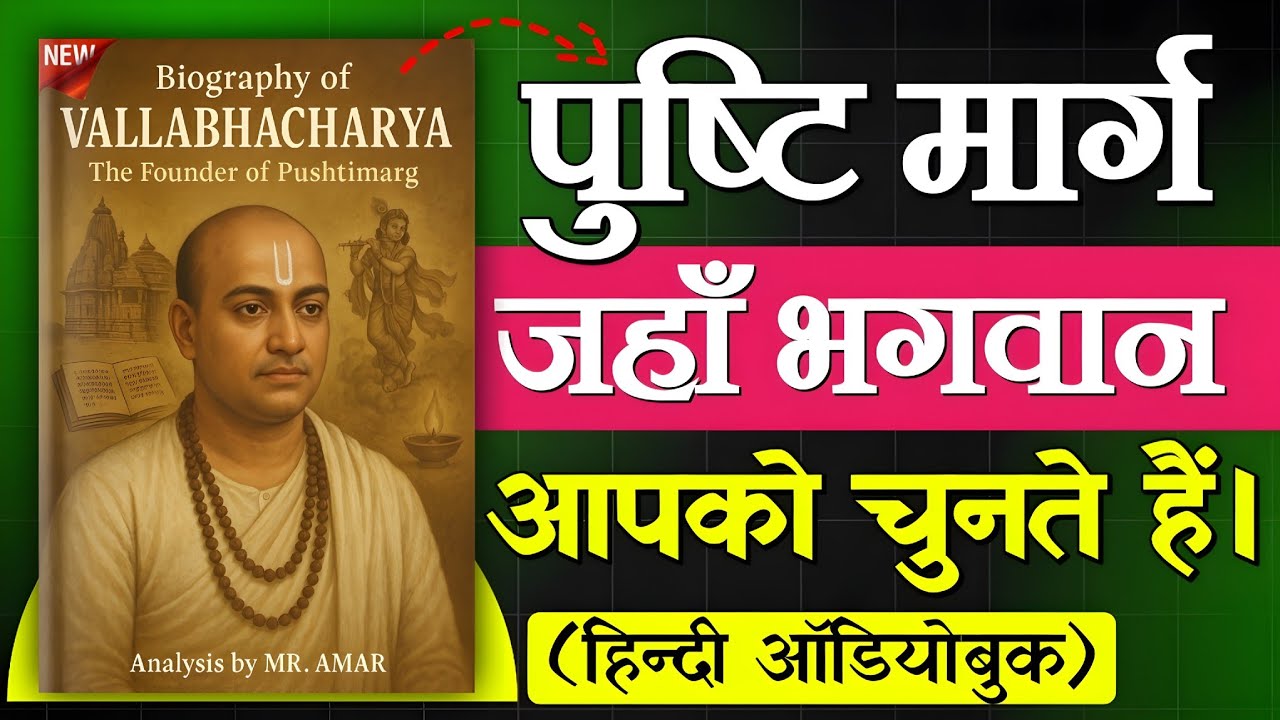
This audiobook explores the life, philosophy, and legacy of Mahaprabhu Vallabhacharya, the founder of the Pushtimarg tradition. It covers his miraculous birth, his intellectual prowess in Kashi, the divine revelation of the Pushtimarg, the philosophical underpinnings of Shuddhadvaita, his extensive travels across India, the practice of Seva, his literary contributions, the challenges he faced, and his lasting impact on Indian spirituality.
- Vallabhacharya's birth was miraculous, protected by a divine fire.
- He astounded scholars in Kashi with his profound knowledge at a young age.
- He received divine revelation from Lord Krishna, leading to the Pushtimarg.
- Shuddhadvaita philosophy posits that the world is not an illusion but a manifestation of Brahman.
- Vallabhacharya traveled extensively, establishing 84 Baithaks and spreading his message of love and devotion.
Chapter 1: The Divine Spark - An Untold Story of a Miraculous Birth
In 15th century India, amidst political turmoil and spiritual awakening, Lakshman Bhat and Illamma Garu, a devout Brahmin couple from Andhra Pradesh, yearned for a child. After performing numerous rituals, they embarked on a pilgrimage, eventually settling in Kashi. Illamma Garu conceived, but foreign invasions forced them to flee. During their journey through the forests of Champారణ্য, Illamma Garu gave birth prematurely. The child appeared lifeless, and the devastated parents had to leave him behind. Later, they had a dream where Lord appeared and told them that the child is alive and he is the one who took birth as their son. They returned to find their baby surrounded by a protective ring of fire. Recognizing the child's divine nature, they named him Vallabha, meaning "beloved."
Chapter 2: The Prodigy of Kashi - When a Child Silenced Great Scholars
Vallabha displayed extraordinary intellect from a young age, mastering the Vedas, Upanishads, Puranas, and other scriptures with ease. At age seven, he was brought to Kashi for higher education, where his brilliance astounded scholars. Known as "Bal Saraswati," he impressed everyone with his ability to grasp complex concepts and pose insightful questions. Following his father's death at age 11, Vallabha embarked on a journey across India with his mother to spread his teachings. In Vijayanagar, he participated in a religious debate in King Krishnadevaraya's court, defeating learned scholars with his profound knowledge and establishing the principle of Shuddhadvaita. He was honored with Kanakabhishekam and the title of Acharya.
Chapter 3: The Mysterious Night When God Himself Appeared
After his triumph in Vijayanagar, Vallabhacharya continued his travels, seeking a simple path to divine experience. Arriving in Brajbhumi, he felt Krishna's presence everywhere. While meditating in Gokul, he questioned how ordinary people could attain God's grace. On Ekadashi night, Lord Krishna appeared to him in the form of ShriNathji, offering the Brahma Sambandha mantra. This mantra allows devotees to dedicate everything—body, mind, wealth, family, and soul—to God with love and faith. This complete surrender eliminates flaws and qualifies one for God's grace, leading to the Pushtimarg, the path of grace. Vallabhacharya initiated his first disciple, Damodar Das Harsani, marking the official beginning of Pushtimarg.
Chapter 4: Pushtimarg - The Path of Grace
Pushtimarg, meaning the path of nourishment or grace, emphasizes devotion and surrender over strict adherence to rituals or intellectual pursuits. Vallabhacharya contrasted it with Maryada Marg, which requires following Vedic rituals, sacrifices, and asceticism. In Pushtimarg, devotees focus on their relationship with God, surrendering themselves entirely, like a kitten relying on its mother. This contrasts with the Maryada Marg, where devotees must exert effort, like a monkey clinging to its mother. The core principle is "Brahm Sambandh," dedicating everything to God and living life as service to Him. This transforms daily activities into acts of worship, making the home a temple.
Chapter 5: Shuddhadvaita - The Doctrine of Pure Non-Dualism
Vallabhacharya's Shuddhadvaita philosophy challenges Adi Shankaracharya's Advaita Vedanta, which posits that the world is an illusion (Maya). Vallabhacharya argued that if Brahman is the truth, then the creation emanating from it cannot be false. Using the analogy of gold and a bangle, he explained that the world is a manifestation of Brahman, not an illusion. In Shuddhadvaita, Brahman has three forms: Paramatma (Lord Krishna), Aksharbrahma (His divine abode), and Jagat (the universe). The universe is a part of Brahman where the aspects of existence and consciousness are apparent, but bliss is hidden. Through devotion, this bliss can be reawakened. The world is not a prison to escape but a playground of God, to be loved and served.
Chapter 6: Three Pilgrimages of India - The Untold Secret of Barefoot Travel and 84 Baithaks
To spread his message, Vallabhacharya undertook three barefoot pilgrimages across India. He walked across the country, engaging with people, sharing his philosophy in simple terms, and debating with scholars. During his travels, Vallabhacharya established 84 Baithaks, places where he recited the Shrimad Bhagavat. These locations became sacred sites for Pushtimarg followers. He organized seven-day Bhagavat Katha sessions at each of these locations. These journeys strengthened the Bhakti movement, teaching that devotion means dedicating one's life to God while fulfilling worldly duties. His message attracted people from all walks of life, promoting cultural and spiritual unity.
Chapter 7: Seva - The Art of Loving Devotion
Seva, or service, is the heart of Pushtimarg. Vallabhacharya taught that devotees should serve God with love rather than merely worship Him with fear and reverence. This service involves treating Shri Krishna, or Thakur Ji, as a member of the family, attending to His needs with affection. The "Ashtayam Seva" divides the day into eight parts, each with specific services, from waking Thakur Ji in the morning to putting Him to rest at night. The seasons dictate changes in clothing, food, and decorations. Devotees offer everything to Thakur Ji before using it themselves, making their lives Krishna-centered.
Chapter 8: Literary Heritage - The Books That Changed the Direction of Indian Philosophy
Vallabhacharya was not only a saint but also a scholar and writer. He composed several important texts in Sanskrit that solidified the Pushtimarg philosophy and influenced Indian thought. His most important work is "Anubhashya," a commentary on the Brahma Sutras, which establishes his Shuddhadvaita philosophy. Another significant work is "Subodhini," a commentary on the Shrimad Bhagavat Purana, revealing the spiritual meanings behind Krishna's stories. He also wrote "Shodash Granth," sixteen shorter texts that serve as practical guides for Pushtimarg followers, covering topics such as devotion, service, and dealing with life's challenges.
Chapter 9: Critics and Controversies - When Questions Arose on Vallabhacharya's Principles and His Answers
Vallabhacharya faced criticism and opposition for his Shuddhadvaita philosophy and the Pushtimarg. Critics questioned his rejection of Maya and the emphasis on grace over strict adherence to rituals. Some accused him of promoting materialism and undermining the need for good deeds and ethical behavior. Vallabhacharya responded by explaining that he considered the world true from the perspective of Brahman, not for indulgence. He emphasized that Pushtimarg does not negate action but rejects the ego of doership. He also defended his गृहस्थ (householder) life, demonstrating that one can attain spiritual heights while fulfilling family responsibilities.
Chapter 10: Immortal Flame - The Living Legacy of Pushtimarg
Vallabhacharya spent his life spreading the message of love and devotion. In his final days, he returned to Kashi and gave his final instructions to his sons and disciples, urging them to maintain the purity of the Pushtimarg tradition and serve selflessly. He then entered the Ganga River and departed from the world, leaving behind a legacy that continues to inspire millions. The Pushtimarg has grown into a vast tradition with followers worldwide. The ShriNath Ji temple in Nathdwara is a central hub, and the 84 Baithaks remain sacred pilgrimage sites. His legacy extends to art, music, and literature, enriching Indian culture. Vallabhacharya's message is that spirituality is not complex but an art of filling life with love, joy, and celebration.

