
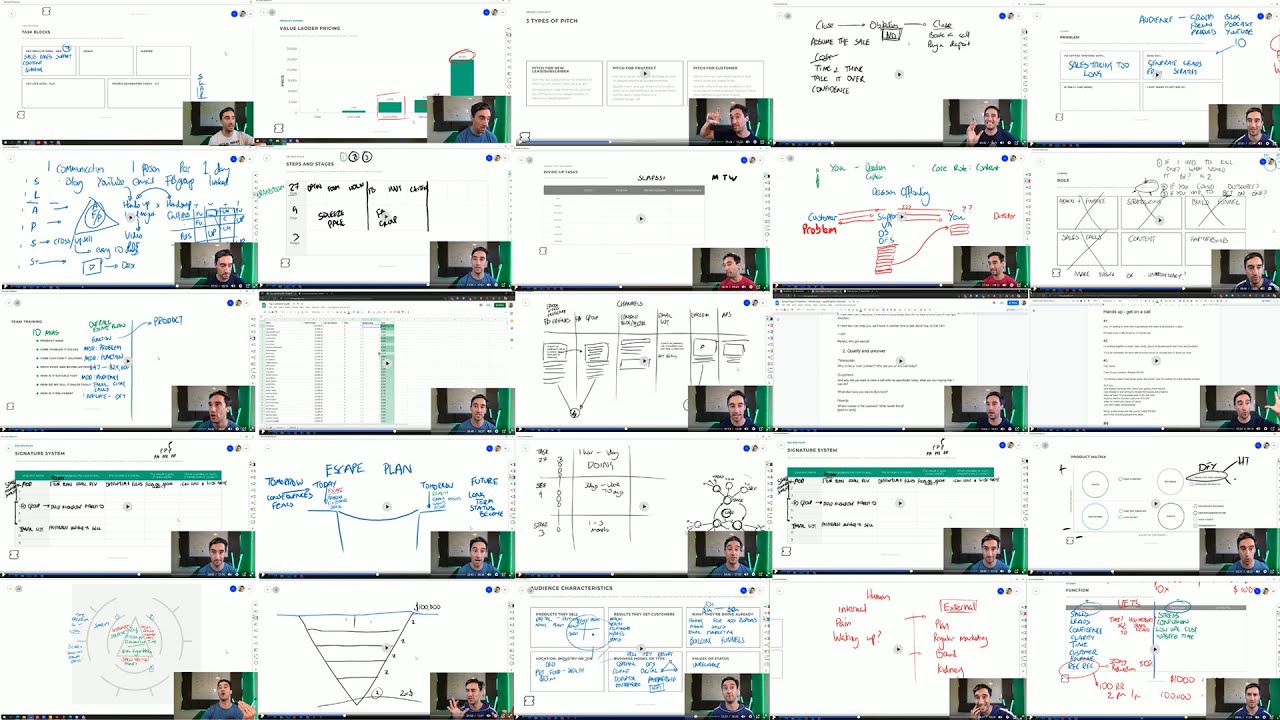
Brief Summary
This YouTube video provides a comprehensive guide on scaling service-based agencies, emphasizing simplification, strategic focus, and efficient systems. It challenges common misconceptions about business growth and offers actionable steps to double income while reducing working hours. The course covers niche selection, audience targeting, service packaging, team management, and sales optimization, all designed to help agency owners achieve financial freedom and a balanced lifestyle.
- Simplify business operations to build a strong foundation.
- Focus on a specific audience, problem, function, role, and outcomes to achieve exponential growth.
- Implement time-saving strategies and delegate tasks effectively.
- Systemize processes and create a product matrix to maximize revenue.
- Optimize sales strategies and qualify clients effectively.
Introduction
The video introduces a course designed to help agency owners scale their businesses to $100,000 or even $1 million a year. The course focuses on finding leads, increasing prices, and improving team management. It promises to double income while reducing work hours by 10 hours a week, supported by success stories from various agency owners.
Simplify Overview
The "Simplify" section introduces the foundation for business growth, focusing on five core areas: audience, problem, function, role, and outcomes. It also covers time freedom through a "stop list" and effective day planning, as well as productivity multipliers like task division and team management. The goal is to streamline processes, prevent issues, and empower team members to solve problems independently.
Million Dollar Drill
The "Million Dollar Drill," or the five cores, is a model for achieving consistent business doubling. It emphasizes focusing on five key elements: audience, problem, function, role, and outcomes. Having multiple answers for each core increases the time it takes to reach the doubling goal. The model aims to tap into a reservoir of resources, enabling repeated business doubling through focused effort.
Audience
Defining the target audience is critical for business success. The audience should meet specific criteria: the business owner enjoys working with them, can achieve great results for them, and they can afford the services. The video introduces the concept of "transition markets," where customers are already in the process of change, such as getting married or becoming homeowners. Identifying and serving these markets can lead to significant growth.
Problem
Identifying the core problem that keeps the target audience awake at night is essential. People buy solutions to problems, not just products or services. The video distinguishes between external problems (e.g., lack of a marketing plan) and internal problems (e.g., stress about revenue). Focusing on internal problems allows for a more human and personal marketing approach.
Niche Selector
A niche is defined by the intersection of "who" (audience) and "what" (problem). A broad audience requires a specific problem, while a broad set of problems requires a specific audience. The niche should meet the criteria of being enjoyable to work with, capable of achieving great results, and able to afford the services.
Function
The function of a business is what it increases or decreases for the customer, also known as currency. It is critical for a unique selling point and helps customers understand the value they receive. A specific function, such as doubling revenue in 90 days, is more effective than a vague description like "marketing consultant."
Role
Defining the business owner's role is essential for time freedom and business growth. The owner should focus on one core role, such as designing the business or building partnerships, and delegate other tasks. This requires making difficult choices and trusting others to handle important responsibilities.
Outcomes
Defining clear outcomes for team members is critical for their success and the business's overall performance. Outcomes should be specific and measurable, providing a way for team members to know they are succeeding in their roles. This reduces the need for constant oversight and empowers team members to take ownership of their work.
Time Freedom
Time freedom involves structuring work time to suit individual needs, eliminating unnecessary tasks, and building a job framework for hires. The goal is to regain one hour a week initially, eventually increasing to 10 hours a week. The video introduces the "stop list" to identify tasks to eliminate and emphasizes the importance of planning the day to maximize productivity.
Stop List
The "stop list" is a tool for identifying tasks that the business owner should stop doing. By documenting activities that do not align with the core role, the owner can delegate or eliminate them. This list also helps define job responsibilities for new hires.
Task Blocks
Task blocks categorize tasks into key result areas, admin, wasted time, key life areas, and income-generating tasks. This helps prioritize activities and identify areas for improvement. The goal is to focus on high-impact tasks and minimize time spent on less productive activities.
Plan Your Day
Planning an ideal day involves scheduling obligations, core roles, and breaks. This structure provides a framework for maximizing productivity and ensuring time for personal activities. The video emphasizes the importance of committing to the plan and protecting time for essential tasks.
Block One Hour
The initial goal is to identify one hour each week to dedicate to personal activities or strategic business tasks. This hour should be protected and used consistently.
Productivity Multiplier
The productivity multiplier focuses on hiring and managing a team to delegate tasks effectively. It emphasizes the importance of defining clear outcomes for team members and trusting them to execute tasks independently.
Divide Up Tasks
Dividing up tasks involves identifying activities that can be delegated to others. The video emphasizes the importance of documenting and recording processes to ensure consistency and quality.
Hiring an OS
The video outlines a four-stage hiring process: job post, interview, trial, and full hire. It emphasizes the importance of qualifying candidates and defining clear outcomes for the role. The video recommends using onlinejobs.ph to hire online specialists from the Philippines.
Offloading Decisions
Offloading decisions involves empowering team members to make decisions independently. This requires trusting them and allowing them to learn from failures. The video introduces the IPO (information, permission, outcomes) framework to guide decision-making.
Systematize Overview
The "Systematize" module focuses on creating systems to streamline business operations and maximize revenue. It covers the escape plan, product matrix, and sales map, all designed to help agency owners scale their businesses effectively.
Escape Plan Overview
The escape plan is the process for helping customers move from their current situation to their desired future. It involves understanding their problems, goals, and the obstacles they face. The video emphasizes the importance of marketing the problem and creating a clear path for customers to achieve their goals.
Problems
Identifying the core problems that customers face is essential for effective marketing. The video distinguishes between internal problems (e.g., stress about revenue) and external problems (e.g., lack of a marketing plan). Focusing on internal problems allows for a more human and personal marketing approach.
Goals
Defining clear goals for customers is essential for guiding their journey and measuring success. Goals should be specific and measurable, providing a target for customers to strive towards.
Myths and Mistakes
Identifying the myths and mistakes that customers believe are true is essential for overcoming their objections and guiding them towards the right solutions. This involves understanding their self-limiting beliefs and addressing their fears.
Signature System
A signature system is a unique process for solving a specific problem for a specific audience. It should be specific and hyper-aware of one type of customer. The signature system should include tasks, steps and stages.
Tasks Steps Stages
The signature system is broken down into tasks, steps, and stages. Tasks are micro-level activities, steps are resources or skills, and stages are mini-statuses.
Benefits
Each step in the signature system should provide a specific benefit to the customer. This helps demonstrate the value of the system and justify the investment.
Audit and Checklist
An audit and checklist are used to assess the customer's current situation and identify areas for improvement. This helps tailor the signature system to their specific needs and demonstrate the value of the services.
Extra Help with Tasks
The video emphasizes the importance of having a team to delegate tasks and free up the business owner's time. It recommends hiring an online specialist from the Philippines to handle administrative and operational tasks.
Product Matrix Overview
The product matrix is a framework for organizing and pricing different products and services. It considers the value to the customer and the investment required from the business owner.
MAtrix Gaps
Identifying gaps in the product matrix involves assessing the current offerings and identifying areas where new products or services could be added. This helps maximize revenue and cater to a wider range of customer needs.
Value Ladder
The value ladder is a model for ascending customers through a range of products and services, from free content to high-ticket offers. The goal is to provide increasing value and generate more revenue over time.
Train Team
Training the team on the signature system is essential for ensuring consistent delivery and quality. This involves creating training videos and documenting processes.
Sales Map Overview
The sales map is a tool for identifying where sales are being lost in the funnel. By tracking key metrics, such as leads, appointments, and proposals, the business owner can identify areas for improvement.
Customer List & Audit
Auditing the customer list involves identifying the top 20% of customers based on revenue, time, and relationship. This helps focus efforts on the most profitable and enjoyable clients.
SLAPSS+ Audit
The SLAPSS+ audit involves tracking subscribers, leads, appointments, proposals, sales, and sales plus. This helps identify where sales are being lost in the funnel and where to focus efforts.
Clone Your Costumer
Cloning customers involves identifying the characteristics of the top 20% and finding more customers who fit that profile. This can be done by researching their interests, affiliations, and networks.
Sales Overview
The sales overview emphasizes the importance of having a consistent pitch, opt-in offer, and sales tool. This creates a cohesive message and makes it easier for customers to understand the value proposition.
Money Magnet
The money magnet is a pitch that attracts the right customers and repels the wrong ones. It should be specific and focus on the core problem that the business solves.
Pitch Perfect
A great pitch makes the customer ask to buy, rather than the business owner having to sell. This involves understanding their needs and presenting a solution that resonates with them.
Optin Offer
The opt-in offer is a way to get people to put their hands up and express interest in the business. It should be specific and relevant to the target audience.
Sales Tool
The sales tool is the method used to close the sale. This could be a call, a webinar, a sales page, or a video sales letter.
Bonus Training
The video offers bonus training on various aspects of sales and marketing.
Velvet Rope
The velvet rope is a metaphor for qualifying customers and ensuring they are a good fit for the business. This involves setting clear criteria and rejecting those who do not meet them.
Qualification Form & Call
The qualification process involves using a form and a call to assess potential customers. The goal is to identify their needs, budget, and decision-making authority.
Strategy Sales Call
The strategy call is a 45-minute session to explore the customer's weaknesses and present a solution. The goal is to get them to sell themselves on the value of the services.
Closing on the Call
Closing on the call involves asking for the sale and addressing any objections. The video emphasizes the importance of assuming the sale and being persistent.
Campaign Crusher Overview
The campaign crusher focuses on automating and repeating successful campaigns to generate leads and sales. This involves creating a CRM pipeline and implementing follow-up sequences.
Almost Bought
The "Almost Bought" campaign targets people who have shown interest but have not yet made a purchase. This involves sending them targeted emails and offers.
Campaigns
The video outlines various campaigns for generating leads and sales, including hands-up campaigns and cross-sell campaigns.
Daily Comms
Daily communication involves maintaining consistent contact with potential and current customers. This can be done through email, social media, or other channels.

