
Brief Summary
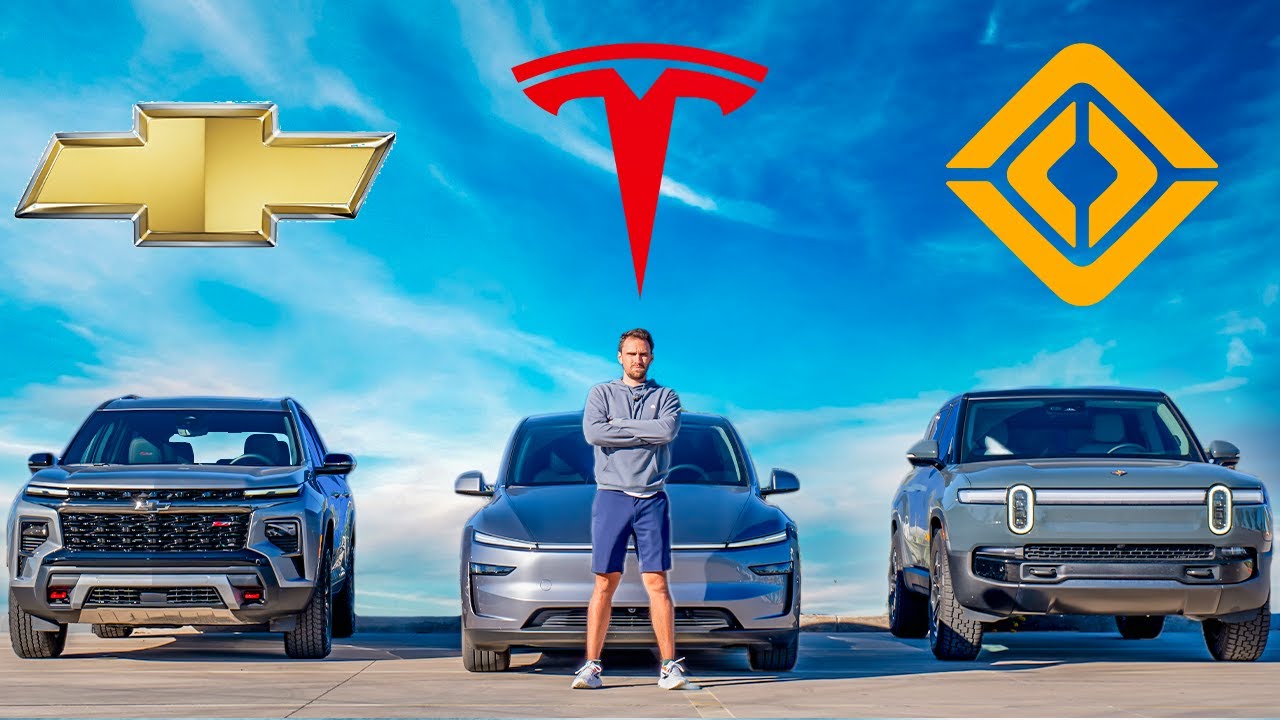
This video compares the self-driving capabilities of three leading vehicles: the Chevy Traverse (GM's Super Cruise), the Tesla Model Y (Tesla's Full Self-Driving), and the Rivian R1S (Rivian's Autonomy Platform). It assesses their self-parking features and highway driving technologies, highlighting strengths, weaknesses, and cost considerations. The conclusion ranks Tesla as the current leader due to its intuitive software and comprehensive features, while also acknowledging Rivian's potential and GM's solid highway ADAS system.
- Tesla's Full Self-Driving is the most advanced but also the most expensive.
- Rivian's Autonomy Platform offers a good balance and potential for future improvements.
- GM's Super Cruise is a reliable highway ADAS system but lacks in other areas.
Intro
The video introduces a comparison of self-driving technologies in three vehicles: a Chevy Traverse with GM's Super Cruise ($3,995 add-on), a Tesla Model Y with Tesla's Full Self-Driving, and a Rivian R1S with Rivian's Autonomy Platform. The aim is to evaluate their capabilities, identify shortcomings, and determine which offers the best features or value. The review will cover self-parking and highway driving functionalities.
Parking Capabilities: Chevy Traverse
The Chevy Traverse's auto park assist is tested in a parking lot. The system requires a reference point to identify parking spaces. When engaged, the system backs the car into a spot, but the parking job is poor, leaving the car too close to the adjacent vehicle. The system's performance is inconsistent, as it failed to recognize a previously identified spot during filming.
Parking Capabilities: Tesla Model Y
The Tesla Model Y's self-parking feature is tested in the same spot. The system automatically detects available parking spots when driving under 8 mph, displaying them on the screen without needing to press any button. The driver selects a spot, and the car parks itself. The parking job is excellent, with ample clearance. The software is intuitive and easy to use.
Parking Capabilities: Rivian R1S
The Rivian R1S does not have self-parking technology. The presenter demonstrates manually parking the Rivian in a spot and compares the time it takes to the automated systems of Tesla and Chevy. The presenter notes that Rivian has the capability to add this feature via over-the-air software updates in the future.
Self-Parking: Conclusion
Tesla wins the self-parking comparison due to its intuitive software and consistent performance. Chevy's system is inconsistent, and Rivian lacks the feature altogether.
Highway Driving: Chevy Traverse
The Chevy Traverse's Super Cruise is tested on the highway. The system is engaged by activating cruise control and then pressing the Super Cruise button. The system maintains lane centering and performs automatic lane changes when the turn signal is activated. However, the lane centering is slightly off at times, and the system sometimes fails to complete automatic lane changes or turn off the turn signal. The system disengages in newer sections of the highway. The car also features a "seconds till impact" display, showing the reaction time to the car in front. Super Cruise does not work on B-roads (smaller, non-interstate roads). The Traverse also has an exit park feature, which drives the car out of a parking space.
Highway Driving: Rivian R1S
The Rivian R1S's universal hands-free driving system is tested on B-roads and highways. The system works on 3.5 million miles of marked roads. The aggressiveness of the system can be adjusted. On the highway, the system maintains lane centering and performs automatic lane changes when the turn signal is tapped. The system handled a newly mapped section of highway without any interventions. The universal hands-free feature will be free until March 2026, after which it will be a paid feature, estimated to cost around $3,000.
Highway Driving: Tesla Model Y
The Tesla Model Y's full self-driving is tested on city streets and highways. The system uses AI voice commands for navigation. The driver can speak "Navigate me to downtown Phoenix" and the car will start full navigation. The system is a point-to-point system, meaning it will drive to a specified destination and park the car. The system has different driving profiles: Mad Max, Hurry, Standard, Chill, and Sloth mode. The car uses neural nets to make decisions based on its surroundings. The cost of the software is $8,000 to buy the license outright or $99 a month for a subscription. The presenter notes that Elon Musk has stated that the full self-driving will only be available as a subscription in the future.
Conclusion
The video concludes by summarizing the costs and capabilities of each system. Super Cruise is a good ADAS system for highway driving, but its self-parking is finicky. Rivian's universal hands-free is promising and works on a variety of roads. Tesla's full self-driving is the most advanced but also the most expensive. Tesla is currently the leader in self-driving technology.

