
Brief Summary
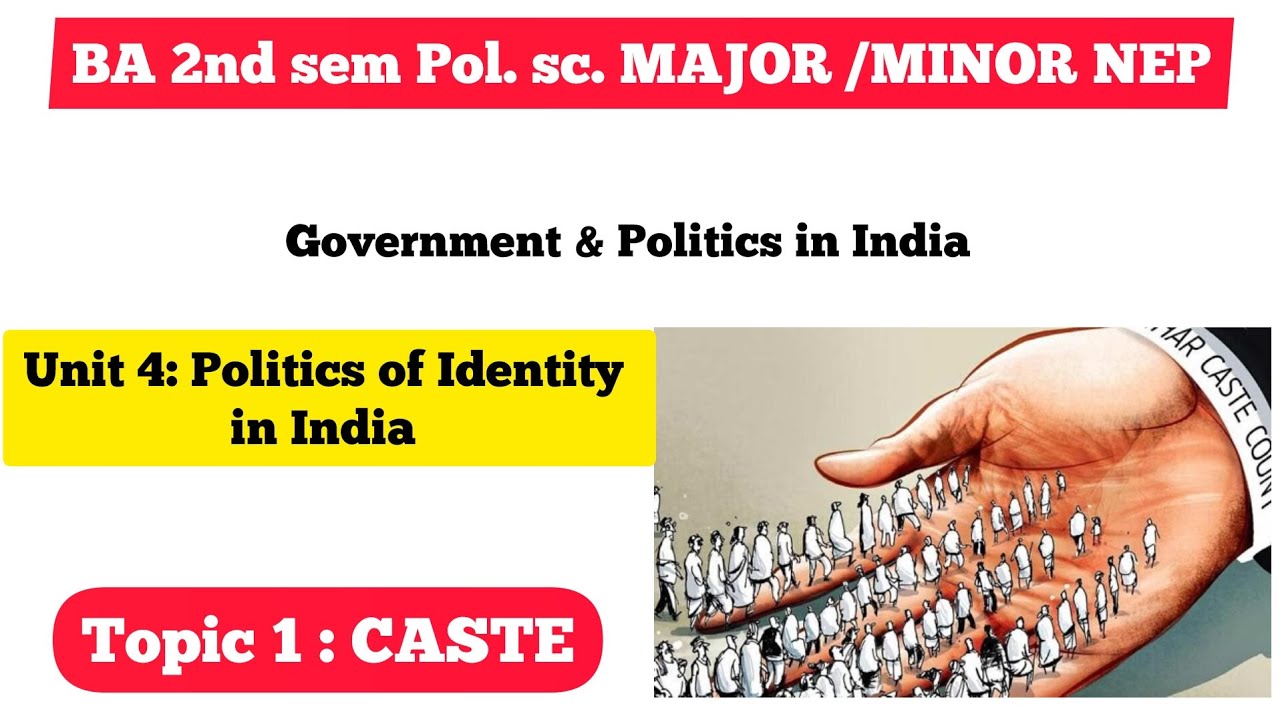
This video discusses the role of caste in Indian politics, explaining the concept of identity politics and how caste influences elections, policy-making, and coalition governments. It highlights both the empowering and divisive aspects of caste-based politics, emphasizing the need for balance in achieving a casteless society.
- Identity politics refers to political positions based on social group interests.
- Caste is a social group with membership largely determined by birth.
- Caste influences elections, policy-making, and coalition governments in India.
Intro
The video introduces the topic of politics of identity in India, focusing on caste as the first key element. It is part of a series covering Government and Politics for the BA second semester, Political Science major/minor NEP batch 2024. The lecture aims to explain what caste is and its role in Indian politics.
Explaining politics of identity
Identity is defined as a person's recognition based on religion, society, caste, nationality, language, and ethnicity. Identity politics refers to political positions based on the interests and perspectives of social groups or a specific identity. This involves political parties using a particular identity as the basis for their politics, such as advocating for the rights of minorities or specific religious or caste groups. Parties often use these identities as vote banks.
Definition of caste
The term "caste" is derived from the Portuguese word "casta," meaning family, race, or lineage. In the Indian context, caste is a social group where membership is largely determined by birth. Initially, the caste system was associated with specific professions, as seen in the early Vedic period's Varna system, which was more flexible. However, in the later Vedic period, the caste system became rigid, with one's caste determined by birth, regardless of achievement.
Indian caste system
The caste system in India originated around 2500 years ago during the Vedic age. Today, it is prevalent not only among Hindus but also in Muslim, Christian, and Sikh societies. Caste is considered a central aspect of India's social structure.
Role of caste in indian politics/caste politics in india
Many castes in India have used politics to improve their conditions and achieve community goals, securing governmental benefits and representation in legislative assemblies and political bodies. Caste-based associations have become a hallmark of political mobilization. Caste serves as a vote bank in elections, influencing candidate selection based on the predominant caste in a constituency. Political parties form alliances based on caste, such as the Bahujan Samaj Party representing Dalit interests and securing Dalit votes. Policy-making is also impacted by the caste system through affirmative actions like reservations for SC, ST, and OBC in education, jobs, and legislatures. Welfare schemes are designed according to caste considerations. Regional caste-based parties gain leverage in coalition governments, influencing coalition politics.
Conclusion
The use of caste in Indian politics is a double-edged sword. On one hand, it empowers marginalized groups through representation and reservation. On the other hand, it contributes to divisions and identity-based polarization. Balancing caste-based justice with the vision of a casteless society, as envisioned by Dr. B.R. Ambedkar, remains a challenging task for India.

