
Brief Summary
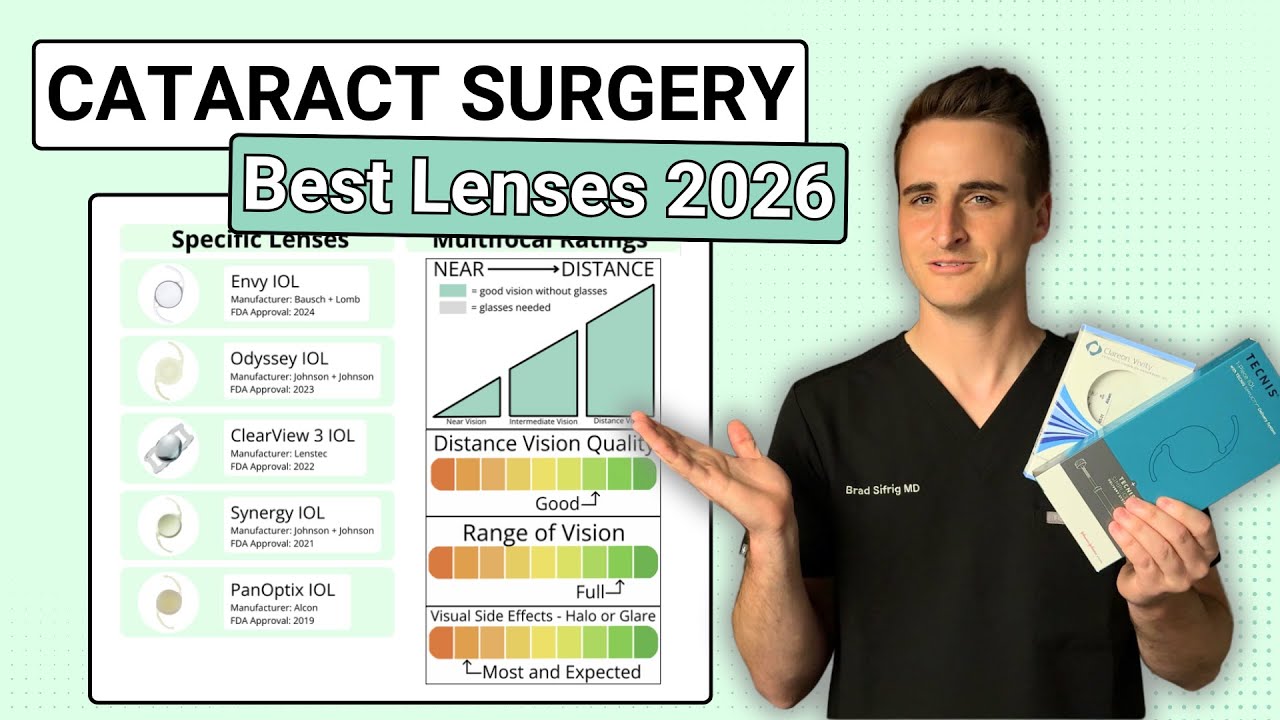
This video provides a comprehensive guide to selecting the best lens for cataract surgery in 2025. It covers the different visual zones (distance, intermediate, and near), categories of lenses (monofocal, toric, extended range, and unique lenses), and specific lens options available, including new FDA-approved lenses. The video also discusses the differences between basic and premium cataract surgery, astigmatism correction, and the trade-offs between range and quality of vision with different lens types.
- Understanding visual zones is crucial for lens selection.
- Premium lenses offer more independence from glasses but may have additional costs and side effects.
- New lens technologies continue to improve vision outcomes and reduce side effects.
Intro
The video introduces the topic of selecting the best lens for cataract surgery in 2025, emphasizing its importance for long-term vision. It promises to cover visual zones, lens categories, and specific lens options, including newly FDA-approved ones. The aim is to inform viewers about making the right lens choice for their desired vision outcomes.
Cataract Surgery Overview
Cataract surgery involves removing the clouded natural lens and replacing it with a clear artificial lens. In 2025, various lenses are available, each offering different vision enhancements, such as focusing at various distances or providing a range of vision. The chosen lens remains stable for life, making the initial selection crucial for achieving desired vision goals.
Three Visual Zones
The three visual zones to consider are distance, intermediate, and near vision. Distance vision is for objects farther than arm's length, like watching TV or driving. Intermediate vision is at arm's length, used for computer screens or car dashboards. Near vision is for close-up tasks like reading or using a phone. Understanding these zones is important when choosing a lens.
Basic vs Premium Surgery
Basic cataract surgery is manual, uses a monofocal lens, and is covered by insurance, aiming to improve vision with glasses or contacts. Premium surgery may be manual or laser-assisted, corrects astigmatism, and uses advanced lenses like toric, multifocal, or EDOF lenses, with the goal of reducing reliance on glasses or contacts. Premium surgery involves additional out-of-pocket costs.
Astigmatism Review
Astigmatism is a condition where the eye's shape causes blur at all distances, correctable with glasses, contacts, or during cataract surgery. Correcting astigmatism during cataract surgery is highly recommended for improved vision without glasses. Small amounts can be corrected with a laser, while medium to high amounts require a toric lens.
Lens Type Overview
The different lens types are categorized into single range monofocal lenses, single range toric monofocal lenses, extended range lenses, and other unique lenses. This categorization helps simplify the understanding of available options and their specific benefits.
Monofocal Lenses
Monofocal lenses provide good vision at one range (distance, intermediate, or near), with most patients choosing distance. Uncorrected astigmatism requires glasses for all zones, while corrected astigmatism provides good vision in the chosen range. These lenses are covered by insurance and prioritize quality distance vision, but offer minimal range, necessitating glasses for other distances. Common brands include Alcon Clareon and Johnson & Johnson Tecnis.
Free Digital Lens Guide Download
A digital lens guide is available for free download in the video description, offering a reference for understanding and reviewing the different lens options discussed in the video.
Toric Lenses
Toric monofocal lenses correct astigmatism, allowing for good vision at a chosen range (usually distance) without glasses. These lenses are suitable for medium to high astigmatism and provide great quality distance vision with minimal nighttime side effects, but offer very limited range. Major manufacturers like Alcon and Johnson & Johnson offer toric lens options.
Extended Range Lenses
Extended range lenses offer a good range of vision, including far and some near vision, reducing the need for glasses. Unlike monovision (where one eye is set for distance and the other for near), extended range lenses provide a range of vision in each eye individually. The two main subtypes are multifocal and extended depth of focus (EDOF) lenses.
Multifocal Lenses
Multifocal lenses provide the most comprehensive range of vision, including good far, intermediate, and near vision, often eliminating the need for glasses. These lenses have rings that split light to achieve this range, but may reduce vision quality and cause nighttime halos or glare. New additions like the Johnson & Johnson Odyssey lens and the Bausch + Lomb Envy IOL aim to minimize these trade-offs.
EDOF Lenses
EDOF (Extended Depth of Focus) lenses offer a range of vision with good far and intermediate vision, and some near vision, though reading glasses may still be needed for small print. EDOF lenses provide slightly less range than multifocal lenses but with fewer side effects and better vision quality. FDA-approved options include the Vivity and Synergy lenses.
IC-8 Aphthera Lens
The IC-8 Apthera lens features a pinhole design that enhances vision and provides a range of focus similar to EDOF lenses. It is particularly useful for patients with irregular corneal shapes, such as those with previous RK or keratoconus, as the pinhole effect can offset some of the vision distortions caused by these conditions.
Light Adjustable Lens
The Light Adjustable Lens is unique because it can be adjusted after surgery to fine-tune vision. This is especially beneficial for patients who have had previous refractive surgery (like LASIK, PRK, or RK), which can make traditional lens calculations less accurate. The adjustability allows for precise correction of any residual prescription, optimizing vision outcomes.
Conclusion
The video concludes by summarizing the different lens options and encouraging viewers to download the free lens guide for reference. It also directs them to a playlist of frequently asked questions about cataract surgery and encourages them to subscribe to the Cataract Companion channel for more information.

